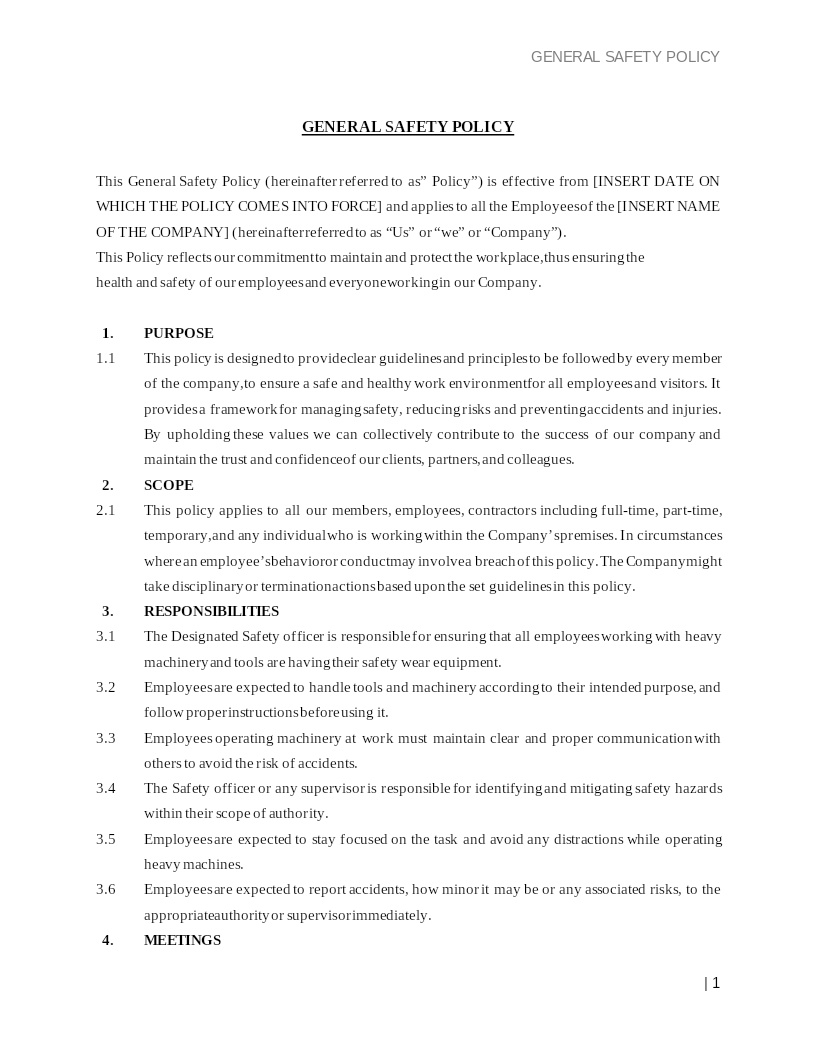
GENERAL SAFETY POLICY
How does it work?
1. Choose this template
Start by clicking on "Fill out the template"
2. Complete the document
Answer a few questions and your document is created automatically.
3. Save - Print
Your document is ready! You will receive it in Word and PDF formats. You will be able to modify it.
Promoting Workplace Protection and Regulatory Compliance Through a General Safety Policy
A General Safety Policy is an organizational directive that establishes the standards, responsibilities, and preventive measures required to maintain a safe and hazard-free workplace. Developed in accordance with U.S. federal and state safety regulations, including the Occupational Safety and Health Act (OSHA), the General Duty Clause, state-specific occupational-safety legislation, and applicable industry regulations for manufacturing, construction, healthcare, transportation, and office environments, this policy outlines the foundational framework for identifying, reporting, and mitigating workplace hazards. It articulates the organization’s commitment to maintaining safe working conditions, providing appropriate safety training, complying with legal obligations, and fostering a proactive safety culture that prioritizes the well-being of employees, customers, contractors, and visitors. The policy also serves as an essential risk-management tool that reduces liability, prevents workplace accidents, and ensures compliance with federal standards.
A comprehensive General Safety Policy outlines the employer’s obligations to provide safe equipment, hazard-free facilities, required personal protective equipment (PPE), emergency procedures, and training consistent with OSHA standards. It describes the responsibilities of employees to follow safety rules, report unsafe conditions, participate in training, and cooperate with investigations following incidents or near-misses. The policy further defines procedures for hazard identification and analysis, workplace inspections, risk assessments, chemical safety and hazard communication in alignment with the OSHA Hazard Communication Standard (HCS), ergonomics guidelines, fire safety mandates, and emergency response protocols. Additionally, it establishes procedures for maintaining compliance records, incident logs, and documentation required by state or federal authorities. By implementing this policy, organizations demonstrate their commitment to legal compliance, operational integrity, and the physical safety of all workplace participants.
Where General Safety Policies Are Commonly Used
General Safety Policies are widely adopted across industries, including:
- Manufacturing, industrial, and construction workplaces prone to physical and mechanical hazards
- Office environments requiring ergonomic and general safety standards
- Healthcare facilities managing patient safety and clinical risks
- Transportation and logistics organizations governed by DOT safety requirements
- Retail, hospitality, and service-based businesses with customer interaction
- Educational institutions overseeing staff, student, and facility safety
- Government contractors required to maintain OSHA-compliant environments
- Nonprofits and community organizations supervising volunteers or public programs
Any organization that employs workers or interacts with the public benefits from a General Safety Policy.
Different Types of Safety Policies
1. Workplace Safety Policies: Cover general safety requirements across all work environments.
2. Hazard-Specific Safety Policies: Address chemical hazards, machinery operation, fire safety, electrical safety, or ergonomics.
3. Emergency Preparedness Policies: Define evacuation procedures, first-aid protocols, and incident reporting.
4. PPE and Equipment Safety Policies: Outline the required personal protective equipment and training for proper use.
5. Health and Environmental Safety Policies: Address waste disposal, environmental protection, and hygiene standards.
When Legal Guidance Becomes Helpful
Legal counsel may be required when:
- Safety incidents involve injuries, fatalities, or OSHA-reportable events
- Workplace hazards relate to regulated chemicals, machinery, or specialized equipment
- Investigations involve potential employer liability or workers’ compensation claims
- Terminations relate to safety violations or noncompliance
- Federal contracting rules impose mandatory safety documentation
- Regulatory audits, citations, or OSHA inspections are anticipated
- The organization operates within a heavily regulated industry (e.g., healthcare, construction)
Legal oversight ensures compliance, reduces liability, and strengthens workplace protection.
How to Work with This Template
- Define the safety expectations and responsibilities of all employees and supervisors
- Identify common workplace hazards and outline procedures for reporting unsafe conditions
- Clarify training requirements, including OSHA-mandated programs
- Establish emergency procedures, including evacuation routes and first-aid protocols
- Document fire-safety rules, equipment operation standards, and hazard communication practices
- Provide guidelines for PPE usage and maintenance
- Outline workplace inspection schedules, risk assessments, and incident-reporting processes
- Require the retention of safety records in compliance with OSHA standards
- Promote continuous safety improvements through audits and corrective-action plans
- Update the policy regularly to reflect regulatory changes and emerging industry risks
This template reflects best practices for U.S. workplace safety compliance and hazard prevention.
Frequently Asked Questions
Q1. What is a General Safety Policy, and why is it important?
A General Safety Policy outlines workplace safety rules and responsibilities. It is important because it reduces accidents, protects employees, and ensures compliance with OSHA regulations.
Q2. Is a General Safety Policy legally required?
Yes. U.S. employers are required under OSHA and state safety laws to provide a safe workplace and maintain safety procedures.
Q3. Does this policy apply to remote workers?
Yes. Remote employees must adhere to ergonomic guidelines and maintain safe working conditions while working from home.
Q4. What types of hazards does the policy address?
Physical hazards, chemical hazards, fire risks, ergonomics concerns, equipment hazards, and environmental risks.
Q5. Are employees required to report unsafe conditions?
Absolutely. Employees must report hazards immediately, and employers are required to investigate and correct unsafe conditions.
Q6. How does the policy handle workplace accidents?
The policy outlines procedures for incident reporting, investigation, documentation, and corrective action.
Q7. Are safety trainings mandatory?
Yes. OSHA requires training on specific hazards, equipment operation, and emergency procedures.
Q8. Does the policy include PPE requirements?
Yes. PPE such as gloves, safety glasses, masks, and specialized equipment must be used in accordance with job duties.
Q9. How often should the General Safety Policy be updated?
At least annually, or when new hazards, regulations, or equipment changes occur.
Q10. Should legal counsel review a General Safety Policy?
Yes. Legal review ensures compliance with OSHA, state safety laws, and industry-specific regulations.