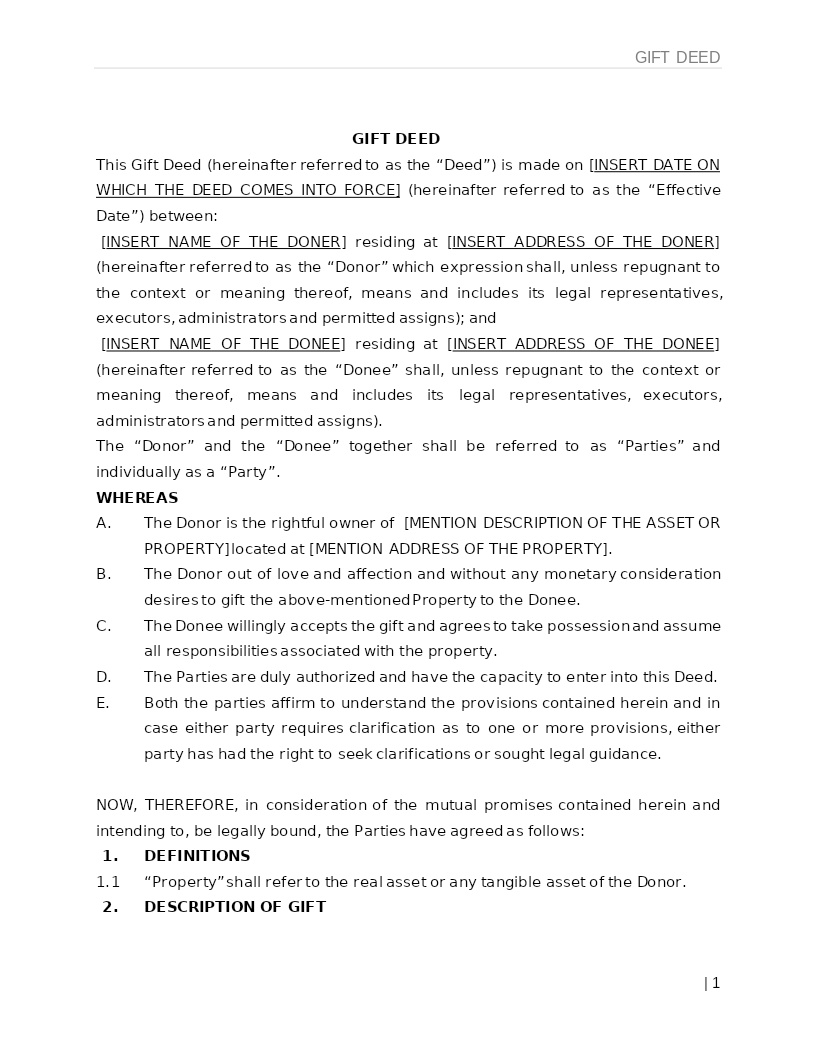
GIFT DEED
How does it work?
1. Choose this template
Start by clicking on "Fill out the template"
2. Complete the document
Answer a few questions and your document is created automatically.
3. Save - Print
Your document is ready! You will receive it in Word and PDF formats. You will be able to modify it.
Transferring Property Through a Gift Deed in the United States
A Gift Deed is a legally enforceable document used to voluntarily transfer ownership of property whether real estate, cash, jewelry, securities, or other valuable assets from one person (the Donor) to another (the Donee) without any exchange of money. In the U.S., a Gift Deed serves as clear, written proof that the transfer was made willingly and with full intention, helping both parties avoid disputes and establish undisputed ownership records.
Gift Deeds are commonly used between family members, parents and children, spouses, close relatives, or trusted individuals to pass down wealth, property interests, or sentimental assets during the Donor’s lifetime. When drafted properly, a Gift Deed provides transparency, prevents future claims, and ensures a smooth transition of ownership under applicable state laws.
Where Gift Deeds Are Commonly Used
Gift Deeds are widely used in many personal and estate-planning situations across the United States, including:
- Transferring residential or commercial real estate to children or family members.
- Gifting shares, securities, or financial assets.
- Passing down family valuables such as artwork, collectibles, or jewelry.
- Donating land or property to charitable organizations.
- Formalizing lifetime gifts for tax planning and wealth distribution.
- Recording transfers made out of love, affection, or goodwill.
Any situation involving the voluntary transfer of valuable property can benefit from a clear, legally documented Gift Deed.
Different Types of Gift Deeds You May Encounter
- Real Property Gift Deed: Used to transfer ownership of land, houses, or real estate; typically requires notarization and county-level recording.
- Personal Property Gift Deed: Used for movable assets such as jewelry, artwork, vehicles, or financial instruments.
- Conditional Gift Deed: Includes specific conditions for example, revocation rights, usage limitations, or future obligations.
- Charitable Gift Deed: Used when a donor transfers property to nonprofit organizations or charitable institutions with or without restrictions.
When Legal Guidance Becomes Helpful
Gift Deeds are simple in concept, but legal advice may be important when:
- The property has existing mortgages, liens, or encumbrances.
- There are multiple beneficiaries or potential heirs.
- The donor wants to impose conditions or revocation rights.
- The transfer involves high-value real estate or large financial assets.
- Tax implications vary under federal or state gift tax laws.
- The deed must comply with recording requirements or title formalities.
- The gift affects Medicaid eligibility, estate planning, or inheritance rights
Legal counsel ensures the deed is enforceable, tax-compliant, and properly executed under state law.
How to Work with This Template
- Identify the Donor and Donee with accurate legal details.
- Describe the property in detail (address, parcel number, asset description).
- State that the transfer is voluntary and without monetary consideration.
- Include acceptance by the Donee, as required for validity.
- Disclose any encumbrances or confirm the property is free of liens.
- Add optional revocation or conditional clauses, if needed.
- Select the governing state law and county recording requirements.
- Sign the deed before a notary and complete state-specific filing procedures
This template supports real and personal property transfers and follows standards recognized in many U.S. jurisdictions.
Frequently Asked Questions
Q1. Is a Gift Deed legally binding in the United States?
Yes. A Gift Deed is legally binding once it is signed by the Donor, accepted by the Donee, and executed in accordance with the relevant state’s requirements. For real estate, most states require notarization and county-level recording. Once properly executed, the deed becomes legal proof that the property was intentionally and voluntarily transferred without consideration.
Q2. Can a Gift Deed be revoked after execution?
Generally, once a Gift Deed is accepted and delivered, it cannot be revoked unless the deed specifically allows for revocation under certain conditions. Some states permit conditional gifts where both parties agree, in writing, on circumstances that allow the Donor to reclaim the property. Without such a clause, the transfer is typically permanent and irreversible.
Q3. Does a Gift Deed need to be registered or recorded?
For real estate, yes. Recording the Gift Deed with the local county recorder’s office is essential to establish legal ownership, update title records, and protect the Donee from future claims. For movable or personal property, formal registration may not be required, but a written and notarized gift document is strongly recommended for evidence and tax purposes.
Q4. Can a Gift Deed be signed electronically?
In many states, yes electronic signatures are valid under U.S. laws such as the ESIGN Act and UETA. However, for real estate transfers, states often require notarization and may have specific rules for remote online notarization (RON). It is important to confirm whether electronic execution is permitted for property deeds in your state.
Q5. What are the tax implications of gifting property in the U.S.?
Gifts may be subject to federal gift tax rules if they exceed the annual exclusion amount established by the IRS. Most gifts between close family members are not taxed at the state level, but larger transfers may require a gift tax return. Additionally, gifted property may affect capital gains calculations when the Donee later sells the asset. Consulting a tax professional ensures compliance and accurate planning.
Q6. Does the Donee have to accept the gift for the deed to be valid?
Yes. Acceptance is a mandatory legal element of a valid Gift Deed in the U.S. The Donee must willingly accept the gift during the Donor’s lifetime for the transfer to be complete. Acceptance can be communicated verbally, in writing, or by taking possession or control of the property.
Q7. What happens if the gifted property has existing mortgages or liens?
If the property has outstanding debt or encumbrances, the Gift Deed must disclose it clearly. The Donee may become responsible for the mortgage, taxes, or liens unless the Donor pays them off. Full disclosure protects both parties and ensures the Donee understands the financial implications of accepting the gift.
Q8. Can property be gifted to minors?
Yes, but additional steps may be required. When gifting to a minor, the property may need to be transferred through a custodian, guardian, or trust. This ensures the minor’s interests are protected and that the property is managed responsibly until they reach the legal age of ownership under state law.