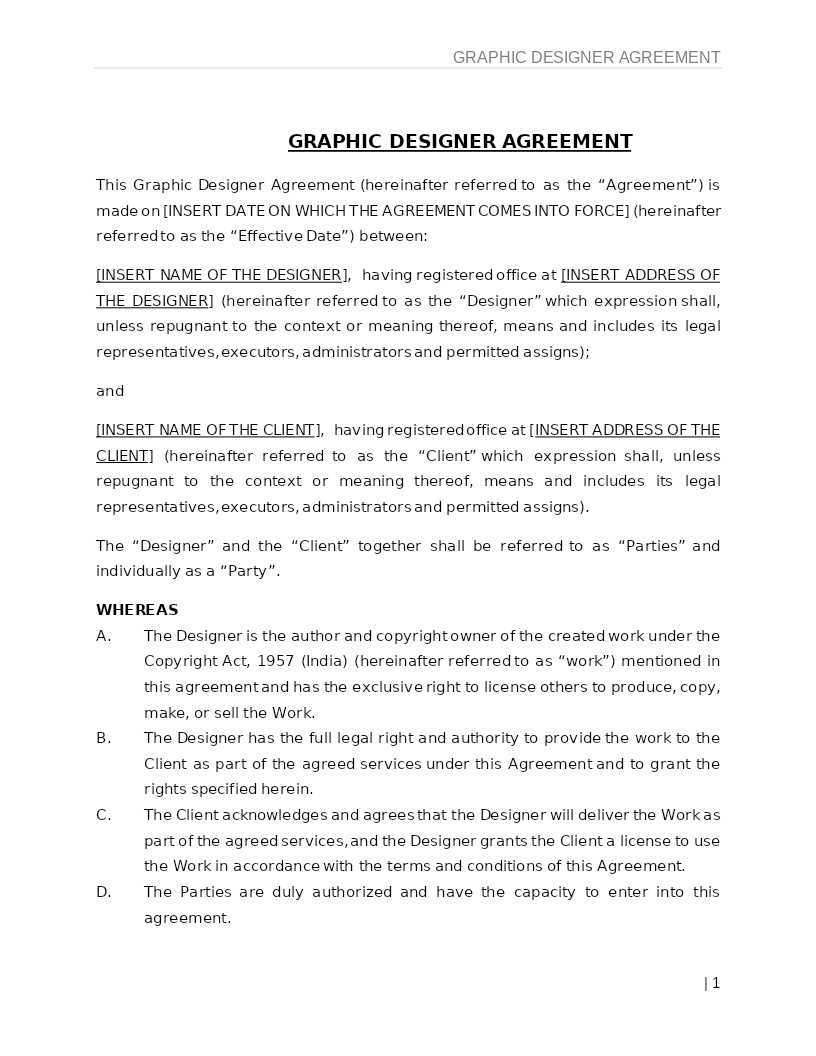
GRAPHIC DESIGNER AGREEMENT
How does it work?
1. Choose this template
Start by clicking on "Fill out the template"
2. Complete the document
Answer a few questions and your document is created automatically.
3. Save - Print
Your document is ready! You will receive it in Word and PDF formats. You will be able to modify it.
Managing Creative Design Services in Professional Collaborations
A Graphic Designer Agreement is a legally binding contract between a Client and a Graphic Designer (freelancer, studio, or design agency) that governs how creative services will be delivered. It defines the scope of work, payment terms, intellectual property ownership, project timelines, confidentiality obligations, and the rights of each party throughout the engagement.
Putting a Graphic Designer Agreement in place creates structure and transparency. It ensures both sides understand how the design process will unfold, who owns the final artwork, how revisions will be handled, and what fees apply. This protects the Client’s brand interests while safeguarding the Designer’s creative rights and compensation.
Where Graphic Designer Agreements Are Commonly Used
Graphic Designer Agreements are routinely used in a wide range of professional design engagements, such as:
- Logo design, branding, and visual identity projects.
- Social media graphics, marketing collateral, and digital advertising design.
- Website UI/UX layouts, mobile app graphics, and digital interfaces.
- Print materials such as brochures, packaging, and book designs.
- Illustration, animation, multimedia creative work, or promotional content.
- Long-term retainer projects with agencies or freelance designers.
- Any time creative materials are produced for commercial use, a written agreement ensures clarity and prevents disputes.
Different Types of Graphic Designer Agreements You May Encounter
- Project-Based Agreement: Used for one-time assignments such as branding packages, website graphics, or marketing campaigns.
- Retainer Agreement: Used when clients engage designers for ongoing monthly work or continuous creative support.
- Hourly-Based Agreement: Used when design services are billed per hour rather than per deliverable.
- Agency or Studio Agreements: Used when multiple designers, art directors, or project managers contribute to the work.
When Legal Guidance Becomes Helpful
Most design engagements proceed smoothly, but professional legal input may be useful when:
- The project involves complex licensing, trademarks, or high-value brand assets
- Multiple designers or subcontractors are contributing to the work
- The client requires exclusive rights, long-term usage rights, or global IP transfers
- Third-party materials (fonts, stock images, templates) are heavily used
- The project spans multiple states or international jurisdictions
- Payment schedules, revision limits, or approval processes are heavily negotiated
- The work will be used in regulated industries (finance, healthcare, advertising compliance)
Legal review ensures that ownership rights, licensing terms, and usage limitations are unambiguous and enforceable.
How to Work with This Template
- Identify the contracting parties and their legal details
- Clearly describe the design services and deliverables
- Specify timelines, milestones, and approval stages
- Set payment terms, deposits, and invoicing cycles
- Define revisions, licensing rights, and IP ownership
- Include confidentiality and data protection obligations
- Clarify who licenses third-party assets and tools
- Select governing state law and dispute resolution method
- Sign electronically or in hard copy
This template is compatible with major e-signature platforms and follows widely accepted standards for U.S. design and creative service contracts.
Frequently Asked Questions
Q1. Is a Graphic Designer Agreement legally binding and why is it necessary?
Yes. A Graphic Designer Agreement becomes legally binding once both the Client and the Designer sign it, and it serves as the foundational document governing the entire creative relationship. Because design projects involve subjective expectations, multiple deliverables, and intellectual property rights, having a written contract prevents misunderstandings and sets clear professional boundaries. It outlines exactly what will be created, how revisions will work, what payments are due, and who owns the final designs—ensuring both parties are protected if disagreements arise or the project scope changes.
Q2. Who owns the designs after the project is completed, and how does IP transfer work?
In most U.S. contracts, the Designer retains ownership of all design work—including drafts, concepts, source files, and preliminary materials until the Client has paid the full agreed amount. Once payment is completed, ownership of the final deliverables transfers to the Client. This means the Client receives the legal rights to use, publish, modify, or reproduce the designs for commercial purposes. However, Designers usually keep the right to display the work in their portfolios or online showcases unless the agreement restricts this. Clear IP transfer language safeguards both business interests and creative rights.
Q3. How does the agreement handle revisions, creative changes, and approval delays?
Revisions are one of the most common sources of conflict in design projects, which is why the agreement specifies how many revision rounds are included and what counts as a “revision” versus a “new request.” If the Client asks for changes outside the agreed scope such as a complete redesign, major brand direction shifts, or additional versions, the Designer may charge extra fees. The agreement also explains how Client approval timelines affect delivery. If the Client delays feedback, the Designer may extend deadlines accordingly. This ensures the project stays fair and manageable for both sides.
Q4. Can the Designer use third-party fonts, stock images, or templates in the project?
Yes, Designers frequently use licensed third-party materials such as fonts, illustrations, stock photos, or templates. The agreement clarifies who is responsible for purchasing and maintaining these licenses either the Client or the Designer, and ensures all assets used in the final design are legally permitted for commercial use. Proper licensing avoids copyright infringement and protects the Client from potential legal claims related to unlicensed creative assets. This clause is especially important for branding, advertising, and large-scale commercial projects.
Q5. Are electronic signatures accepted for a Graphic Designer Agreement in the U.S.?
Yes. Under the ESIGN Act and UETA, electronic signatures are legally valid and enforceable across the United States. This means Clients and Designers can finalize their agreements using digital platforms such as DocuSign, Adobe Sign, or similar tools. E-signatures are especially helpful for remote collaborations, cross-state projects, or freelance engagements where parties may never meet in person. Using electronic signatures ensures quick onboarding and provides a securely stored record of the contract.
Q6. What happens if the Client requests major changes or the project scope evolves during the engagement?
Design projects sometimes evolve as creative ideas develop. When the Client requests changes that significantly alter the original scope, such as new deliverables, additional versions, rebranding, or expanded usage rights, the agreement typically requires a written change order or updated fee estimate. This protects Designers from unpaid extra work and ensures Clients understand the financial and timeline implications of expanded requirements. The contract also allows Designers to adjust deadlines if substantial changes are introduced mid-project.
Q7. What if either the Client or the Designer breaches the agreement?
If either party fails to meet their contractual obligations for example, failure to pay, failure to deliver work, unauthorized use of designs, or disclosure of confidential information, the non-breaching party has the right to take corrective action. They may terminate the agreement, request payment for completed work, demand cessation of unauthorized usage, or pursue legal remedies such as damages or injunctive relief. The dispute resolution clause in the agreement outlines whether the matter will be handled through negotiation, mediation, arbitration, or litigation, ensuring a clear pathway to resolving conflicts.
Q8. Why is confidentiality included in a Graphic Designer Agreement?
Designers often receive access to sensitive business information, including brand strategies, product launch details, internal documents, customer data, and proprietary creative assets. Confidentiality clauses ensure this information cannot be shared, used outside the project, or disclosed to third parties. For Clients, this helps protect competitive advantage and brand integrity. For Designers, confidentiality also prevents misuse of proprietary design processes or internal workflows. Including strong confidentiality language aligns the agreement with U.S. privacy expectations and builds trust between both parties.
Related Templates You May Need
• Consulting Services Agreement
• Non-Disclosure Agreement (NDA)
• Intellectual Property (IP) Assignment Agreement