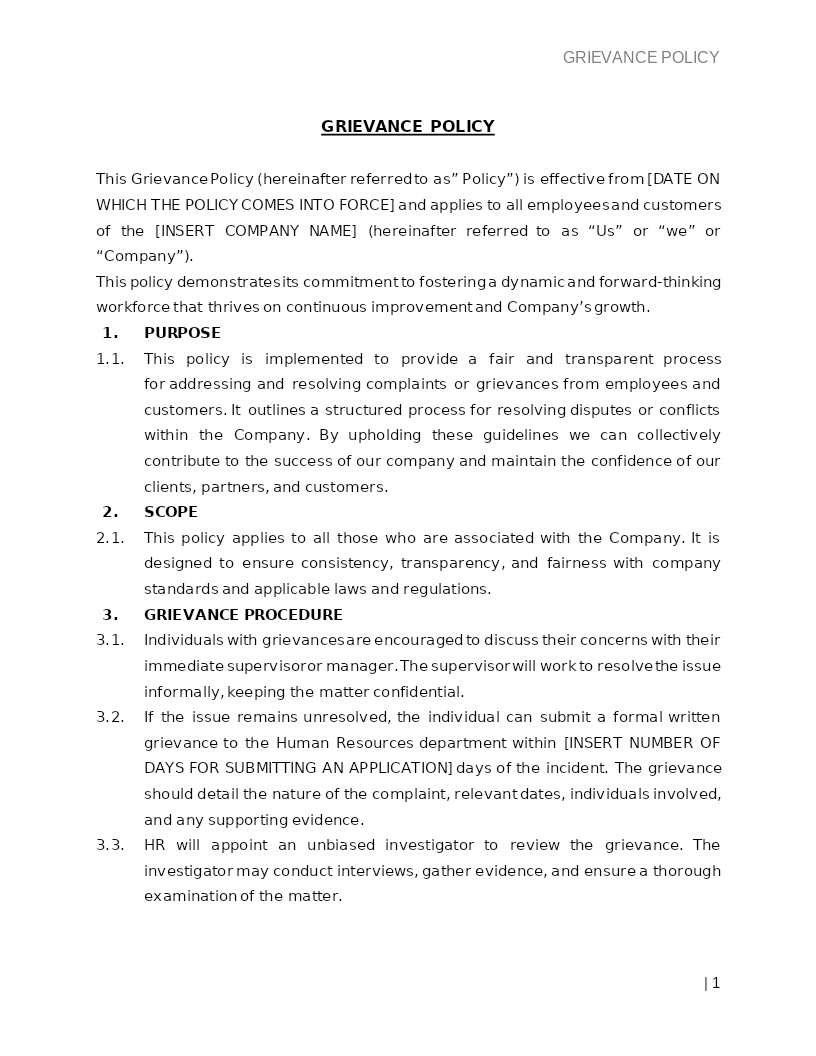
GRIEVANCE POLICY
How does it work?
1. Choose this template
Start by clicking on "Fill out the template"
2. Complete the document
Answer a few questions and your document is created automatically.
3. Save - Print
Your document is ready! You will receive it in Word and PDF formats. You will be able to modify it.
Addressing Workplace Concerns Through a Clear Grievance Policy
Every organization needs a reliable way for employees to raise concerns, report problems, and seek fair resolution. A Grievance Policy provides that framework. It explains how grievances should be submitted, how management will review them, and what steps will be taken to reach a resolution.
A well-defined grievance process helps maintain trust, supports transparency, and ensures employees feel heard whether the issue involves workplace behavior, policy disputes, discrimination, harassment, or interpersonal conflict. It also protects the employer by demonstrating fairness, consistency, and compliance with U.S. labor and employment regulations.
Where Grievance Policies Are Commonly Used
Grievance procedures are standard in a wide range of workplaces, including:
• Corporate offices, professional services, and technology firms
• Retail stores, hospitality, and service industries
• Healthcare organizations and educational institutions
• Nonprofits, government entities, and public agencies
• Manufacturing units and industrial settings
Different Types of Workplace Grievances You May Encounter
- Informal Grievances: Everyday concerns or minor conflicts that can be resolved through discussion or mediation.
- Formal Written Grievances: Official complaints submitted using internal forms or written statements.
- Policy-Related Grievances: Concerns related to work rules, disciplinary actions, or inconsistencies in policy enforcement.
- Interpersonal or Behavioral Grievances: Issues involving colleagues, supervisors, workplace behavior, or harassment.
- Compliance-Related Grievances: Concerns involving discrimination, retaliation, or violations of federal or state employment laws.
When Legal Guidance Becomes Helpful
While many concerns can be handled internally, legal review is valuable when:
• A grievance involves allegations of discrimination, harassment, or retaliation
• The issue relates to wage and hour disputes or labor law compliance
• There are multiple parties or union involvement
• The grievance may lead to disciplinary action, termination, or legal claims
• The organization operates in a regulated industry such as healthcare or education
How to Work with This Template
• Identify who may file a grievance
• Specify the steps for reporting concerns
• Outline timelines for investigation and response
• Clarify confidentiality and protection from retaliation
• Define responsibilities of HR, supervisors, and investigators
• Select the governing state law
• Share the policy with employees and keep it accessible
• Allow electronic submissions or digital signatures for forms
Frequently Asked Questions
Q1. What is the purpose of a Grievance Policy?
A Grievance Policy provides employees with a safe, structured way to report workplace concerns. It ensures complaints are handled fairly, promptly, and in compliance with employment laws, helping maintain a respectful and professional environment.
Q2. Who can file a grievance under this policy?
Any employee who experiences or witnesses' misconduct, unfair treatment, policy violations, or workplace issues may file a grievance. The policy covers both formal and informal complaints.
Q3. Are grievances kept confidential?
Yes. Employers must keep grievance details confidential to the extent possible. Information is only shared with those responsible for investigating or resolving the complaint.
Q4. How quickly will the organization respond to a grievance?
Most policies set timelines for acknowledgment, investigation, and resolution. Timely action demonstrates fairness and minimizes workplace disruption.
Q5. Can an employee face retaliation for filing a grievance?
No. U.S. labor laws prohibit retaliation against employees who raise workplace concerns in good faith. The policy typically includes strong anti-retaliation protections.
Q6. What types of issues qualify as grievances?
Typical issues include harassment, discriminatory behavior, safety concerns, unfair treatment, policy disputes, or unresolved conflicts with coworkers or supervisors.
Q7. What happens during a grievance investigation?
HR or management will gather facts, interview involved parties, review documentation, and determine an appropriate resolution. Findings are communicated to the employee.
Q8. Can a grievance be escalated if the employee disagrees with the outcome?
Yes. Most policies include appeal procedures, allowing employees to request a secondary review by a higher-level manager or HR official.
Q9. Are anonymous grievances allowed?
Some organizations accept anonymous submissions, though they may be harder to investigate. The policy will specify whether this option is available.
Q10. Should employees document their concerns before filing?
Yes. Keeping notes, emails, or examples helps provide clarity and supports a thorough, fair evaluation of the grievance.