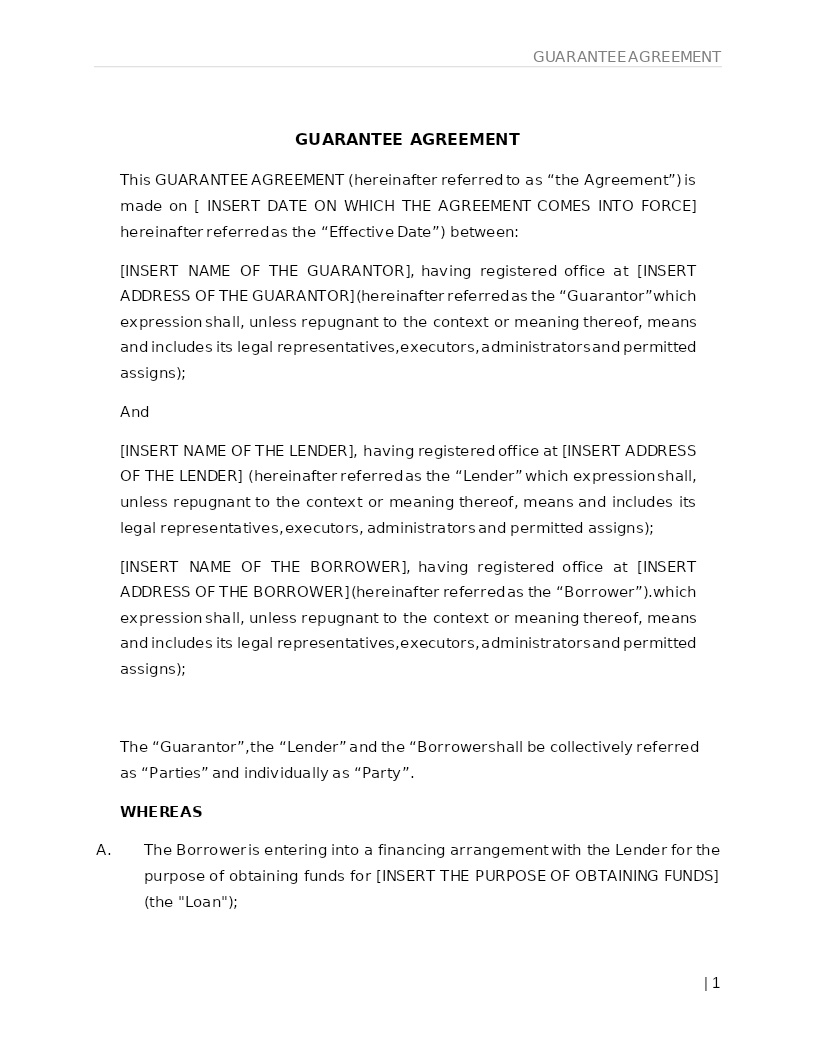
GUARANTEE AGREEMENT
How does it work?
1. Choose this template
Start by clicking on "Fill out the template"
2. Complete the document
Answer a few questions and your document is created automatically.
3. Save - Print
Your document is ready! You will receive it in Word and PDF formats. You will be able to modify it.
Understanding Guaranty Agreements
A Guaranty Agreement is a legally binding contract in which one party (the “Guarantor”) agrees to be responsible for the financial or performance obligations of another party (the “Debtor”) if the Debtor fails to meet those obligations. This agreement outlines the scope of the guaranty, financial responsibilities, default events, creditor rights, and enforcement procedures.
In the United States, Guaranty Agreements are governed by state contract laws, the Uniform Commercial Code (UCC), lending regulations, and federal consumer protection standards. These agreements are commonly used in commercial lending, business transactions, real estate leases, financing arrangements, and corporate credit extensions.
A properly drafted Guaranty Agreement gives lenders and creditors additional security while clearly stating the Guarantor’s obligations.
Where Guaranty Agreements Are Commonly Used
Guaranty Agreements are widely used in financial and commercial transactions, including:
- Business loans, credit lines, and bank financing
- Commercial leases requiring personal or corporate guarantors
- Equipment financing and vendor credit arrangements
- Construction contracts and project performance guarantees
- Real estate purchase agreements with financing contingencies
- Startup funding involving personal guarantees
- Corporate transactions requiring assurance of payment or performance
Any time a creditor needs assurance that obligations will be fulfilled, a Guaranty Agreement provides added protection.
Different Types of Guaranty Agreements You May Encounter
- Personal Guaranty: An individual guarantees the obligations of a business or another person.
- Corporate Guaranty: A company guarantees the debts or performance of an affiliated entity.
- Limited Guaranty: The Guarantor’s liability is capped or restricted to certain terms or amounts.
- Unlimited/Absolute Guaranty; The Guarantor assumes full responsibility for all obligations, including late fees, interest, and collection costs.
- Payment Guaranty: Guarantees repayment of a financial obligation.
- Performance Guaranty: Guarantees completion of contractual duties, common in construction and service contracts.
When Legal Guidance Becomes Helpful
Legal advice is recommended when:
- The guaranty involves significant financial obligations
- The agreement includes personal liability for business debts
- Multiple guarantors or complex financial structures are involved
- The obligations are tied to real estate or long-term commercial leases
- Lenders require additional collateral or security terms
- The Guarantor needs clarity on enforcement and default consequences
- The guaranty must comply with UCC rules or lending regulations
Legal review helps ensure the agreement is enforceable and the Guarantor understands their responsibilities under U.S. law.
How to Work with This Template
- Identify the Creditor, Debtor, and Guarantor clearly
- Specify the obligations being guaranteed, payment, performance, or both
- Define limits, conditions, and duration of the guaranty
- Include representations, warranties, and Guarantor obligations
- Add default terms, creditor rights, and collection procedures
- Choose the governing U.S. state law
- Include waiver provisions commonly required by lenders
- Sign electronically or physically in accordance with state rules
This template is compatible with U.S. lending practices and major e-signature platforms.
Frequently Asked Questions
1. What is a Guaranty Agreement and why is it important?
A Guaranty Agreement ensures that a third party will pay or perform obligations if the primary party fails. It is important because it provides creditors with added security and reduces financial risk in lending or contractual relationships.
2. Are Guaranty Agreements enforceable in the U.S.?
Yes. Guaranty Agreements are enforceable under state contract law and, in many cases, UCC provisions. They must be written, clearly stated, and signed by the Guarantor for enforceability.
3. What obligations can be guaranteed?
A guaranty can cover loan repayment, rent payments, equipment leases, contract performance, business debts, vendor credit, or other financial liabilities. The agreement specifies exactly what is being guaranteed.
4. Who typically signs a personal guaranty?
Business owners, startup founders, partners, or executives often sign personal guaranties when a lender or landlord requires additional assurance beyond the company’s creditworthiness.
5. Can a Guaranty Agreement limit the Guarantor’s liability?
Yes. A Limited Guaranty can cap liability to a specific dollar amount or percentage. A Full Guaranty, however, holds the Guarantor responsible for all obligations, including costs of collection.
6. What happens if the Debtor defaults?
Upon default, the creditor may demand payment or performance from the Guarantor. The creditor may also pursue legal action, collect interest, and recover damages according to the agreement.
7. Can a Guarantor revoke the agreement?
No, unless the agreement includes revocation terms. Most guaranties remain in effect until the obligations are fully satisfied, or the creditor releases the Guarantor in writing.
8. Does signing a guaranty affect credit?
Possibly. If the Debtor defaults and the Guarantor is responsible for repayment, it may impact the Guarantor’s credit if unpaid debts are reported or legal action is taken.
9. Are electronic signatures valid for Guaranty Agreements?
Yes. Under the U.S. ESIGN Act, electronic signatures are legally enforceable. Many banks and lenders accept digitally signed guaranties.
10. Is a Guaranty Agreement suitable for small businesses?
Absolutely. Small businesses often rely on guaranties to secure leases, equipment, and financing. A well-written agreement protects lenders while helping businesses access credit.