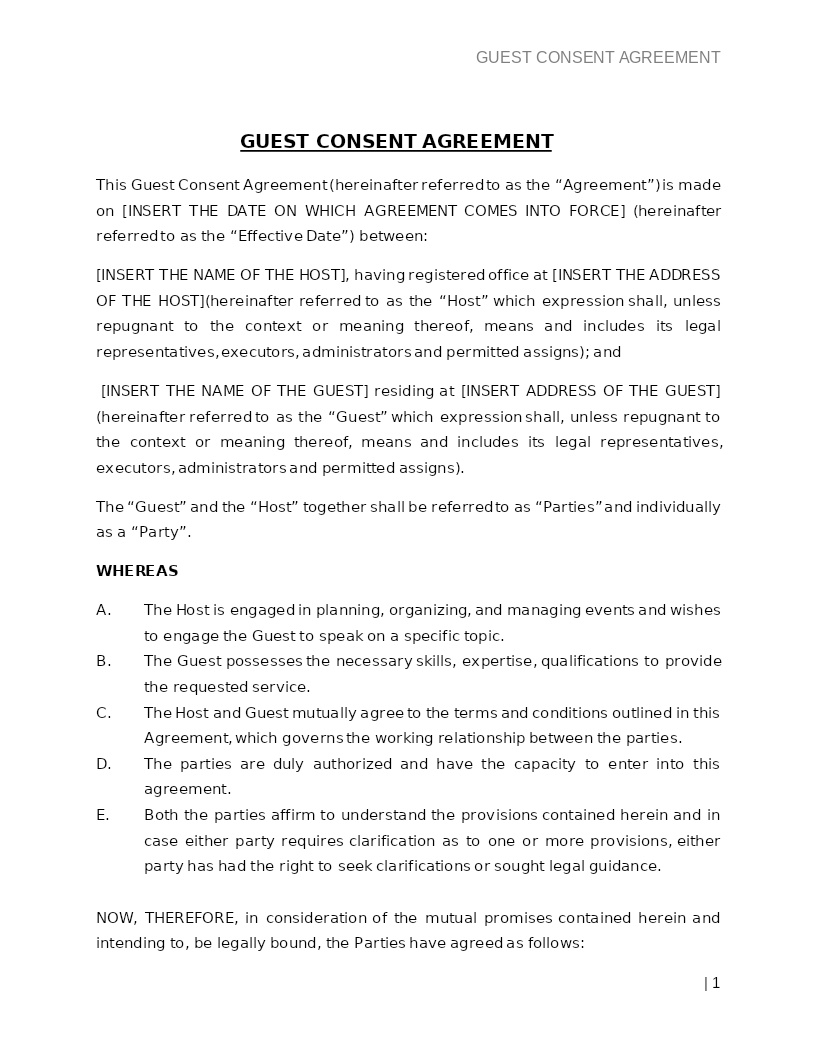
GUEST CONSENT AGREEMENT
How does it work?
1. Choose this template
Start by clicking on "Fill out the template"
2. Complete the document
Answer a few questions and your document is created automatically.
3. Save - Print
Your document is ready! You will receive it in Word and PDF formats. You will be able to modify it.
Ensuring Transparency, Safety, and Legal Protection Through Guest Consent Agreements
A Guest Consent Agreement is a legal document in which a guest formally agrees to the rules, conditions, and policies of a host, business, property owner, or event organizer before using a service or entering a premises. In the United States, these agreements play a crucial role in defining guest responsibilities, setting behavioral expectations, outlining safety requirements, and securing consent for liability waivers, privacy practices, and compliance with house or event rules.
By obtaining documented consent, hosts and businesses can safeguard against liability, prevent misuse of property, and ensure a safe, compliant, and transparent experience for both parties. Guest Consent Agreements are widely used across hospitality, event management, short-term rentals, wellness centers, recreational facilities, and corporate properties.
Where Guest Consent Agreements Are Commonly Used
Guest Consent Agreements are standard across a variety of U.S. industries and services, including:
- Short-term rentals (Airbnb, VRBO), hotels, and guesthouses
- Event venues, conferences, workshops, and retreats
- Gyms, fitness studios, spas, and wellness centers
- Recreational activities such as sports facilities, adventure parks, or tours
- Property tours, open houses, and community amenities
- Co-working spaces or corporate campuses
- Private residences hosting paid or sponsored events
Any situation involving guests entering a property or participating in an activity benefit from a clear written agreement to establish expectations and protect both parties.
Different Types of Guest Consent Agreements You May Encounter
- Liability Waiver and Release Agreement: This agreement releases the host or business from legal responsibility if a guest suffers an injury, accident, or property damage while using the premises or participating in an activity. It clearly outlines the inherent risks involved and ensures the guest acknowledges and accepts those risks. Commonly used in gyms, adventure parks, recreational activities, co-working spaces, and wellness centers.
- Property Use and Conduct Agreement: This agreement defines rules regarding how guests should behave and interact with the property. It includes expectations on noise levels, cleanliness, prohibited activities, use of amenities, and responsibility for damages. It helps maintain order, prevents property misuse, and sets boundaries for acceptable conduct, especially useful for short-term rentals, shared spaces, and event venues.
- Privacy and Data Consent Agreement: This agreement explains how the guest’s personal information, such as identification details, contact information, or payment data, may be collected, used, stored, or shared in compliance with U.S. privacy laws (like CCPA or state-specific regulations). It ensures transparency and protects both parties when digital check-ins, smart devices, or surveillance systems are in use.
- Event Participation Consent: Used when guests attend an organized event, workshop, retreat, seminar, or recreational activity. This agreement covers event rules, participant obligations, safety protocols, and expected conduct. It may also include waivers for physical activities, photography releases, and disclaimers for food allergies or environmental risks.
- Media and Photo Release Consent: This agreement gives the host permission to record, photograph, or use video/audio content featuring the guest for promotional, marketing, or archival purposes. It outlines where and how the content may be used, ensuring compliance with U.S. publicity and privacy laws. Common in events, educational workshops, corporate functions, and creative studios.
When Legal Guidance Becomes Helpful
Guest Consent Agreements may involve legal compliance, liability issues, and operational risks. Legal guidance becomes essential when:
- Activities involve physical risk or specialized safety requirements
- The agreement includes indemnity, waiver, or release clauses
- Property use involves sensitive areas, high-value items, or shared spaces
- Guest data is collected or stored, triggering privacy law compliance (CCPA, state data laws)
- Multi-state operations require alignment with varying legal standards
- Events involve alcohol service, minors, or special permitting requirements
- The host requires protection from potential property damage or misconduct
A lawyer-reviewed agreement ensures enforceability and legal alignment with U.S. state-specific laws.
How to Work With This Template
- Identify the host/business and the guest receiving access or services
- Specify the type of access granted, the purpose, and the guest’s responsibilities
- Set rules for safety, conduct, confidentiality, and property use
- Include liability waivers, indemnification, and risk disclosures
- Add privacy consent terms for data collection and recording
- Define payment rules, fees, or penalties for damage or violations
- Choose governing state law and dispute resolution methods
- Obtain electronic or written signatures, both legally enforceable in the U.S.
This template aligns with common practices in the U.S. hospitality, event, and recreation industries.
Frequently Asked Questions:
Q1. Why is a Guest Consent Agreement important for U.S. hosts and businesses?
A Guest Consent Agreement protects the host by clearly outlining guest responsibilities, liability waivers, conduct rules, and privacy disclosures. It ensures both parties understand expectations, reducing misunderstandings and legal exposure.
Q2. What key terms should a Guest Consent Agreement include?
Core elements include liability waivers, property rules, payment terms, safety guidelines, privacy notices, and consequences for violations. These provisions help protect the host’s property, clarify guest rights, and ensure compliance with U.S. laws.
Q3. Does signing a Guest Consent Agreement limit a guest’s ability to sue?
While a waiver cannot eliminate all legal rights, a properly drafted agreement can significantly reduce liability claims by proving the guest knowingly accepted certain risks. Enforceability varies by state, so clear wording and legal review improve protection.
Q4. Can a Guest Consent Agreement apply to online bookings or digital check-ins?
Yes. Electronic consent is legally valid under the ESIGN Act and UETA. Hotels, rentals, and event venues commonly use digital forms, apps, or check-box acceptance to obtain guest consent.
Q5. Does the agreement protect the guest as well?
Yes. Guests receive clarity about their rights, expectations, safety rules, and any fees or penalties. This transparency helps prevent disputes and ensures a fair, predictable experience.
Q6. Are Guest Consent Agreements required for all events or property uses?
Not always, but they are strongly recommended for any situation involving risk, liability exposure, or property access. They are essential for rentals, fitness activities, guided tours, events, and any environment where safety or conduct rules apply.
Q7. Can the agreement include data privacy and media consent?
Absolutely. Most U.S. versions include clauses about video recordings, photographs, and personal data collection to comply with privacy laws and clearly inform guests of how their information will be used.