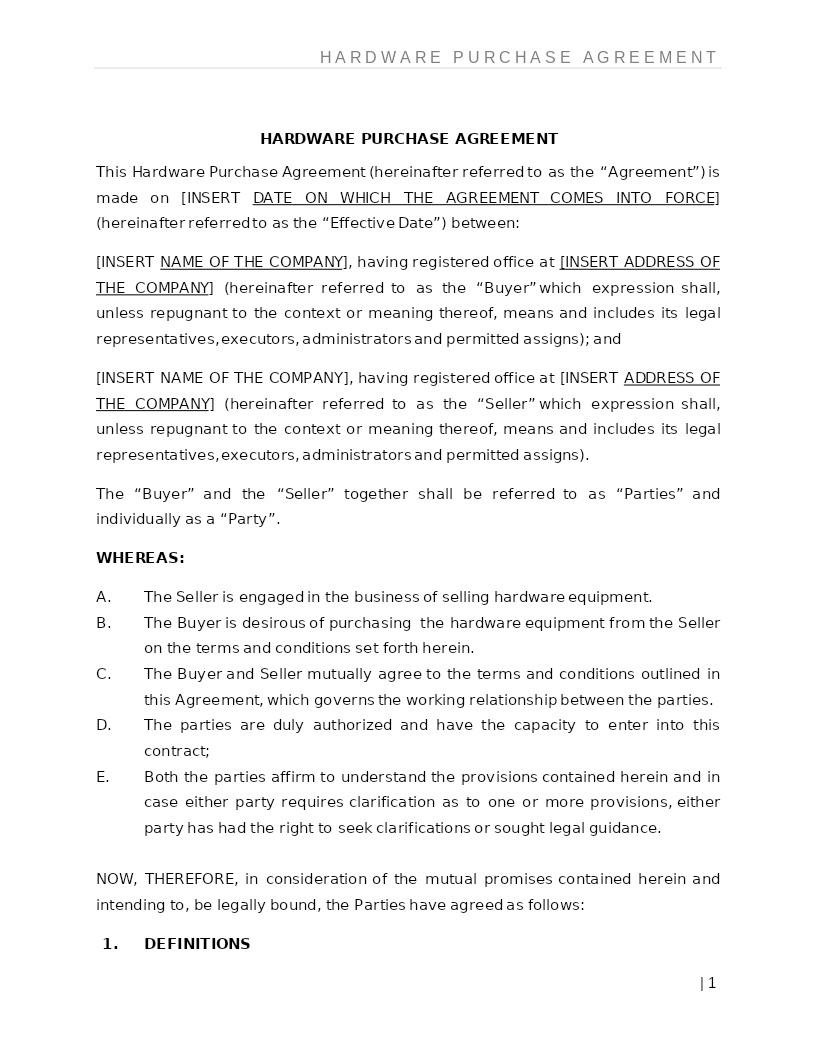
HARDWARE PURCHASE AGREEMENT
How does it work?
1. Choose this template
Start by clicking on "Fill out the template"
2. Complete the document
Answer a few questions and your document is created automatically.
3. Save - Print
Your document is ready! You will receive it in Word and PDF formats. You will be able to modify it.
Understanding Hardware Purchase Agreements
When a business acquires computers, servers, networking devices, office equipment, or any related hardware, it is essential to have a clear contractual framework that defines each party’s rights and responsibilities. A Hardware Purchase Agreement provides that structure. It outlines product specifications, pricing, delivery terms, warranties, installation requirements, returns, and after-sales obligations.
Having a detailed Hardware Purchase Agreement ensures transparency, reduces disputes, and protects both the buyer and seller throughout the procurement and deployment process. It also ensures compliance with relevant U.S. commercial laws, product safety regulations, and industry standards.
Where Hardware Purchase Agreements Are Commonly Used
Hardware Purchase Agreements are widely used across technology-driven operations, including:
• Procurement of office computers, laptops, and peripherals
• Purchase of servers, data-center hardware, and networking devices
• Acquisition of POS systems and retail equipment
• Industrial machines, sensors, and manufacturing hardware
• Medical or laboratory equipment purchases
• Educational institutions buying classroom or administrative technology
• Outsourced IT procurement and managed hardware services
Any time physical technology equipment changes ownership, a Hardware Purchase Agreement sets clear expectations for performance, delivery, and support.
Different Types of Hardware Purchase Agreements You May Encounter
- Standard Hardware Purchase Agreement: Used for one-time equipment purchases with straightforward delivery and warranty terms.
- Bulk or Enterprise Purchase Agreement: Covers large-scale or repeat purchases, often including discount structures and custom warranty terms.
- Hardware + Installation Agreement: Includes installation, configuration, and setup obligations in addition to the sale.
- Hardware Procurement with Support Services: Combines purchase terms with ongoing maintenance, updates, or managed services.
- Leasing-to-Purchase Contracts: Blends hardware leasing with an optional buyout or ownership transfer at the end of the term.
When Legal Guidance Becomes Helpful
Legal review may be helpful when:
• The hardware is mission-critical or high-value equipment
• Custom specifications or integration with existing systems is required
• Intellectual property or licensed firmware/software is bundled with hardware
• The agreement includes service-level commitments or uptime guarantees
• International shipment, customs, or import/export rules apply
• Extended warranties, indemnities, or liability disclaimers affect long-term use
• The buyer needs assurance of data security or compliance with U.S. regulations.
How to Work with This Template
• Identify the buyer and seller clearly
• Describe the hardware and technical specifications in detail
• Set pricing, payment terms, and delivery schedule
• Include warranty, repair, and replacement rights
• Clarify shipping responsibilities and risk of loss
• Specify inspection and acceptance procedures
• Add return policies or defect reporting timelines
• Select the governing U.S. state law
• Sign electronically or physically
Frequently Asked Questions
Q1. What is a Hardware Purchase Agreement and why is it important?
A Hardware Purchase Agreement is a contract that outlines the terms of buying physical technology equipment. It is crucial because it defines specifications, pricing, delivery timelines, warranty rights, and after-sales obligations ensuring both parties understand exactly what is being provided and how issues will be handled.
Q2. Does a Hardware Purchase Agreement cover warranties and defects?
Yes. Most agreements include detailed warranty terms covering defects, malfunction, replacement, and repair procedures. These terms help the buyer know what protections they have if the equipment fails or does not meet expected performance standards.
Q3. Are Hardware Purchase Agreements legally enforceable in the U.S.?
Absolutely. These agreements are enforceable under U.S. contract law and the Uniform Commercial Code (UCC), which governs the sale of goods. Having a written agreement reduces disputes and ensures legal clarity.
Q4. Can this agreement include installation and configuration services?
Yes. Many hardware agreements bundle installation, cabling, setup, and testing services. When included, the agreement should clearly describe the scope of installation, technician responsibilities, and any additional service fees.
Q5. What happens if hardware is damaged during shipping?
Responsibility depends on what the agreement states. Typically, risk of loss transfers to the buyer only after delivery and acceptance. Before that, the seller or shipper may be responsible for damage claims.
Q6. Does the agreement address compatibility with existing systems?
It can and should. If the hardware must integrate with current technology, compatibility requirements, testing procedures, and technical specifications should be clearly documented to avoid performance issues.
Q7. Can buyers return hardware if it does not meet expectations?
Returns depend on agreed terms. Some agreements allow returns within a specific timeframe, while others limit returns to defective products only. Clear return and inspection clauses help avoid misunderstandings.
Q8. Are software and firmware included in a Hardware Purchase Agreement?
Many devices come with embedded software or firmware. The agreement should specify whether these components are included, licensed separately, or subject to additional terms, ensuring compliance with U.S. intellectual property laws.
Q9. Can businesses negotiate pricing or volume discounts?
Yes. Bulk purchases or multi-year procurement cycles often qualify for negotiated pricing, rebates, or enterprise-level discounts. These negotiated terms should always be included in the agreement for enforceability.
Q10. Are electronic signatures valid for Hardware Purchase Agreements?
Yes. Under the U.S. ESIGN Act, electronic signatures are fully enforceable, making it easy to complete the agreement through platforms like Doc sign, Adobe Sign, or similar tools.