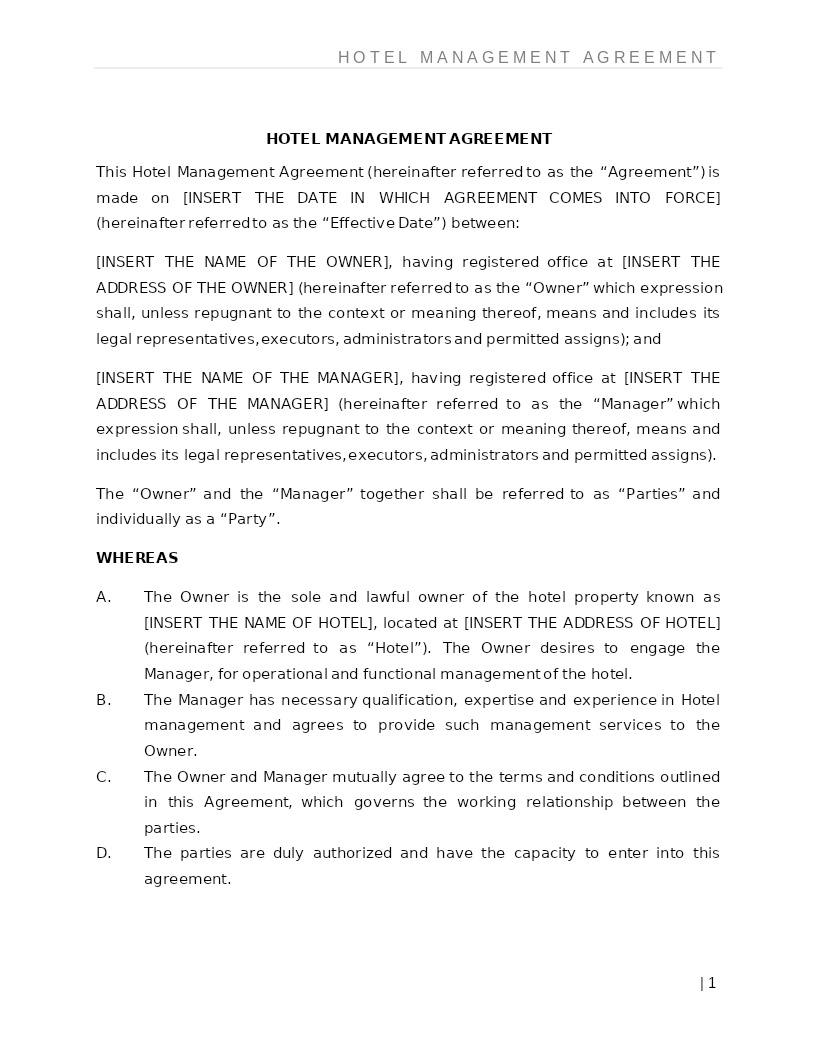
HOTEL MANAGEMENT AGREEMENT
How does it work?
1. Choose this template
Start by clicking on "Fill out the template"
2. Complete the document
Answer a few questions and your document is created automatically.
3. Save - Print
Your document is ready! You will receive it in Word and PDF formats. You will be able to modify it.
Managing Hotel Operations Through a Clear Agreement
When a hotel owner hires a professional management company to operate, market, and oversee daily hotel functions, it’s essential to have a clear legal framework governing that relationship. A Hotel Management Agreement provides that structure. It outlines the scope of management services, financial responsibilities, operational standards, brand requirements, and performance expectations between the property owner and the hotel management company.
A well-drafted Hotel Management Agreement ensures both parties know how the hotel will be run, who makes operational decisions, how revenue will be handled, and what obligations exist throughout the partnership.
Where Hotel Management Agreements Are Commonly Used
Hotel Management Agreements are standard in situations such as:
- Owners hiring established hotel operators to manage day-to-day activities
- Boutique hotel properties engaging specialized management firms
- Franchise hotels requiring third-party operational expertise
- Investors entering the hospitality business for the first time
- Asset owners seeking professional oversight for better profitability
- Resorts, extended-stay hotels, and branded chains outsourcing operations
- Hotels that require expertise in compliance, staffing, marketing, or revenue systems
Any time a hotel owner allows a third party to manage operations, this agreement sets the performance standards and financial framework.
Different Types of Hotel Management Agreements You May Encounter
- Full-Service Management Agreement: The management company oversees all hotel operations from staffing to budgeting to guest services.
- Limited-Service Management Agreement: The operator manages selected aspects such as reservations, marketing, or staffing.
- Franchise or Brand-Affiliated Management Agreement: Used when the hotel is operated under a national brand and must comply with brand standards.
- Independent Hotel Management Agreement: Ideal for boutique or privately owned properties that want customized management services.
- Asset Management Agreement: Focuses on financial oversight, profitability analysis, and long-term property performance.
When Legal Guidance Becomes Helpful
Legal review can be especially useful when:
- The agreement includes performance benchmarks or financial incentives
- Brand requirements, licensing rules, or franchising obligations are involved
- Management fees, expense allocations, or revenue-sharing need clarification
- The operator will hire and supervise employees on behalf of the owner
- The property is subject to strict hospitality, safety, or health regulations
- Long-term contracts include automatic renewal or termination conditions
- Intellectual property (brand usage, trademarks, marketing materials) is included
Legal guidance helps both parties ensure financial fairness, regulatory compliance, and long-term operational stability.
How to Work with This Template
- Identify the hotel owner and management company
- Define the scope of management responsibilities
- Clarify staffing authority, financial controls, and decision-making power
- Specify management fees, budgets, and reporting requirements
- Include brand standards, marketing duties, and performance expectations
- Select governing U.S. state law
- Review the agreement together; legal review is optional but helpful
- Sign electronically or in hard copy
This template follows widely accepted U.S. hospitality industry standards and works with major e-signature platforms.
Frequently Asked Questions
Q1. What is a Hotel Management Agreement and why is it important?
A Hotel Management Agreement outlines the rights and duties of a hotel owner and the management company operating the property. It ensures a clear understanding of financial arrangements, operational authority, and performance expectations reducing conflicts and improving operational efficiency.
Q2. Who controls hotel employees under this agreement?
Typically, the management company oversees hiring, training, and supervising hotel staff. However, the agreement may define certain roles that require owner approval, depending on the structure of the relationship.
Q3. How are management fees structured?
Fees may include a base management fee, incentive fee, or performance-based bonus tied to revenue or profit metrics. The agreement explains how these fees are calculated and paid.
Q4. Does a hotel owner retain any decision-making power?
Yes. Owners usually maintain authority over major financial decisions, capital expenditures, branding choices, and long-term planning. Daily operations are typically handled by the management company.
Q5. Are electronic signatures valid for Hotel Management Agreements?
Yes. Under U.S. federal and state laws, electronic signatures are fully enforceable, making it easy for owners and management companies to execute agreements remotely.
Q6. Can the owner terminate the management company?
Termination depends on the contract. Some agreements allow early termination for non-performance, breach of obligations, or failure to meet revenue targets, while others may require notice or termination fees.
Q7. What happens if the hotel fails to meet performance standards?
Many agreements include performance tests, budgeting requirements, or financial metrics. If standards are not met, the owner may request corrective actions or invoke termination rights.
Q8. Is a Hotel Management Agreement required for boutique or small hotels?
Absolutely. Regardless of size, a written agreement protects the owner’s investment and ensures professional management practices are followed.
Q9. Does the agreement address brand and marketing requirements?
Yes. Many agreements include detailed provisions on marketing, brand standards, advertising, online presence, and guest experience expectations.
Q10. Does the management company have liability for guest safety?
The agreement often addresses liability, insurance requirements, and risk management responsibilities. Both the owner and manager must follow applicable safety and hospitality regulations.