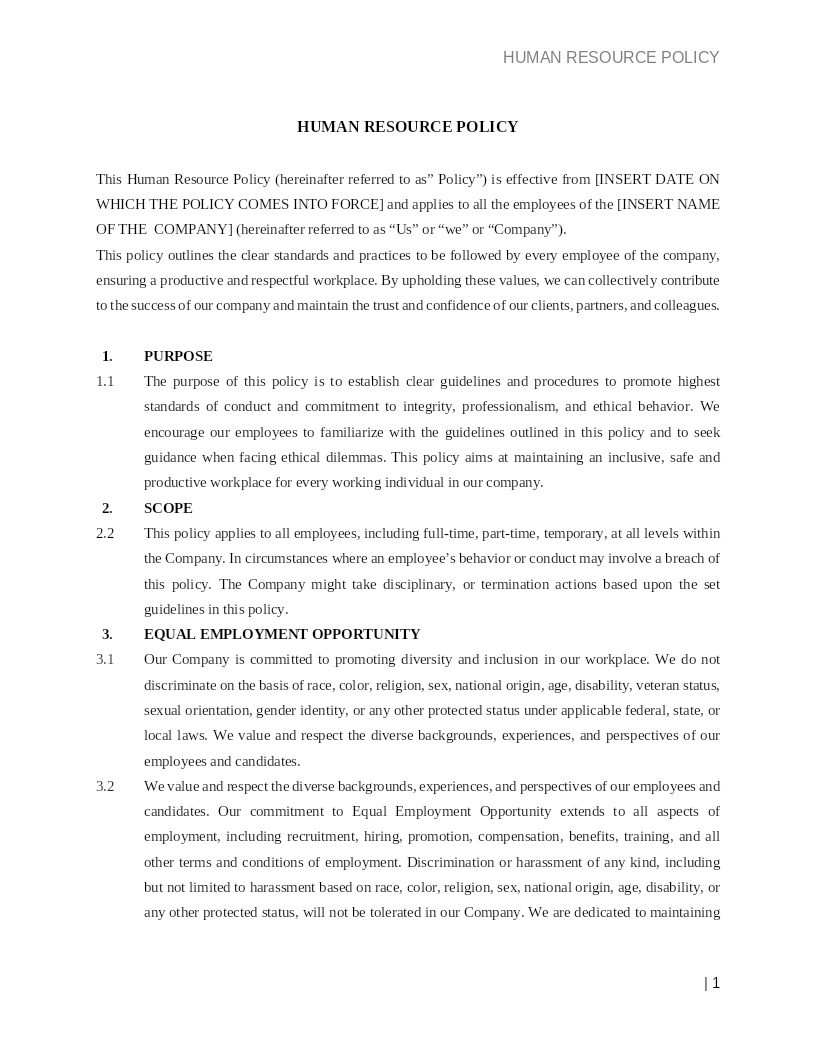
HUMAN RESOURCE POLICY
How does it work?
1. Choose this template
Start by clicking on "Fill out the template"
2. Complete the document
Answer a few questions and your document is created automatically.
3. Save - Print
Your document is ready! You will receive it in Word and PDF formats. You will be able to modify it.
Ensuring Organizational Compliance and Workforce Governance Through a Human Resource Policy
A Human Resource Policy is a comprehensive governance document that establishes the standards, procedures, and obligations that define the employment relationship between an organization and its workforce. Drafted in accordance with U.S. federal and state labor laws, including the Fair Labor Standards Act (FLSA), the Equal Employment Opportunity Commission (EEOC) regulations, the National Labor Relations Act (NLRA), and applicable workplace safety requirements under OSHA, this policy outlines the organization’s legal, ethical, and operational responsibilities in managing employees across all stages of the employment lifecycle. It provides a structured framework for recruitment, onboarding, compensation, performance management, workplace conduct, benefits administration, grievance resolution, and termination procedures, ensuring that the organization maintains compliance with governing employment standards while promoting fairness, transparency, and efficiency.
A well-developed Human Resource Policy addresses the essential elements of workforce administration, including hiring practices, job classifications, wage and hour compliance, overtime rules, leave entitlements, diversity and inclusion standards, and employee rights regarding equal treatment and non-discrimination. It further establishes guidelines for training and development, workplace behavior expectations, communication channels, employee evaluations, and disciplinary procedures. The policy also describes rules governing confidentiality, data privacy, employee records management, workplace accommodations required under the Americans with Disabilities Act (ADA), and protections against retaliation. By implementing this policy, organizations establish a uniform and legally compliant system of HR management that strengthens internal governance, mitigates risk, and fosters a professional and equitable work environment.
Where Human Resource Policies Are Commonly Used
Human Resource Policies are utilized across nearly every industry, including:
- Corporate organizations with diverse workforce structures
- Manufacturing and industrial firms with safety and compliance requirements
- Retail, hospitality, and service-sector employers with large hourly workforces
- Healthcare institutions subject to strict privacy, licensing, and patient-safety regulations
- Technology companies employing remote or hybrid workforces
- Educational institutions managing staff, faculty, and student employees
- Nonprofit organizations requiring legally compliant workforce governance
- Government contractors subject to federal labor and reporting obligations
Any organization employing workers benefits from a clear and comprehensive Human Resource Policy.
Different Types of Human Resource Policies You May Encounter
1. General HR Policies: Cover core employment standards such as recruiting, compensation, and workplace conduct.
2. Compliance-Focused HR Policies: Address mandatory legal requirements related to labor law, discrimination protections, and workplace safety.
3. Benefits and Leave Policies: Outline healthcare benefits, paid time off, family leave, and accommodation rights.
4. Performance Management and Conduct Policies: Cover evaluations, disciplinary procedures, and professional expectations.
5. Remote Work and Digital Workplace Policies: Adapt HR standards to modern, digitally distributed work settings.
When Legal Guidance Becomes Helpful
Legal review is recommended when:
- Policies involve wage-and-hour rules that vary by state or job classification
- The organization must comply with federal or state anti-discrimination laws
- Mandatory leave requirements such as FMLA or state family leave laws apply
- Workplace accommodations under ADA or pregnancy-disability laws are required
- The organization interacts with unions or operates under collective-bargaining agreements
- The company handles sensitive employee data requiring privacy protections
- Employee discipline or termination procedures pose potential liability
- Background checks, drug testing, or pre-employment screenings require compliance with federal and state laws
Legal oversight ensures that the Human Resource Policy supports U.S. employment-law compliance, minimizes risk, and protects organizational integrity.
How to Work with This Template
- Define the structure and expectations of the employer-employee relationship
- Provide clear hiring, onboarding, and classification standards to maintain wage compliance
- Outline compensation, overtime policies, pay periods, and benefits eligibility
- Establish rules for workplace conduct, anti-harassment protections, and equal-opportunity commitments
- Provide guidelines for performance evaluations, feedback systems, and development programs
- Include clear disciplinary and grievance procedures
- Address workplace-safety obligations and reporting responsibilities
- Identify data-privacy standards and employee-records management requirements
- Establish leave policies consistent with federal (e.g., FMLA) and state regulations
- Require employees to acknowledge receipt and understanding of the policy
- Update the policy regularly to reflect changing employment laws and organizational needs
This template reflects best practices for creating a legally compliant and organizationally effective HR governance framework.
Frequently Asked Questions
Q1. What is a Human Resource Policy, and why is it important?
A Human Resource Policy defines the rules, standards, and procedures governing an organization’s workforce. It is important because it ensures compliance with U.S. labor laws, promotes fairness, and provides consistency across HR practices.
Q2. Does U.S. law require companies to have an HR policy?
While not strictly required, having a documented HR policy is strongly recommended because it protects employers from disputes, clarifies employee rights, and ensures compliance with federal and state employment regulations.
Q3. What topics are typically included in an HR policy?
Typical topics include hiring practices, compensation, equal-employment rights, workplace conduct, leave policies, training, disciplinary procedures, safety standards, and termination guidelines.
Q4. Does the HR policy cover equal-employment and anti-harassment laws?
Yes. HR policies must incorporate EEOC requirements, anti-discrimination rules, and protections against harassment and retaliation.
Q5. How does the HR policy support compliance with wage-and-hour laws?
By defining job classifications, overtime rules, pay schedules, and compliance procedures consistent with FLSA and state labor laws.
Q6. What happens if an employee violates HR policy?
Violations typically result in progressive discipline or corrective action, depending on severity, consistent with company procedures and legal safeguards.
Q7. Are remote employees covered under the HR Policy?
Yes. Remote and hybrid employees must comply with workplace standards, data-protection rules, and performance expectations applicable to their roles.
Q8. Can employees file complaints or grievances?
Yes. Most HR policies include structured grievance procedures to ensure employees can raise concerns safely and without retaliation.
Q9. How often should an HR Policy be updated?
Policies should be reviewed regularly at least annually to reflect updates in employment law, organizational practices, and regulatory guidance.
Q10. Should legal counsel review a Human Resource Policy?
Absolutely. Legal review ensures compliance with federal, state, and local labor standards and significantly reduces the risk of legal disputes.