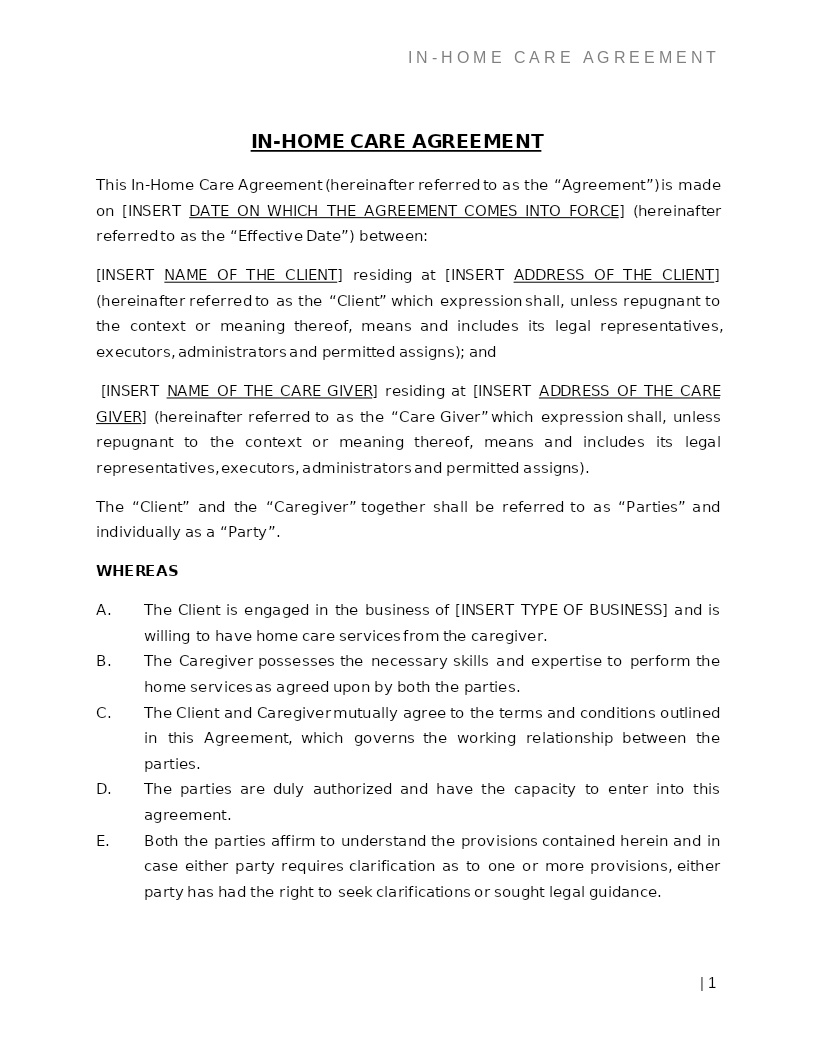
IN-HOME CARE AGREEMENT
How does it work?
1. Choose this template
Start by clicking on "Fill out the template"
2. Complete the document
Answer a few questions and your document is created automatically.
3. Save - Print
Your document is ready! You will receive it in Word and PDF formats. You will be able to modify it.
Providing Safe, Reliable, and Structured Care in the Home Environment
An In-Home Care Agreement is a formal contract that governs the provision of personal, medical, and household care services to an individual within their residence. It establishes the legal framework under which the caregiver, agency, or service provider delivers support ranging from daily living assistance and companionship to specialized care directed by healthcare professionals. The agreement specifies the scope of services, schedules, compensation structure, responsibilities of the parties, and mechanisms for monitoring the quality of care.
By clearly defining what constitutes “care services,” “authorized activities,” and the respective obligations of the caregiver and the care recipient, the agreement fosters transparency, reduces ambiguity, and ensures accountability throughout the caregiving relationship. It provides a structured mechanism for exchanging sensitive personal information, managing access to the recipient’s home and medical details, and setting boundaries on what the caregiver may and may not do in the course of performing their duties.
This contractual framework is essential in contexts such as eldercare, post-hospital recovery, disability support, respite care, or long-term in-home assistance. The agreement enables families and service providers to communicate expectations openly and assess the care arrangement without fear of misuse, negligence, or unauthorized conduct.
Where In-Home Care Agreements Are Commonly Used
In-Home Care Agreements are utilized across a wide range of personal-care situations, including:
- Elderly or senior care requiring daily support
- Post-operative or post-hospitalization recovery
- Disability-related care and mobility assistance
- Home-based health monitoring or medication management
- Short-term or long-term companionship services
- Household assistance (meal preparation, cleaning, errands)
- Live-in caregiving arrangements
- Family-employed caregivers or agency-assigned personnel
An In-Home Care Agreement is typically employed in any circumstance in which a caregiver, attendant, or service provider is required to enter and operate within the private residence of an individual for the purpose of rendering personal, medical, or household support services
Types of In-Home Care Agreements
- Unilateral Care Agreement: Used when only one party (the caregiver) is providing services and accessing the recipient’s personal environment.
- Mutual Care Agreement: Used when both parties exchange responsibilities—for instance, when a family provides accommodation, resources, or certain benefits in return for caregiving services.
- Agency-Based Care Agreement: A formal contract where a licensed care agency assigns caregivers under regulated terms of service.
- Live-In Care Agreements: Comprehensive agreements governing 24-hour, on-premise caregiving arrangements, typically involving specific rules on privacy, breaks, accommodation, and access.
When Legal Guidance Becomes Essential
While basic caregiving arrangements may not always require intensive legal input, professional consultation becomes crucial when:
- The caregiver handles medical tasks or medication
- The arrangement involves a live-in caregiver
- Multiple family members or an agency are involved
- The care recipient is vulnerable or lacks legal capacity
- The agreement includes confidentiality, financial controls, or access to sensitive household areas
- The caregiver may handle banking, transportation, or confidential records
- Local licensing, labor laws, insurance, or elder-care regulations apply
Attorneys ensure that service scope, liabilities, compensation, conduct standards, emergency procedures, and dispute resolution mechanisms are addressed comprehensively and enforceably.
How to Use This In-Home Care Agreement Template
- Identify the parties and define their roles
- Specify the scope and purpose of the caregiving services
- Describe personal care, household duties, and medical-related tasks
- Select the governing law and duration of services
- Establish compensation, reimbursements, and schedule
- Include confidentiality, safety, and conduct requirements
- Review the terms jointly (legal review recommended)
- Sign electronically or in physical form
This description forms a strong foundation for creating a legally sound, transparent, and enforceable caregiving arrangement that safeguards the rights and well-being of both the caregiver and the care recipient.
Frequently Asked Questions
1. Is an In-Home Care Agreement necessary at the start of care?
Yes. Sensitive personal, financial, and medical information is often shared from the outset. A written agreement allows the parties to communicate openly, maintain accountability, and avoid misunderstandings.
2. Can the same agreement be reused for another caregiver?
It can, but it should be revised to reflect the new caregiver’s identity, responsibilities, and schedule to maintain enforceability.
3. What if the caregiver refuses to sign the agreement?
You should limit access to personal spaces and avoid sharing sensitive information until protections are in place.
4. Are electronic signatures valid for In-Home Care Agreements?
Yes. Federal and state e-signature laws recognize electronically executed agreements as legally binding.
5. Does this agreement protect medical information?
Yes, provided that confidentiality clauses explicitly include personal health information. Additional compliance obligations may apply for regulated health data.
6. Can this agreement cover temporary or part-time care?
Absolutely. Terms may be drafted for hourly, daily, or short-duration care services.
7. How long should the agreement last?
The term depends on the nature of the care—ongoing services often renew monthly, while short-term recovery care may be time-bound.
8. Is this suitable for independent caregivers and agencies?
Yes. The agreement may be used for family-employed caregivers, private attendants, or agency personnel.
9. What happens if the caregiver breaches the agreement?
The care recipient may suspend services, demand corrective action, or pursue legal remedies based on the agreement’s dispute resolution provisions.
10. Does it cover verbal instructions or household rules?
If the agreement includes provisions for oral directions, then yes. It is advisable to document such instructions in writing for clarity.
11. Can the agreement specify medical procedures?
Only to the extent permitted by law. Some tasks require licensed personnel, which the agreement should expressly address.
12. Do both parties need to approve revisions?
Yes. Amendments are only effective when mutually agreed upon in writing.
13. Can this agreement be used if the caregiver and recipient live in different states?
Yes. The parties may designate a governing state law for contractual purposes.
14. What if additional services arise later?
The agreement may be expanded through written addenda describing the new services and compensation.
15. Should family members also sign the agreement?
It is advisable when family members are supervising or funding the care arrangement.