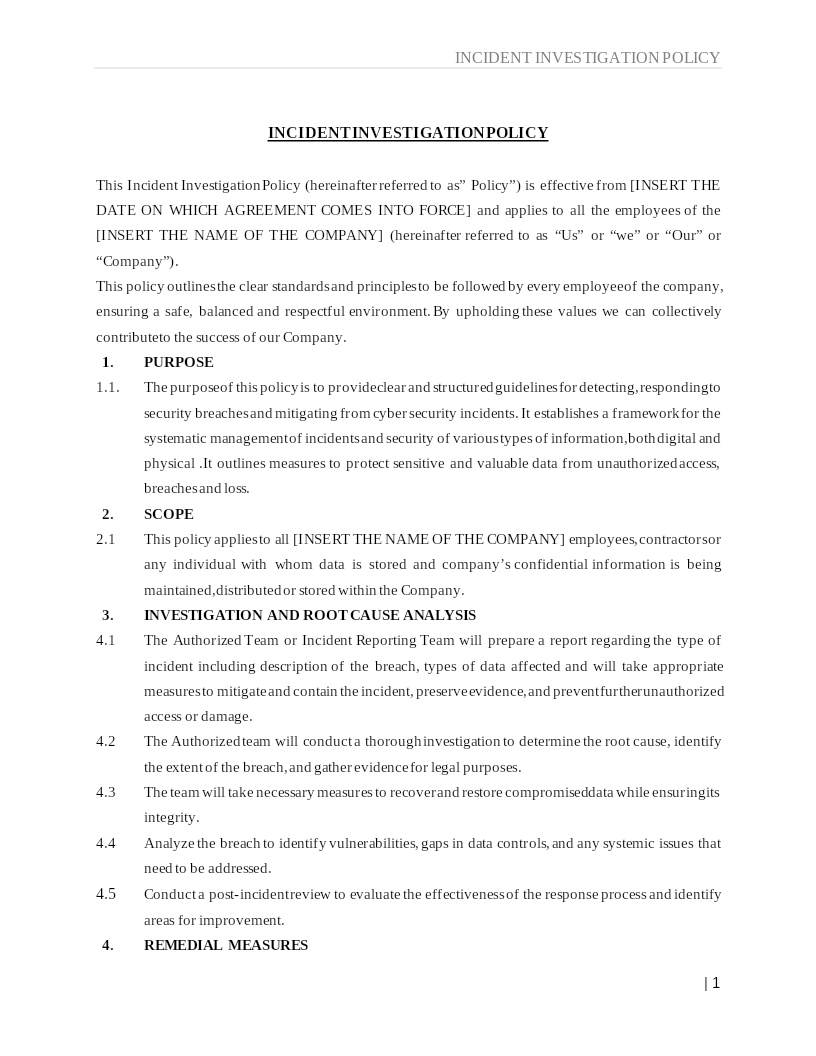
INCIDENT INVESTIGATION POLICY
How does it work?
1. Choose this template
Start by clicking on "Fill out the template"
2. Complete the document
Answer a few questions and your document is created automatically.
3. Save - Print
Your document is ready! You will receive it in Word and PDF formats. You will be able to modify it.
Understanding the Purpose of an Incident Investigation Policy
When a workplace incident occurs, whether it involves an accident, near miss, safety hazard, or security breach, it is critical to have a clear framework that guides how the investigation is conducted. An Incident Investigation Policy provides that structure. It outlines how incidents should be reported, who is responsible for investigating them, what evidence must be collected, and how findings will be reviewed and documented.
Implementing this policy allows organizations to identify root causes, improve safety measures, and take corrective actions to prevent future harm. It also supports compliance with regulatory requirements and demonstrates a proactive approach to workplace safety and risk management.
Where Incident Investigation Policies Are Commonly Used
These policies are standard across various industries and operational environments, including:
- Manufacturing plants, warehouses, and industrial facilities
- Corporate offices, retail environments, and logistics operations
- Healthcare settings, educational institutions, and government agencies
- Construction sites, energy companies, and high-risk work environments
- Technology firms, financial institutions, and organizations handling sensitive data
- Any workplace where employees, customers, or assets may be exposed to risk
Any organization that aims to maintain safety, reduce liability, and ensure proper documentation benefits from a formal incident investigation policy.
Different Types of Incident Investigation Policies You May Encounter
- Workplace Safety Incident Policy: Focuses on injuries, accidents, near misses, unsafe conditions, and OSHA-regulated incidents.
- Security Incident Investigation Policy: Covers breaches, unauthorized access, data theft, or suspicious activity affecting physical or digital assets.
- Operational Incident Investigation Policy: Used for equipment malfunctions, production breakdowns, or system failures that disrupt operations.
- Environmental Incident Investigation Policy: Applicable when spills, emissions, or hazardous material exposures occur.
- Comprehensive Incident Response Policy: Integrates safety, security, operational, and environmental investigations into one overarching framework.
When Legal Guidance Becomes Helpful
Most routine incidents can be handled internally, but legal expertise is valuable when:
- The incident involves serious injury, fatality, or significant property damage
- Investigations may be reviewed by OSHA, insurance providers, or regulatory agencies
- There are potential claims of negligence, non-compliance, or workplace violations
- Sensitive employee information, security breaches, or confidential data is involved
- The organization spans multiple states with differing reporting requirements
- Disciplinary actions or termination decisions arise from the investigation findings
- Third parties, contractors, or vendors are involved in the incident
Legal review helps ensure investigations are compliant, thorough, and defensible against potential disputes.
How to Work with This Template
- Define what qualifies as a reportable incident
- Establish clear reporting timelines and documentation requirements
- Assign investigative responsibilities to safety officers or authorized personnel
- Outline procedures for evidence collection, witness interviews, and root-cause analysis
- Detail how findings are reviewed, approved, and stored
- Align the policy with OSHA regulations and internal risk-management practices
- Review the final document with legal or compliance teams
This policy framework aligns with standard U.S. workplace safety expectations and can be adapted for organizations of all sizes.
Frequently Asked Questions
Q1. What is an Incident Investigation Policy and why is it important?
An Incident Investigation Policy establishes procedures for documenting, analyzing, and responding to workplace incidents. It ensures thorough evaluation of accidents, near misses, and safety hazards. This helps prevent recurrence and improves overall workplace safety. The policy also supports compliance with U.S. safety regulations.
Q2. What types of incidents should be investigated under this policy?
Incidents may include injuries, equipment failures, near misses, property damage, security breaches, or environmental hazards. Investigating all types of incidents—big or small, helps uncover root causes. This proactive approach reduces future risks. It also strengthens safety culture within the organization.
Q3. How does an Incident Investigation Policy help with regulatory compliance?
The policy ensures incidents are reported, documented, and addressed according to OSHA and other regulatory requirements. Proper investigation demonstrates due diligence and reduces legal exposure. It strengthens record-keeping practices, which regulators often review during audits. Compliance helps avoid penalties and improves workplace safety ratings.
Q4. What steps are typically included in an incident investigation?
Most investigations follow a structured process: reporting the incident, securing the scene, gathering evidence, interviewing witnesses, identifying root causes, documenting findings, and recommending corrective actions. This thorough approach ensures accuracy. It also promotes fair and consistent handling across all departments.
Q5. Who is responsible for conducting incident investigations?
Typically, supervisors, safety officers, HR personnel, or designated incident investigators lead the process. They work together to gather facts and assess contributing factors. The policy clarifies each person’s role to ensure accountability. Proper training ensures investigations are handled professionally and objectively.
Q6. How does this policy help prevent future workplace incidents?
By analyzing root causes and identifying potential hazards, organizations can implement targeted corrective actions. These may include training, procedural changes, equipment upgrades, or safety controls. Preventive measures reduce the likelihood of similar incidents occurring. Over time, this strengthens workplace safety culture.
Q7. Why is documentation essential during incident investigations?
Accurate documentation provides a detailed record of what happened, who was involved, and what actions were taken. This helps in regulatory audits, insurance claims, and internal reviews. Clear records also support transparency and accountability. They serve as evidence of responsible incident management.
Q8. Can this policy be customized for different industries?
Yes. Industries such as construction, healthcare, manufacturing, and technology face unique risks. The policy can be tailored to include sector-specific procedures, reporting requirements, and safety standards. Customization ensures relevance and effectiveness. It also enhances compliance with industry regulations.