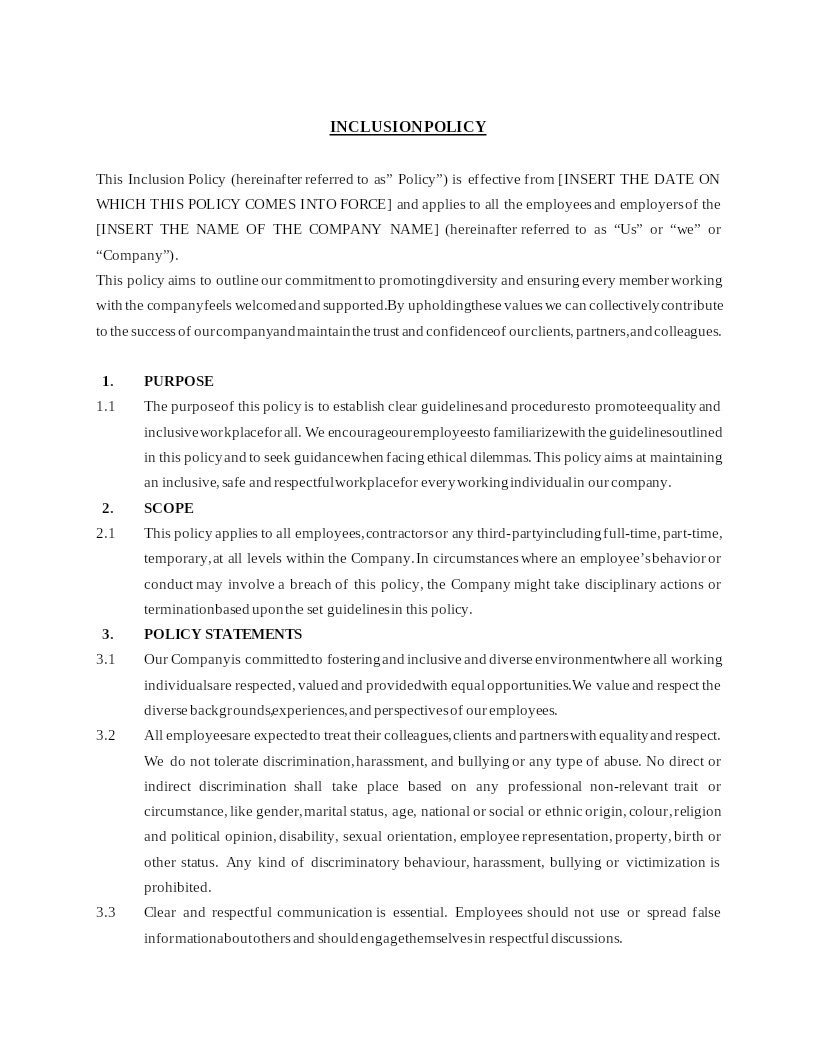
INCLUSION POLICY
How does it work?
1. Choose this template
Start by clicking on "Fill out the template"
2. Complete the document
Answer a few questions and your document is created automatically.
3. Save - Print
Your document is ready! You will receive it in Word and PDF formats. You will be able to modify it.
Fostering Fairness, Respect, and Equal Opportunity Through an Inclusion Policy
An Inclusion Policy is an organizational directive that articulates the institution’s commitment to creating a professional environment grounded in dignity, respect, equal opportunity, and nondiscriminatory practices. Developed in accordance with U.S. federal and state employment laws, including Title VII, the ADA, the ADEA, GINA, the Equal Pay Act, and related EEOC enforcement provisions, this policy establishes the standards, protections, and responsibilities required to maintain an inclusive workplace where all individuals regardless of protected characteristic can contribute fully and equitably. It outlines the organization’s obligation to provide equal access to employment opportunities, training, advancement, and workplace resources, while prohibiting discrimination, harassment, exclusionary practices, or retaliation. By formalizing these commitments, the organization demonstrates its dedication to upholding ethical employment standards, encouraging diverse perspectives, and fostering a culture in which differences are valued as assets.
A comprehensive Inclusion Policy details the behaviors, practices, and structural mechanisms that advance inclusion in the workplace, including equitable hiring processes, accessible work environments, reasonable accommodations under the ADA, nondiscriminatory promotion and compensation decisions, and inclusive communication practices. It identifies protected characteristics as recognized under federal and state law such as race, color, religion, sex, national origin, disability, age, genetic information, veteran status, and any additional classifications protected by applicable state regulations. The policy further outlines expectations for supervisors and employees to contribute to an inclusive culture by treating all colleagues respectfully, avoiding implicit or explicit bias, and participating in training programs designed to promote awareness and cultural competency. Additionally, the policy provides channels for reporting concerns, explains the organization’s obligation to investigate allegations promptly, and prohibits retaliation against individuals who report violations or participate in related investigations. Implementing this policy promotes workplace harmony, supports legal compliance, and strengthens organizational performance.
Where Inclusion Policies Are Commonly Used
Inclusion Policies are frequently implemented in organizations such as:
- Corporations, startups, and professional services firms seeking equitable workplace environments
- Educational institutions committed to inclusive hiring and student engagement
- Healthcare providers governed by ADA and nondiscrimination requirements
- Government agencies and contractors legally bound by equal employment obligations
- Nonprofit organizations serving diverse populations
- Retail, hospitality, and service industries employing large, varied workforces
- Technology companies advancing diversity initiatives and accessibility programs
- Manufacturing and logistics companies focused on equitable working conditions
Any organization that employs staff or interacts with the public benefits from a formal Inclusion Policy.
Different Types of Inclusion Policies
1. Equal Employment Opportunity (EEO) Policies: Focus on nondiscrimination in hiring, promotion, and compensation.
2. Diversity, Equity, and Inclusion (DEI) Policies: Provide a broader framework centered on representation, fairness, and cultural awareness.
3. ADA Accessibility and Accommodation Policies: Ensure equal access for individuals with disabilities.
4. Workplace Respect and Anti-Harassment Policies: Regulate conduct to prevent exclusionary or discriminatory behavior.
5. Inclusive Communication and Cultural Competency Policies: Promote respectful, accessible, and culturally sensitive interactions.
When Legal Guidance Becomes Helpful
Legal consultation may be necessary when:
- The organization receives discrimination or harassment complaints
- Workplace practices intersect with ADA accommodations or religious accommodations
- Retaliation claims may arise under federal or state laws
- Employment decisions involve legally protected classifications
- Multi-state operations require compliance with different labor codes
- Policies affect unionized workplaces or collective-bargaining agreements
- Regulatory audits or complaints are filed with the EEOC or state agencies
Legal review ensures compliance with complex U.S. employment laws and reduces liability risks.
How to Work with This Template
- Define the organization’s inclusion commitments and employees’ responsibilities
- List the protected categories recognized under federal, state, and local laws
- Establish nondiscriminatory hiring, promotion, compensation, and evaluation practices
- Clarify procedures for requesting ADA accommodations
- Specify the expectations for respectful conduct and inclusive communication
- Provide reporting mechanisms for concerns, violations, or barriers to inclusion
- Establish protections against retaliation for good-faith reporting
- Require periodic training on diversity, cultural competency, and bias prevention
- Maintain documentation of investigations and policy enforcement
- Review and update the policy regularly to reflect changes in U.S. laws or workforce needs
This template reflects best practices in employment compliance, workplace culture, and organizational governance.
Frequently Asked Questions
Q1. What is an Inclusion Policy, and why is it important?
An Inclusion Policy outlines the organization’s commitment to equitable treatment, nondiscrimination, and respect for all employees. It is important because it promotes fairness, reduces legal risk, and enhances workplace performance.
Q2. What laws govern inclusion in the workplace?
Key laws include Title VII, ADA, ADEA, GINA, the Equal Pay Act, and relevant state nondiscrimination laws.
Q3. Does this policy apply to all employees?
Yes. All employees, contractors, supervisors, and managers must follow the Inclusion Policy and support an inclusive workplace.
Q4. What types of behaviors are prohibited?
Discrimination, harassment, exclusionary conduct, retaliation, or any actions undermining equal opportunity.
Q5. Are reasonable accommodations addressed?
Yes. The policy includes procedures for requesting accommodations under the ADA and related laws.
Q6. How can employees report concerns?
Employees may report concerns to HR, a supervisor, or through designated reporting channels outlined in the policy.
Q7. Does the policy require training?
Yes. Organizations typically require periodic training to promote awareness, cultural competency, and legal compliance.
Q8. Are managers held to a higher standard?
Yes. Supervisors have enhanced obligations to model inclusive behaviors and enforce policy standards.
Q9. Can an employee face retaliation for reporting a violation?
No. Retaliation is strictly prohibited under federal law and this policy.
Q10. Should legal counsel review the Inclusion Policy?
Yes. Legal review ensures compliance with federal, state, and local employment laws and reduces risk of litigation.