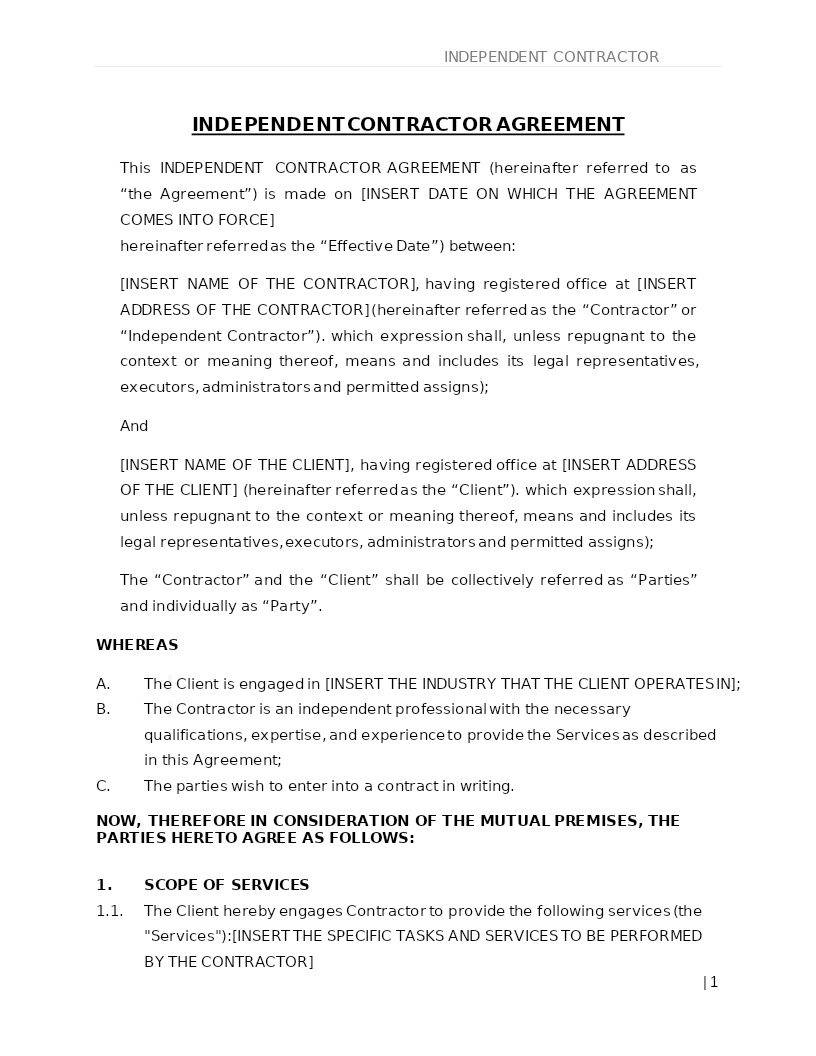
INDEPENDENT CONTRACTOR AGREEMENT
How does it work?
1. Choose this template
Start by clicking on "Fill out the template"
2. Complete the document
Answer a few questions and your document is created automatically.
3. Save - Print
Your document is ready! You will receive it in Word and PDF formats. You will be able to modify it.
Understanding Independent Contractor Agreements
An Independent Contractor Agreement is a legally binding contract between a business (the “Client”) and an individual or entity providing services as a non-employee (the “Contractor”). It outlines the scope of work, payment terms, project deadlines, confidentiality obligations, intellectual property rights, and the independent contractor relationship, ensuring the Contractor is not treated as an employee.
In the United States, Independent Contractor Agreements are governed by federal labor laws, IRS worker classification rules, state employment statutes, wage regulations, and industry compliance standards. This agreement is crucial for defining a contractor’s responsibilities and protecting businesses from misclassification issues, tax penalties, and employment-related liabilities.
Where Independent Contractor Agreements Are Commonly Used
Independent Contractor Agreements are widely used in industries that hire specialized talent, freelancers, or short-term professionals, including:
- Marketing, creative, and media services
- Freelance writing, graphic design, and content creation
- Software development, IT support, and cybersecurity
- Real estate, consulting, and professional services
- Healthcare staffing and specialized medical services
- Construction, home improvement, and technical trades
- Gig economy platforms and remote service providers
Any time a business hires a non-employee for project-based or ongoing work, this agreement sets clear expectations and legal boundaries.
Different Types of Contractor Arrangements You May Encounter
- Project-Based Contractor Agreement: Used for one-time assignments with defined deliverables and timelines.
- Ongoing Services Agreement: For contractors providing continuous support, consulting, or recurring tasks.
- Consulting Agreement: Used when hiring professional advisors or experts with specialized knowledge.
- Freelancer/Creative Contractor Agreement: Covers content creation, design services, digital marketing, and media production.
- Technical or IT Contractor Agreement: Used for software development, engineering, cybersecurity, or technical work.
When Legal Guidance Becomes Helpful
Legal review is valuable when:
- The contractor will access confidential data, trade secrets, or intellectual property
- The business wants to avoid misclassification under IRS and Department of Labor guidelines
- Payment involves commissions, milestones, or complex invoicing structures
- The agreement includes non-compete, non-solicitation, or IP assignment clauses
- The contractor is located in another state or country
- The project involves industry compliance (HIPAA, FINRA, FERPA, etc.)
- Liability, insurance, or indemnification terms must be clearly defined
Legal guidance ensures the agreement meets federal and state requirements and protects the company from unnecessary risk.
How to Work with This Template
- Identify the Client and the Independent Contractor
- Define the scope of services, timelines, and deliverables
- Specify fees, payment schedules, and invoicing procedures
- Include confidentiality, data protection, and IP ownership provisions
- Clarify that the contractor is not an employee, addressing taxes and benefits
- Choose the governing U.S. state law
- Set rules for termination, dispute resolution, and renewal
- Add insurance or liability requirements if needed
- Sign electronically or in hard copy following U.S. contract standards
This template is compatible with major U.S. e-signature platforms and follows widely accepted freelance and consulting contract practices.
Frequently Asked Questions
Q1. What is an Independent Contractor Agreement and why is it important?
Ans. An Independent Contractor Agreement defines the working relationship between a business and a non-employee service provider. It clarifies expectations, protects both parties legally, and helps ensure the contractor is properly classified for tax and labor law compliance.
Q2. How is an independent contractor different from an employee in the U.S.?
Ans. Independent contractors operate as self-employed professionals. They control how they perform the work, use their own tools, pay their own taxes, and are not entitled to employee benefits. U.S. labor laws require businesses to classify workers correctly to avoid penalties.
Q3. What should be included in an Independent Contractor Agreement?
Ans. A strong agreement includes scope of services, compensation terms, deadlines, confidentiality obligations, IP ownership, tax responsibility, liability limitations, and termination rights. These terms protect both the client and the contractor.
Q4. Can a business control how a contractor performs their work?
Ans. Only to a limited extent. Under IRS and Department of Labor standards, contractors must maintain control over how work is performed. The client may set expectations and deadlines, but the contractor decides the method, tools, and work process.
Q5. Do contractors pay their own taxes?
Ans. Yes. Independent contractors are responsible for self-employment taxes, income taxes, and business expenses. Clients typically issue a Form 1099-NEC for U.S. tax reporting when payments exceed the IRS threshold.
Q6. Who owns the work created by the contractor?
Ans. The agreement should include an Intellectual Property Assignment or “work-for-hire” clause. This ensures that all work created for the client legally belongs to the client, not the contractor. This is especially important for creative, technical, and proprietary work.
Q7. Can an Independent Contractor Agreement include confidentiality requirements?
Ans. Absolutely. Most agreements include confidentiality, non-disclosure, data protection, and sometimes non-solicitation clauses to protect sensitive business information and customer relationships.
Q8. Can the contract be terminated early?
Ans. Yes. Most agreements allow termination with notice or for specific reasons, such as breach of terms or failure to meet deadlines. Clear termination provisions help prevent disputes and protect both parties.
Q9. Are electronic signatures valid for Independent Contractor Agreements?
Ans. Yes. Under the U.S. ESIGN Act, electronic signatures are legally enforceable. Many businesses use platforms like Docu Sign or Adobe Sign to execute contractor agreements quickly and securely.
Q10. Is an Independent Contractor Agreement suitable for freelancers and small businesses?
Ans. Absolutely. Freelancers, consultants, and small businesses rely on these agreements to define professional boundaries, protect their rights, and ensure they are paid fairly. It also helps clients maintain compliance and avoid employment-related risks.