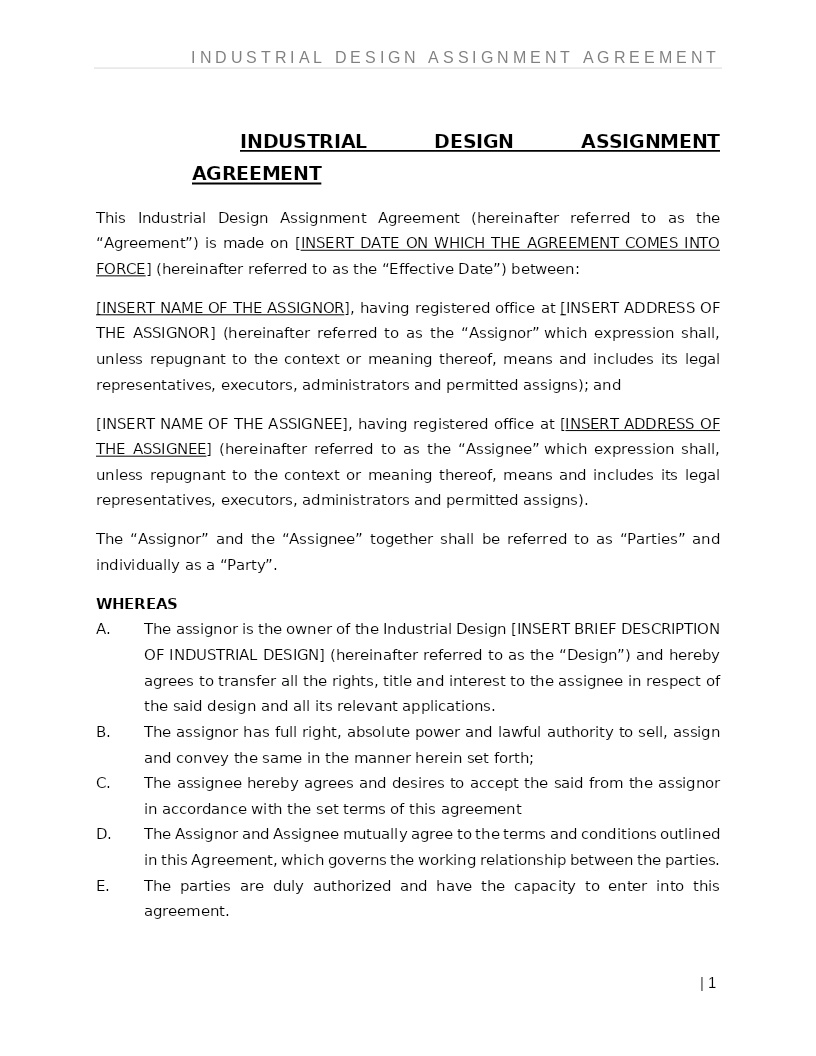
INDUSTRIAL DESIGN ASSIGNMENT AGREEMENT
How does it work?
1. Choose this template
Start by clicking on "Fill out the template"
2. Complete the document
Answer a few questions and your document is created automatically.
3. Save - Print
Your document is ready! You will receive it in Word and PDF formats. You will be able to modify it.
Securing Full Ownership and Exclusive Rights Through Industrial Design Assignment Agreements
An Industrial Design Assignment Agreement is a legally binding contract that transfers complete ownership and all associated rights of an industrial design from the original creator (assignor) to another individual or business (assignee). In the United States, this agreement is essential for protecting intellectual property (IP), ensuring the assignee gains full legal control, and enabling commercial exploitation of the design.
Industrial designs, such as product shapes, patterns, packaging aesthetics, or ornamental features, often hold significant commercial value. A well-drafted assignment agreement ensures that ownership transitions smoothly, allowing the assignee to manufacture, license, sell, enforce, or modify the design without restrictions. It also helps eliminate disputes, clarify compensation, and establish legal safeguards aligned with U.S. IP laws.
Where Industrial Design Assignment Agreements Are Commonly Used
Industrial Design Assignment Agreements are widely used across U.S. industries, including:
- Consumer product manufacturing and packaging
- Furniture, fashion, and accessory design
- Electronics, gadgets, and appliances
- Automotive and machinery components
- Industrial equipment and tools
- Medical devices and specialized hardware
- Licensing transactions and IP acquisitions
- Startups purchasing original product designs from contractors or freelancers
Any business acquiring or commercializing a design benefits from a clear and enforceable ownership transfer.
Different Types of Industrial Design Assignments You May Encounter
- Full Ownership Assignment: Transfers 100% of the rights, title, and interest in the industrial design, giving the assignee complete control for manufacturing, selling, licensing, or enforcement.
- Partial or Limited Rights Assignment: Transfers specific rights, such as the right to use or sell the design in certain markets or industries, while the assignor retains other rights.
- Assignment with Royalty or Revenue Sharing: Allows the assignor to receive ongoing royalties or profit-sharing even after transferring ownership. Common when original creators retain long-term financial interest.
- Assignment as Part of a Larger Asset or Business Sale: Occurs during mergers, acquisitions, or sale of a company’s IP portfolio. The industrial design forms part of a broader asset package.
- Assignment for Registration or Legal Enforcement: Used when a business purchases a design to register it with the U.S. Patent and Trademark Office (USPTO) or enforce it against third-party infringement.
Each type provides clarity on rights, limitations, and commercial use, ensuring compliance with U.S. IP standards.
When Legal Guidance Becomes Helpful
Industrial design transfers involve complex intellectual property considerations. Legal review becomes especially important when:
- The design is registered or pending registration with the USPTO
- The design is part of a high-value product or competitive market
- There are concerns about originality, infringement, or prior ownership
- Licensing or royalty structures must be negotiated
- The design is created by contractors, freelancers, or third-party vendors
- The assignment is tied to a larger commercial or international transaction
- Confidentiality and non-compete protections are required
Professional legal review ensures that rights are properly assigned, enforceable, and protected under U.S. IP laws.
How to Work With This Template
- Identify the assignor and assignee and confirm ownership of the design
- Specify the design being transferred with drawings or descriptions
- Clarify whether the rights assigned are full or partial
- Define compensation terms, lump sum, royalties, or hybrid models
- Include warranties on originality, ownership, and freedom from claims
- Add indemnification protections for prior infringement issues
- Outline responsibilities for USPTO filings, renewals, or registrations
- Choose governing state law and appropriate dispute mechanisms
- Sign electronically or physically, both enforceable under U.S. law
This template aligns with U.S. intellectual property practices and supports clean, enforceable design transfers.
Frequently Asked Questions
Q1. Why is an Industrial Design Assignment Agreement important in the U.S.?
This agreement ensures the assignee becomes the legal owner of the industrial design, with exclusive rights to commercialize, modify, or enforce it. It prevents disputes and provides clear evidence of ownership for registrations, licensing, and enforcement actions.
Q2. What key terms must an Industrial Design Assignment Agreement include?
Essential elements include the design description, ownership warranties, compensation details, transfer scope, indemnification, confidentiality, and filing responsibilities. These terms protect both parties and ensure a clean, lawful transfer.
Q3. Does this agreement transfer all intellectual property rights automatically?
Only if it explicitly states so. A full assignment transfers all rights, while a partial assignment limits rights to agreed uses or territories. Clear language is crucial to avoid misunderstandings.
Q4. Can an industrial design assignment include royalties or ongoing payments?
Yes. Many U.S. agreements include royalty-based compensation, allowing the original designer to benefit financially while granting full or partial rights to the buyer.
Q5. Is the assignment valid without USPTO filing?
Yes, the contract itself is legally binding. However, filing a record of assignment with the USPTO strengthens legal protection, especially for registered or pending designs.
Q6. What happens if the design is later found to infringe another product?
Most agreements include indemnification clauses requiring the assignor to cover losses arising from prior infringement or ownership disputes, protecting the assignee from unexpected liabilities.
Q7. Are electronic signatures valid for IP assignment agreements in the U.S.?
Absolutely. Under the ESIGN Act and UETA, electronic signatures are legally enforceable, making digital execution common for design and IP assignments.