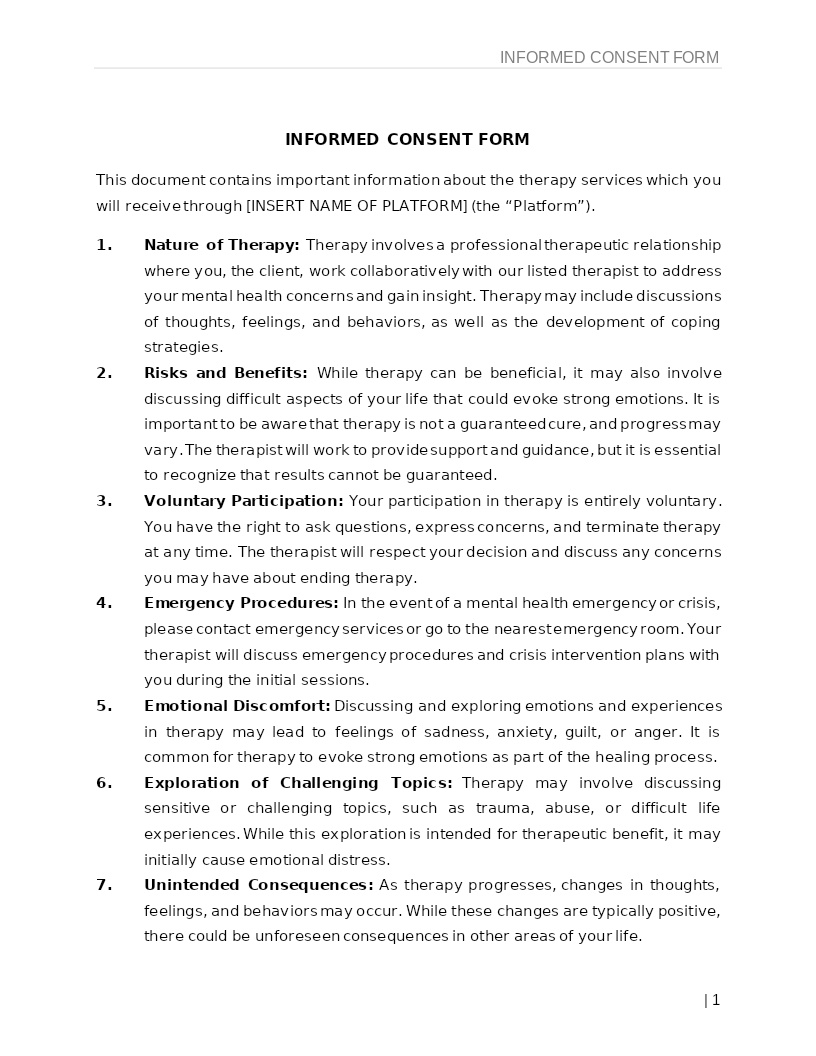
INFORMED CONSENT FORM
How does it work?
1. Choose this template
Start by clicking on "Fill out the template"
2. Complete the document
Answer a few questions and your document is created automatically.
3. Save - Print
Your document is ready! You will receive it in Word and PDF formats. You will be able to modify it.
Ensuring Transparency and Legal Compliance Through an Informed Consent Form
An Informed Consent Form is a formal document used to ensure that an individual fully understands and voluntarily agrees to participate in a procedure, service, study, or activity after being provided with all legally required information regarding risks, benefits, alternatives, confidentiality protections, and withdrawal rights. Prepared in accordance with U.S. federal and state medical-consent laws, as well as regulatory frameworks such as the Health Insurance Portability and Accountability Act (HIPAA), the Food and Drug Administration (FDA) human-subject protections, and the Common Rule (45 CFR 46) governing research involving human subjects, this form serves as an essential legal safeguard for both the participant and the organization administering the procedure or service.
A comprehensive Informed Consent Form outlines, in clear yet legally precise language, the nature and purpose of the proposed activity, including the potential risks, expected outcomes, necessary disclosures, and any alternatives available to the participant. It describes the rights of individuals to ask questions, receive additional information, refuse participation, or withdraw consent at any time without penalty. It also details privacy protections concerning personal, medical, or research data, especially when such data may be used, disclosed, or stored under federal privacy laws. By implementing this form, organizations demonstrate compliance with regulatory obligations, strengthen ethical standards, and ensure that individuals make knowledgeable, voluntary decisions regarding their participation.
Where Informed Consent Forms Are Commonly Used
Informed Consent Forms are routinely used in numerous sectors, including:
- Healthcare settings involving medical procedures, diagnostics, telehealth services, or treatment plans
- Clinical research studies regulated by FDA or institutional review boards (IRBs)
- Behavioral, psychological, and academic research involving human participants
- Educational institutions conducting surveys or observational studies
- Biotech and pharmaceutical companies running clinical trials
- Nonprofit organizations administering medical outreach or public-health interventions
- Service providers requiring consent for data collection, therapy, coaching, or risk-based activities
- Businesses offering wellness, fitness, or high-risk services
Any organization that collects personal information or involves individuals in potentially impactful activities benefits from a legally compliant Informed Consent Form.
Different Types of Informed Consent Forms
1. Medical Treatment Consent Forms: Used in hospitals, clinics, and telehealth services for procedures and treatments.
2. Research Participant Consent Forms: Required for human-subject research governed by IRBs and federal regulations.
3. Therapeutic or Counseling Consent Forms: Used in mental-health, coaching, or therapy environments.
4. Data-Collection Consent Forms: Explain how personal, biometric, or health information will be collected, used, and retained.
5. Activity or Risk-Based Consent Forms: Used for fitness programs, educational activities, or participation involving physical risk.
When Legal Guidance Becomes Helpful
Legal counsel should be consulted when:
- The activity falls under FDA or Common Rule human-subject research regulations
- The form collects or references Protected Health Information (PHI) under HIPAA
- State-specific laws impose additional consent requirements for minors or emergency treatment
- The activity involves high-risk or invasive procedures
- The organization requires waivers of liability or assumption-of-risk statements
- The business must integrate privacy notices required under state data-protection laws
- Consent must be obtained electronically under e-signature compliance rules
- Consent language involves sensitive populations, including minors, elderly individuals, or persons with limited decision-making capacity
Legal review ensures that the form satisfies U.S. regulatory, ethical, and privacy requirements while reducing liability exposure.
How to Work with This Template
- Clearly define the purpose, scope, and nature of the proposed service, treatment, or activity
- List all known and reasonably foreseeable risks, discomforts, and potential consequences
- Provide a balanced explanation of the expected benefits and possible alternative options
- Explain the voluntary nature of participation and the right to withdraw at any time
- Include a statement of confidentiality, data-protection measures, and HIPAA compliance if applicable
- Describe how questions, concerns, or complaints may be addressed
- Detail the procedures for documenting consent, including digital signatures where permitted
- Outline rights related to access, correction, or revocation of consent
- Incorporate legally required disclosures for minors, guardians, or special populations
- Update the form regularly in response to changing laws, ethical guidelines, or procedural updates
This template reflects best practices for U.S. consent documentation and ethical compliance.
Frequently Asked Questions
Q1. What is an Informed Consent Form, and why is it important?
An Informed Consent Form provides individuals with essential information needed to make an informed, voluntary decision about participating in a medical, research, or service-based activity. It protects both participants and organizations and supports legal and ethical compliance.
Q2. Is an Informed Consent Form legally required?
Yes, in many contexts. Healthcare procedures, research studies involving human subjects, and various therapeutic or data-collection activities require written informed consent under U.S. law.
Q3. What information must be included in an Informed Consent Form?
Descriptions of risks, benefits, alternatives, voluntary participation, privacy protections, data use, withdrawal rights, and the purpose of the activity.
Q4. Does an Informed Consent Form need to comply with HIPAA?
If the activity involves the use or disclosure of Protected Health Information (PHI), the form must include HIPAA-compliant language regarding privacy and data rights.
Q5. Can consent be obtained electronically?
Yes, electronic signatures are legally valid under the ESIGN Act and UETA, provided the organization meets all procedural requirements.
Q6. Are minors allowed to sign informed consent documents?
Typically, no. Most states require parental or guardian consent for minors, except in specific circumstances involving reproductive health, emergencies, or other state-defined exceptions.
Q7. Can participants withdraw consent after signing?
Yes. Participation must remain voluntary, and individuals may withdraw at any time without penalty.
Q8. Are organizations required to retain copies of consent forms?
Yes. Many federal and state regulations require long-term retention of consent records, especially in healthcare or research environments.
Q9. Does an Informed Consent Form limit an organization’s liability?
It may reduce legal risk by demonstrating informed decision-making but does not eliminate liability, especially in cases involving negligence or regulatory violations.
Q10. Should legal counsel review an Informed Consent Form?
Yes. Legal review is highly recommended to ensure compliance with federal regulations, privacy laws, and ethical standards applicable to the activity.