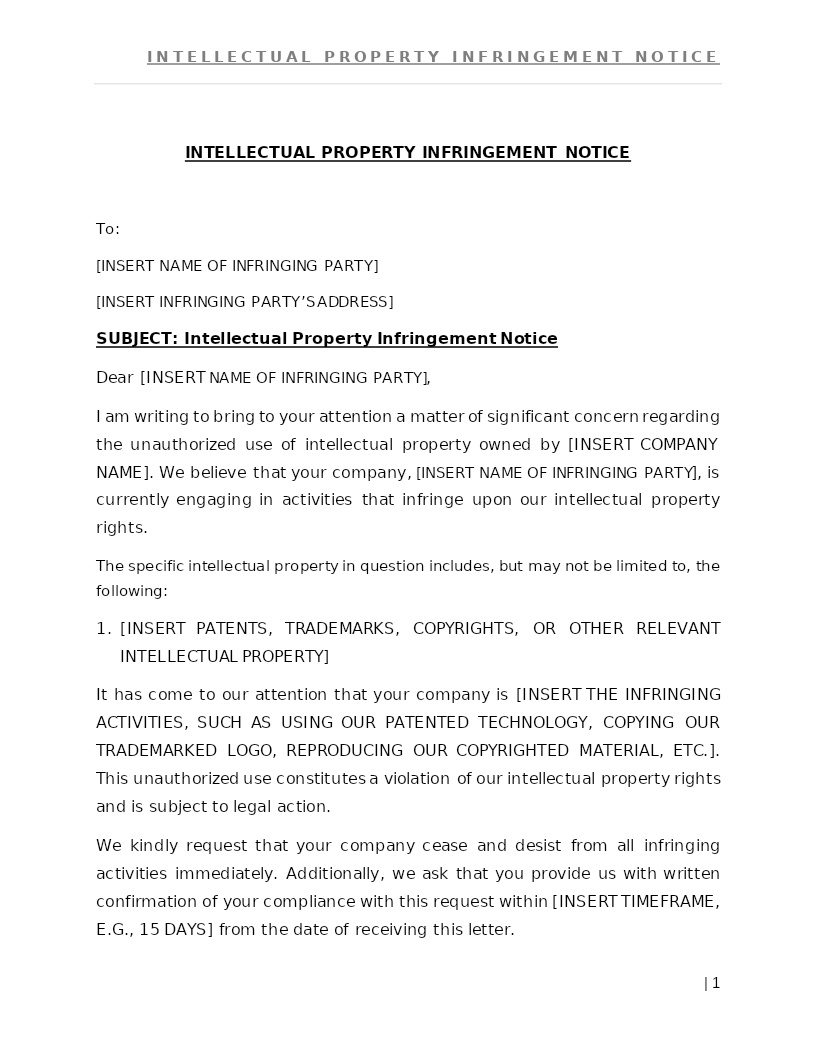
INTELLECTUAL PROPERTY INFRINGEMENT NOTICE
How does it work?
1. Choose this template
Start by clicking on "Fill out the template"
2. Complete the document
Answer a few questions and your document is created automatically.
3. Save - Print
Your document is ready! You will receive it in Word and PDF formats. You will be able to modify it.
Understanding Intellectual Property Infringement Notices
When your copyrighted work, trademark, images, content, software, brand materials, or proprietary assets are used without your permission, it becomes important to formally notify the person or entity responsible. An Intellectual Property (IP) Infringement Notice provides that structure. It outlines what rights you own, how those rights were violated, and the actions you expect the infringing party to take, such as removing the content, ceasing unauthorized use, or providing proof of licensing.
Issuing an infringement notice creates a formal record, establishes your ownership position, and gives the other party a clear chance to respond or correct the violation before legal action becomes necessary.
Where IP Infringement Notices Are Commonly Used
Infringement notices are standard in a wide range of business and online environments, including:
• Unauthorized use of copyrighted images, videos, or written content
• Trademark misuse on websites, social media, or advertising
• Unlicensed distribution of software or digital products
• Products copied or counterfeited on e-commerce platforms
• Brand impersonation or logo misuse
• Fraudulent resale or reproduction of digital art, NFTs, or media files
• Use of proprietary business materials without permission
Different Types of IP Infringement Notices You May Encounter
- Copyright Infringement Notice: Used when written work, graphics, videos, music, or digital content is copied without permission.
- Trademark Infringement Notice: Sent when someone uses your company name, logo, slogan, or branding in a confusing or misleading way.
- DMCA Takedown Notice: A specific digital copyright notice used to remove infringing online content under the U.S. Digital Millennium Copyright Act.
- Patent Infringement Notice: Alerts a company or individual that their product or technology violates a registered patent.
- Cease-and-Desist Infringement Letter: A formal demand to immediately stop unauthorized use and avoid legal escalation.
When Legal Guidance Becomes Helpful
Most routine infringements can begin with a simple notice, but legal review becomes valuable when:
• The infringement involves commercial profit, counterfeiting, or brand damage
• You need to enforce rights under the DMCA, USPTO, or Copyright Act
• Multiple jurisdictions or foreign entities are involved
• The infringing party refuses to comply after receiving notice
• The matter could escalate to a lawsuit, arbitration, or settlement
• The IP is part of a high-value asset or proprietary technology
How to Work with This Template
• Identify your intellectual property and ownership proof
• Clearly explain how and where the infringement occurred
• Specify the corrective action you expect (takedown, stop use, proof of license, etc.)
• Choose the governing state law (if applicable)
• Include deadlines for response or compliance
• Review internally or with legal counsel (optional)
• Send electronically, via mail, or through platform reporting tools
Frequently Asked Questions
Q1. What is an Intellectual Property Infringement Notice?
An IP Infringement Notice is a formal communication informing someone that they are using your copyrighted, trademarked, or proprietary material without permission. It outlines your ownership rights and requests immediate corrective action, helping you protect your brand and content.
Q2. When should I send an infringement notice?
You should send a notice as soon as you become aware of unauthorized use of your content, brand, or creative work. Acting early helps prevent further misuse, limits financial harm, and establishes a record of enforcement.
Q3. Is an infringement notice legally enforceable?
While the notice itself is not a lawsuit, it serves as a legally significant warning. It demonstrates that you asserted your rights, which can be important evidence if the issue escalates to legal action.
Q4. Do I need proof of ownership before sending a notice?
Yes. You should have documentation such as registrations, copyrights, trademarks, timestamps, contracts, or original files that confirm you own the intellectual property being misused.
Q5. What happens if the infringing party ignores the notice?
If they do not comply, you may send additional notices, file a DMCA takedown, contact hosting providers or platforms, or seek legal remedies such as cease-and-desist letters, settlement negotiations, or litigation.
Q6. Can an IP Infringement Notice be sent for online content?
Absolutely. Online misuse such as copying text or images, brand impersonation, or reposting media is one of the most common reasons for sending an infringement notice, especially under the DMCA.
Q7. Is an attorney required to send the notice?
No. Anyone can issue an infringement notice. However, having an attorney draft or review it may make the notice more authoritative and ensure the claims are legally sound.
Q8. Can a notice stop someone from using my trademark or brand name?
Yes. Trademark infringement notices demand immediate cessation of unauthorized brand use and help prevent consumer confusion, brand dilution, and reputational harm.
Q9. What should I include in the notice for it to be effective?
Include a detailed description of the IP, evidence of ownership, specific examples of the infringement, requested actions, deadlines, and your contact information. Clarity increases compliance rates.
Q10. Can I send an infringement notice internationally?
Yes. IP rights can be enforced across borders, but procedures vary by country. When dealing with international infringement, referencing treaties like the Berne Convention can strengthen your claim.