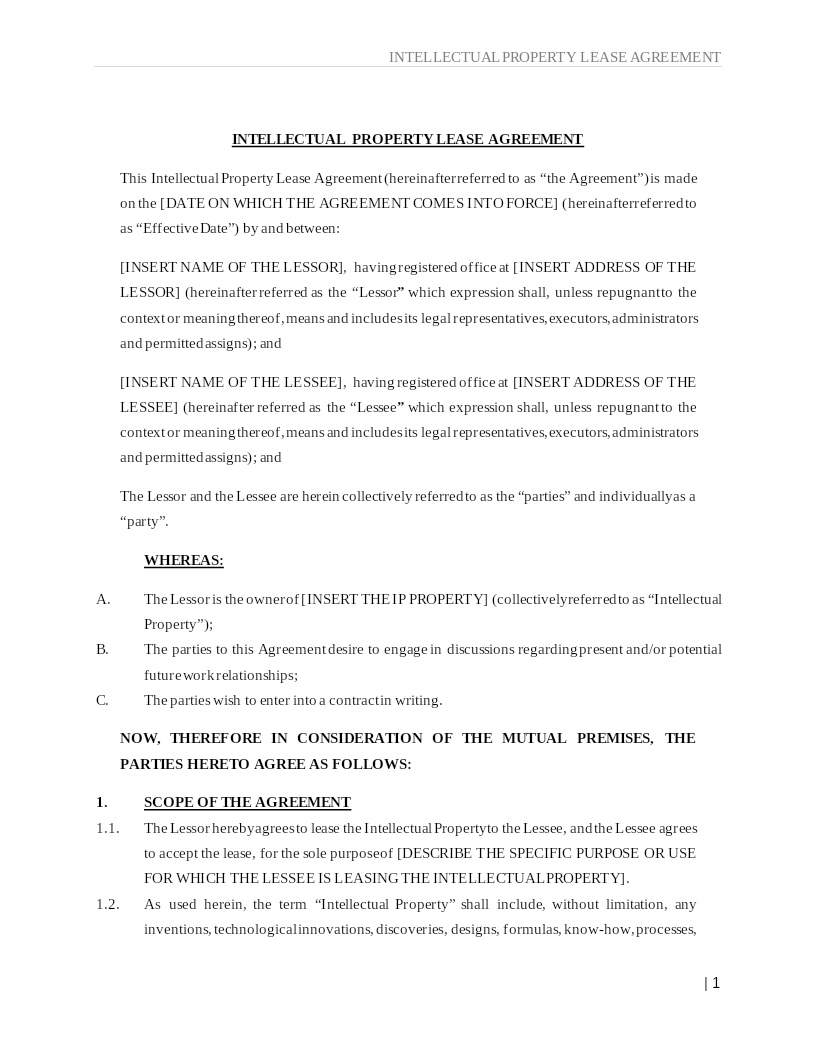
INTELLECTUAL PROPERTY LEASE AGREEMENT
How does it work?
1. Choose this template
Start by clicking on "Fill out the template"
2. Complete the document
Answer a few questions and your document is created automatically.
3. Save - Print
Your document is ready! You will receive it in Word and PDF formats. You will be able to modify it.
Protecting Licensed Intellectual Property in Commercial Arrangements
When businesses license or lease intellectual property such as technologies, trademarks, artistic works, or proprietary systems, they must ensure that the rights granted are clearly defined and legally protected. An Intellectual Property (IP) Lease Agreement provides this structure. It outlines the scope of permitted use, ownership status, restrictions, confidentiality requirements, and financial terms governing the temporary use of IP.
Putting an IP Lease Agreement in place creates clarity and trust, enabling both parties to engage confidently without concerns about misuse, unauthorized distribution, or infringement.
Where IP Lease Agreements Are Commonly Used
IP leasing is standard across various industries and commercial scenarios, including:
- Licensing proprietary software, algorithms, or patented technologies
- Granting temporary rights to trademarks or brand collateral
- Leasing copyrights for creative works, digital content, or media productions
- Allowing third parties to use design assets, manufacturing methods, or trade secrets
- Collaboration agreements requiring shared access to proprietary tools
- Franchise operations needing brand and process usage rights
Whenever intellectual property is shared outside the owner’s environment, an IP Lease Agreement sets clear boundaries governing how the IP may be used.
Different Types of IP Lease Agreements You May Encounter
- Technology or Patent Lease: Used when a business grants temporary rights to use patented inventions, software, or proprietary tools.
- Trademark or Brand Asset Lease: Allows a licensee to use logos, brand names, and marketing assets for approved purposes.
- Copyright Lease: Applicable for creative works, digital assets, publications, or audiovisual content.
- Process or Methodology Lease: Used when proprietary systems, methods, or operational frameworks are licensed for limited use.
When Legal Guidance Becomes Helpful
While simple leases can be drafted from standard templates, legal assistance is particularly valuable when:
- High-value or sensitive intellectual property is involved
- The IP spans multiple jurisdictions or regulatory environments
- Revenue-sharing, royalties, or sublicensing rights are included
- The IP is central to a partnership, joint venture, or commercial expansion
- The agreement must incorporate non-solicitation, non-compete, or advanced confidentiality terms
Legal review helps ensure protection, compliance, and enforceability, especially when complex IP rights or multi-party arrangements are involved.
How to Work with This Template
- Identify the IP being leased and the purpose of its use
- Define permitted usage, restrictions, and geographic limitations
- Specify fees, royalties, and payment schedules
- Select governing law and dispute resolution terms
- Set terms for confidentiality and data protection
- Outline duration, renewal, and termination rights
- Sign electronically or in hard copy
Frequently Asked Questions
Q1. Why is an Intellectual Property Lease Agreement important?
An IP Lease Agreement ensures that the owner retains full ownership while granting limited rights for specific purposes. It establishes boundaries on what the lessee can and cannot do with the IP, preventing misuse or unauthorized replication. This protects valuable proprietary assets and ensures compliance with applicable laws. It also creates a legally enforceable framework that supports smooth business relationships.
Q2. What types of intellectual property can be leased under this agreement?
This agreement can cover patents, copyrights, trademarks, trade secrets, proprietary software, digital content, branding assets, algorithms, and even business methods. It allows creators and companies to monetize their IP without transferring ownership. Each asset type can have customized usage restrictions and permissions. Leasing IP ensures both flexibility and protection. It is widely used across technology, entertainment, manufacturing, and creative industries.
Q3. How does the agreement define and limit usage rights?
The document clearly outlines how the lessee may use the IP, including geographic restrictions, permitted applications, and any limitations on modification or sublicensing. These boundaries prevent confusion and protect the owner's interests. The agreement also details prohibited actions to ensure safe handling of the property. Having defined usage rights helps avoid disputes and strengthens enforceability. It also ensures the IP is used only for the intended business purpose.
Q4. Are confidentiality requirements included in the IP Lease Agreement?
Yes, confidentiality provisions play a critical role in protecting proprietary information, trade secrets, and sensitive materials associated with the IP. These clauses restrict disclosure to unauthorized parties and require secure handling of all related data. Confidentiality terms also continue beyond the agreement’s expiration in many cases. This safeguards long-term interests of the IP owner. Strict confidentiality strengthens trust and minimizes risks of infringement.
Q5. How are payment terms and royalties handled?
The agreement specifies lease fees, royalty structures, periodic payments, and any revenue-sharing arrangements tied to the use of the IP. These terms ensure transparency and predictable financial obligations for both parties. Including detailed payment terms prevents billing disputes or unexpected charges. It also enables accurate financial planning and compliance. Clear monetary terms strengthen the commercial viability of the IP arrangement.
Q6. What happens when the lease period ends?
Upon expiration, the lessee must cease all usage of the IP unless the agreement is renewed or extended. The document usually requires return or deletion of IP-related materials, ensuring continued ownership protection. Expiration terms help prevent unauthorized long-term use. They also provide a clean transition that supports business continuity. Many agreements include renewal options to maintain ongoing access.
Q7. Can the agreement include liability and risk allocation provisions?
Yes, liability clauses outline each party’s responsibilities regarding misuse, infringement claims, or damages. These provisions help prevent unexpected exposure and financial risks. They also clarify which actions fall outside the owner's control. Risk allocation creates a fair balance between the parties. It strengthens the overall enforceability and security of the leasing arrangement.
Q8. What if disputes arise regarding IP usage or payments?
The agreement typically includes mediation, arbitration, or jurisdiction-specific litigation procedures. These pre-defined mechanisms ensure conflicts are handled professionally and efficiently. Having structured dispute resolution prevents escalation and reduces legal costs. It also promotes faster resolution and continuity of business operations. Clear processes help maintain positive working relationships even when disagreements occur.