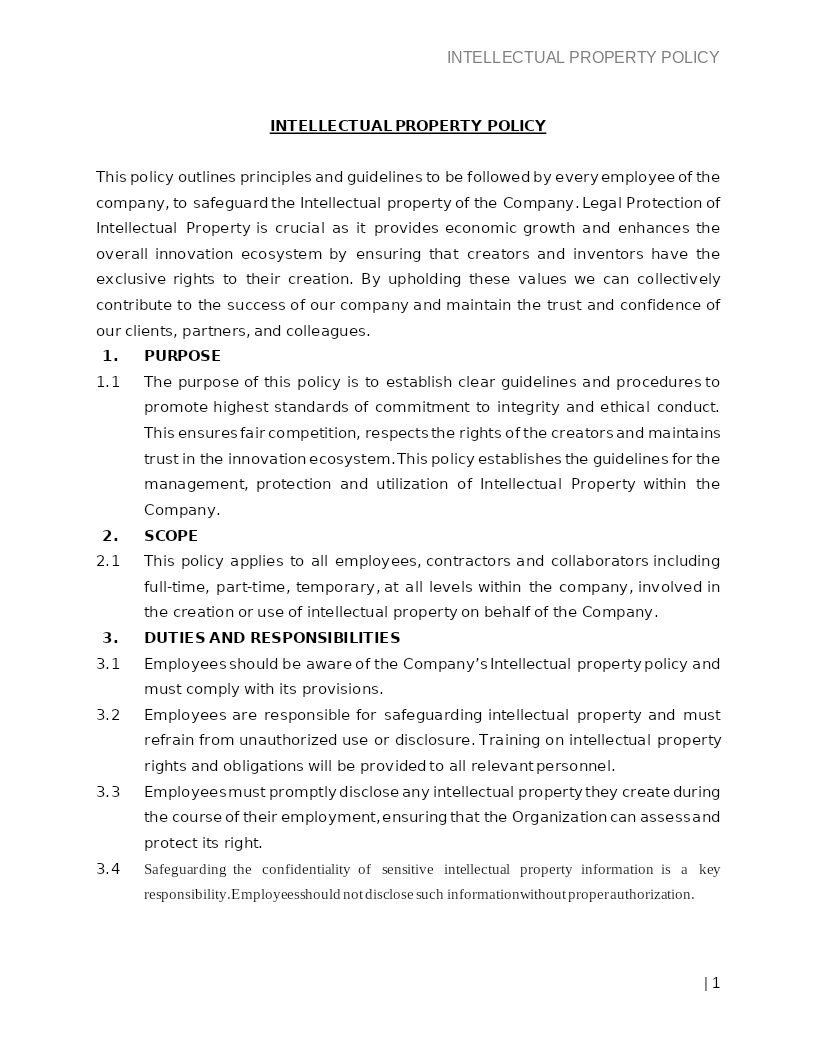
INTELLECTUAL PROPERTY POLICY
How does it work?
1. Choose this template
Start by clicking on "Fill out the template"
2. Complete the document
Answer a few questions and your document is created automatically.
3. Save - Print
Your document is ready! You will receive it in Word and PDF formats. You will be able to modify it.
Protecting Intellectual Property in Modern Business Operations
Intellectual property plays a central role in shaping competitive advantage, driving innovation, and defining a company’s unique identity. Whether a business is developing new products, creating original content, designing software, or managing proprietary information, it needs a clear framework that governs how such intellectual assets are created, owned, used, and protected. An Intellectual Property Policy provides that structure. It outlines what qualifies as IP, explains how ownership is determined, and sets rules for responsible use and disclosure both inside and outside the organization.
Implementing an IP Policy builds trust within teams, encourages innovation, safeguards creative assets, and ensures that intellectual property is managed in compliance with U.S. laws and industry standards. It allows organizations to operate confidently in environments where creativity, knowledge, and technology drive growth.
Where Intellectual Property Policies Are Commonly Used
Intellectual property policies apply across a wide variety of industries—especially those that create, handle, or commercialize original work. Common use cases include:
- Technology development, software engineering, and product design
- Research institutions, laboratories, and innovation-driven enterprises
- Creative fields such as marketing, writing, design, and media production
- Businesses protecting brand identity through trademarks and copyrights
- Manufacturing and engineering roles involving proprietary processes
- Organizations managing trade secrets, confidential formulas, or algorithms
Any time an individual produces work that contributes to the organization’s intellectual value, an IP Policy defines the boundaries of ownership and responsible use.
Different Types of Intellectual Property Rules You May Encounter
- Employee-Created IP Rules: These guidelines define how intellectual property created by employees, during work hours, using company resources, or as part of their job duties, is owned and managed by the organization.
- Third-Party and Collaborative IP Rules: These apply when the company works with contractors, vendors, or partners. They outline rights, licensing terms, and usage limitations for IP created jointly or accessed during collaboration.
- Branding, Trademarks & Copyright Standards: These rules govern how the organization’s brand assets, marketing materials, digital content, logos, and proprietary documents may be used internally and externally.
- Patent, Trade Secret & Innovation Management Standards: These cover inventions, proprietary processes, confidential formulas, and other innovations. They specify how discoveries are documented, disclosed, and protected.
- IP Usage, Licensing & Permission Requirements: These rules define when employees, contractors, or partners may use company IP, and under what conditions approval must be obtained. They also address open-source software use and licensing compliance.
When Legal Guidance Becomes Helpful
Legal review is particularly valuable when intellectual property is central to the organization’s value, revenue, or competitive differentiation. Attorneys help clarify ownership in employee-created works, structure IP licensing terms, and draft enforceable protection clauses.
Legal advice is also critical when dealing with multi-jurisdictional operations, collaborations involving shared IP, invention assignments, or potential infringement risks. When patents, trademarks, copyrights, or trade secrets are involved, legal input ensures full compliance with U.S. federal and state IP laws, reducing exposure to costly disputes.
How to Work with This Template
- Identify who owns IP created during employment or contractual work
- Specify what types of intellectual property the policy covers
- Define usage rules, approval requirements, and licensing rights
- Clarify how trade secrets and confidential information must be protected
- Set procedures for invention disclosure and documentation
- Select governing law for resolving disputes
- Review policy terms internally and with legal counsel
- Sign electronically or in hard copy during onboarding or contracting
The template follows widely accepted U.S. intellectual property management standards and is compatible with major e-signature platforms.
Frequently Asked Questions
Q1. What types of intellectual property are covered under this policy?
This policy covers all forms of intellectual property created or used within the organization, including copyrights, trademarks, patents, trade secrets, proprietary data, software code, creative content, and product designs. It also applies to innovations developed by employees, contractors, or partners while working with the company. The goal is to protect both registered and unregistered IP across all business operations.
Q2. Who owns the intellectual property created by employees?
Generally, IP created by employees within the scope of employment, using company resources, or relating to company operations belongs to the organization. This policy clarifies ownership to avoid disputes and ensure proper rights assignment. It also explains exceptions, such as personal projects created outside work hours without use of company tools. Clear definitions reduce confusion and protect business interests.
Q3. How does the policy protect the company’s trade secrets and proprietary information?
The policy identifies which information is considered confidential or protected and establishes strict rules for handling, storing, and sharing such materials. Employees must follow security protocols to prevent unauthorized access or disclosure. It also outlines consequences for breaches, ensuring that sensitive business knowledge remains secure. This helps maintain competitive advantage and reduces legal risk.
Q4. Can employees use company IP for personal projects or external work?
No, unless explicit written permission is granted. Unauthorized use of company IP can lead to legal liability, loss of competitive value, or brand inconsistency. The policy explains when approval is necessary and how to request access for limited or licensed use. It ensures that intellectual property is used responsibly and only in ways that align with business objectives.
Q5. Does the policy apply to contractors and third-party collaborators?
Yes. Contractors, freelancers, and external partners often access or create IP during engagements, and this policy ensures their rights and obligations are clearly defined. It specifies ownership boundaries, licensing terms, and protection requirements for shared or co-created work. This reduces disputes and ensures consistent IP practices across all relationships.
Q6. How are inventions or new ideas disclosed under this policy?
Employees must document and report inventions or innovations using the company’s designated disclosure procedures. This ensures that new ideas are properly reviewed, recorded, and evaluated for potential patent filings or trade secret protection. The policy also describes how decisions are made regarding commercialization or internal use. Proper documentation preserves legal rights and prevents ownership conflicts.
Q7. What happens if someone violates the Intellectual Property Policy?
Violations may lead to disciplinary action, termination, and potential legal consequences depending on the severity of the breach. Unauthorized disclosure, misuse, or theft of IP can result in financial damages or injunctive relief. The policy outlines reporting mechanisms so issues can be addressed promptly. This ensures a strong deterrent and reinforces responsible practices.
Q8. How often should this policy be reviewed or updated?
At minimum, the policy should be reviewed annually or whenever major legal, technological, or business changes occur. Intellectual property laws evolve, and new innovations may require updated protection measures. Regular reviews help maintain compliance and ensure the policy remains relevant to organizational needs. This keeps the company’s IP framework effective and up to date.