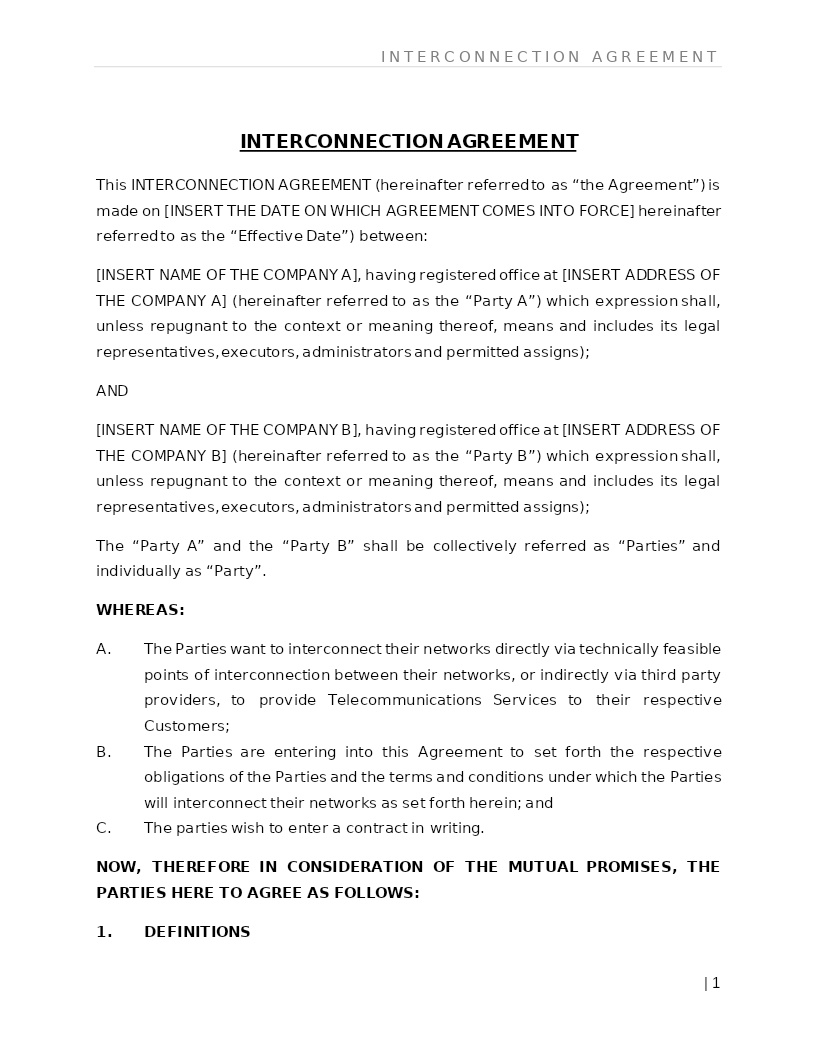
INTERCONNECTION AGREEMENT
How does it work?
1. Choose this template
Start by clicking on "Fill out the template"
2. Complete the document
Answer a few questions and your document is created automatically.
3. Save - Print
Your document is ready! You will receive it in Word and PDF formats. You will be able to modify it.
Ensuring Seamless Network Connectivity Through Interconnection Agreements
When two or more telecommunications providers exchange traffic, connect networks, or share infrastructure, an Interconnection Agreement establishes the rules that make these connections work smoothly. It defines how networks will link, how traffic will be routed, what technical standards must be followed, and how costs and responsibilities will be shared.
An Interconnection Agreement creates a transparent framework that allows carriers, ISPs, VoIP providers, and other telecom operators to cooperate efficiently. By putting this agreement in place, service providers can ensure stable, uninterrupted communication for end-users across different networks, reduce operational disputes, and maintain compliance with U.S. telecom regulations.
Where Interconnection Agreements Are Commonly Used
Interconnection Agreements are essential in a wide range of U.S. telecommunications scenarios, including:
- Local exchange carriers (LECs) connecting with wireless or VoIP networks
- Internet service providers exchanging data traffic
- Long-distance carriers linking with regional networks
- Cable operators interconnecting with telecom carriers
- Mobile carriers connecting with fixed-line providers
- Voice, SMS, and data traffic exchange between telecom companies
- Emergency service routing (E911) and public safety system connections
- Peering arrangements between ISPs and data service operators
Any time networks must interoperate, transport traffic, or provide mutual access, an Interconnection Agreement sets reliable standards for performance and accountability.
Different Types of Interconnection Agreements You May Encounter
- Voice Interconnection Agreement: For exchanging voice traffic (PSTN, VoIP, SIP trunks) between networks.
- Data/Internet Peering Agreement:Used between ISPs or carriers to exchange data traffic directly (peering or transit).
- SMS and Messaging Interconnection Agreement: Covers routing, delivery, filtering, and fees for text and messaging services.
- Network Access or UNE Agreements: Allows a carrier to access another’s network elements under FCC rules.
- Roaming Interconnection Agreement: Enables mobile users to connect when traveling outside their home network.
- Infrastructure Sharing Agreement: Covers co-location, fiber interconnection, and shared equipment facilities.
Each type establishes mutual responsibilities and ensures smooth, uninterrupted communication across networks.
When Legal Guidance Becomes Helpful
Telecom interconnection involves complex technical and regulatory elements, making legal review valuable when:
- Multiple carriers or cross-border providers are involved
- Interconnection must comply with FCC and state utility commission rules
- Critical services like E911 or emergency routing are affected
- The agreement includes traffic-based fees, revenue sharing, or settlement charges
- Network interoperability involves sensitive data or security protocols
- High volumes of traffic or essential service obligations are at stake
- Disputes may arise over congestion, outages, misuse, or quality of service
- Interconnection impacts competitive market positioning or customer experience
Legal guidance helps ensure the agreement is compliant, enforceable, and aligned with U.S. regulatory requirements.
How to Work With This Template
- Identify the providers entering into the interconnection arrangement
- Define the purpose of the interconnection (voice, data, messaging, peering, etc.)
- Specify the technical standards, network interfaces, and testing requirements
- Outline traffic handling rules, QoS expectations, and performance benchmarks
- Define pricing, settlement charges, and billing procedures
- Choose the governing state law and regulatory framework
- Review the terms together or with counsel (recommended for telecom matters)
- Execute via electronic signatures or hard copy
This template follows widely accepted U.S. telecommunications contracting practices and is compatible with standard e-signature platforms.
Frequently Asked Questions
Q1. Is an Interconnection Agreement necessary for carriers to exchange traffic?
Yes. An Interconnection Agreement is essential because it ensures that two networks can exchange voice, data, or messaging traffic reliably and securely. It sets all the technical, commercial, and operational rules required for seamless communication between different service providers.
Q2. Can the same Interconnection Agreement be reused for multiple carriers or new routes?
Yes, but it must be updated to reflect new network connections, traffic types, capacity requirements, pricing, and technical standards. Customizing each agreement ensures compliance and reduces the risk of disputes.
Q3. What happens if network errors, call drops, or routing issues arise between carriers?
The agreement specifies how performance issues are handled, who investigates outages, and how responsibilities are allocated. It includes detailed procedures for incident reporting, fault isolation, and service restoration to minimize customer impact.
Q4. Are electronic signatures valid for Interconnection Agreements in the U.S.?
Yes. Under the ESIGN Act and state laws, electronically signed interconnection contracts are fully enforceable. Most telecom carriers use e-signatures for faster execution.
Q5. Does this agreement cover congestion, peak traffic, or quality-of-service issues?
Yes. Interconnection Agreements typically include traffic management rules, capacity planning requirements, and quality-of-service benchmarks. These provisions help prevent congestion and ensure consistent service across networks.
Q6. Can this agreement support interstate or cross-border interconnection?
Yes. Interconnection Agreements often cover interstate traffic and may extend to international carriers. However, they must comply with FCC regulations, state utility rules, and applicable international telecom standards.
Q7. What type of fees or charges does an Interconnection Agreement usually include?
Common financial terms include termination charges, transit fees, port charges, bandwidth or capacity costs, and revenue-sharing arrangements. Clear financial terms help prevent billing disputes and ensure transparent settlements.
Q8. Can providers use third-party carriers or intermediaries for interconnection?
Yes, if the agreement allows it. The contract should specify when third-party use is permitted, who is liable for technical failures, and how compliance is maintained when subcontracted networks are involved.