INTERNAL CONTROL POLICY
How does it work?
1. Choose this template
Start by clicking on "Fill out the template"
2. Complete the document
Answer a few questions and your document is created automatically.
3. Save - Print
Your document is ready! You will receive it in Word and PDF formats. You will be able to modify it.
Ensuring Organizational Integrity Through Structured Internal Controls
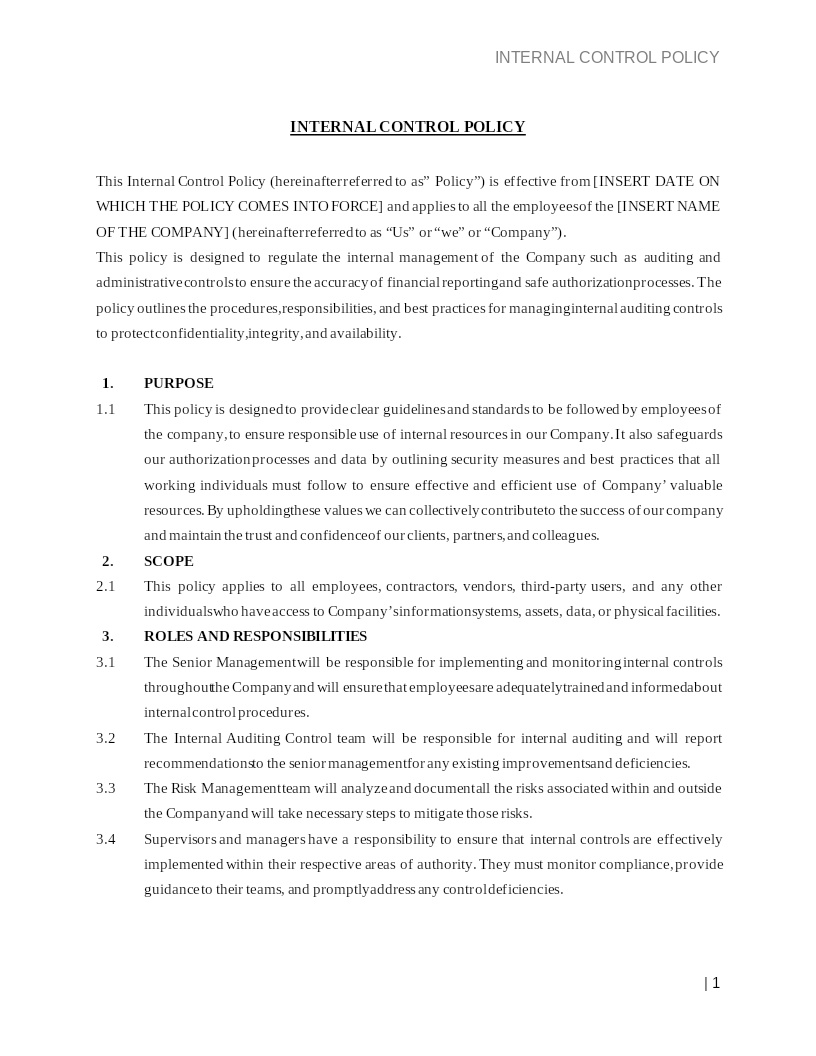
When an organization manages financial data, operational workflows, and business assets, it becomes essential to implement a structured framework that governs accuracy, transparency, and accountability. An Internal Control Policy provides this structure. It defines the mechanisms, procedures, and checks that ensure data reliability, prevent fraud, and maintain the overall integrity of business operations.
Implementing an Internal Control Policy builds trust across the organization and with external stakeholders by creating consistent measures that protect assets, support compliance, and foster ethical conduct.
Where Internal Control Policies Are Commonly Used
Internal control frameworks are widely implemented across various sectors, including:
- Corporate finance, accounting, and audit environments
- Public companies subject to SOX compliance
- Healthcare, banking, and other regulated industries
- IT departments managing access controls and digital resources
- Government agencies and nonprofit entities
- Organizations performing inventory, procurement, or cash-handling operations
Any time financial reporting, operational integrity, or compliance obligations exist, a structured internal control policy becomes essential.
Different Types of Internal Controls You May Encounter
- Preventive Controls: Designed to stop errors or fraud before they occur—such as segregation of duties, authorization protocols, access controls, and system restrictions.
- Detective Controls: Identify issues after they happen through reconciliations, audits, exception reports, and monitoring tools.
- Corrective Controls: Address errors that have been identified, helping restore accuracy and prevent recurrence.
- Operational Controls: Support efficiency through standardized procedures, workflow automation, and performance monitoring.
- Compliance Controls: Ensure adherence to federal and state regulations, industry standards, and internal policies.
When Legal or Professional Guidance Becomes Helpful
Though many internal controls can be designed internally, expert guidance becomes essential when:
- The company operates in highly regulated sectors (finance, healthcare, government contracting)
- You need structured compliance with SOX, GAAP, HIPAA, GLBA, or state transparency laws
- Multiple entities, jurisdictions, or cross-border transactions are involved
- You require conflict-of-interest procedures or fraud-prevention mechanisms
- The organization experiences rapid growth or restructuring
- New technology systems require integrated access and accuracy controls
Professional or legal review ensures your policy aligns with U.S. regulatory requirements and supports a strong governance environment.
How to Work with This Template
- Identify key financial, operational, and compliance risk areas
- Establish preventive, detective, and corrective mechanisms
- Assign responsibilities and segregation of duties
- Determine the reporting and escalation structure
- Implement documentation and record-keeping requirements
- Review controls with internal auditors or compliance teams
- Update controls periodically as operations evolve
This approach aligns with widely recognized U.S. standards for corporate governance and internal audit practices.
Frequently Asked Questions
Q1. Why is an Internal Control Policy essential for U.S. organizations?
An Internal Control Policy protects an organization’s assets, supports accurate financial reporting, and strengthens governance practices. U.S. businesses face complex regulatory obligations, making structured controls essential for transparency and accountability. This policy helps reduce fraud risks, ensures compliance, and promotes confidence among investors, employees, and regulatory bodies.
Q2. Does an Internal Control Policy help prevent fraud and misconduct?
Yes. Internal controls include segregation of duties, authorization protocols, audits, and monitoring systems that deter fraudulent activities. These measures make it difficult for any single individual to manipulate financial records or misuse assets. By detecting irregularities early, organizations can prevent losses and maintain a culture of ethical conduct.
Q3. How does this policy support accurate financial reporting?
Accuracy in financial reporting is one of the main goals of internal controls. Reconciliations, automated system checks, audit trails, and review procedures help ensure that all financial data is valid and complete. This reduces accounting errors, supports compliance with GAAP, and provides reliable information for management and investors.
Q4. Are internal controls required under U.S. regulations?
Many industries require internal controls by law. Public companies must comply with SOX Section 404, which mandates internal controls over financial reporting. Highly regulated sectors such as banking, insurance, and healthcare must also maintain documented controls. Even organizations not legally required to do so adopt internal controls to strengthen risk management and operational reliability.
Q5. Who is responsible for enforcing an Internal Control Policy?
Responsibility typically lies with management, internal auditors, compliance teams, and department leaders. The policy defines clear roles to ensure accountability at every level. Senior leadership is responsible for establishing a supportive control environment, while employees must follow established procedures and report inconsistencies.
Q6. Can internal controls improve operational efficiency?
Absolutely. Internal controls streamline processes, reduce redundancies, and eliminate bottlenecks in financial and operational workflows. Automation tools further improve consistency and reduce human error. As a result, organizations experience faster decision-making, better resource utilization, and overall efficiency improvements.
Q7. How often should internal controls be reviewed or updated?
Review frequency depends on organizational changes, regulatory requirements, and the level of risk. Many U.S. organizations conduct quarterly assessments, while others do annual internal audits. Regular reviews ensure that controls remain effective as technology, business operations, and regulatory landscapes evolve.
Q8. Does an Internal Control Policy apply to digital systems and IT environments?
Yes. Modern internal controls include IT governance measures such as access restrictions, password policies, encryption standards, and system audit logs. These safeguards ensure that sensitive data, financial records, and digital assets remain secure and protected from unauthorized access or cyber threats.