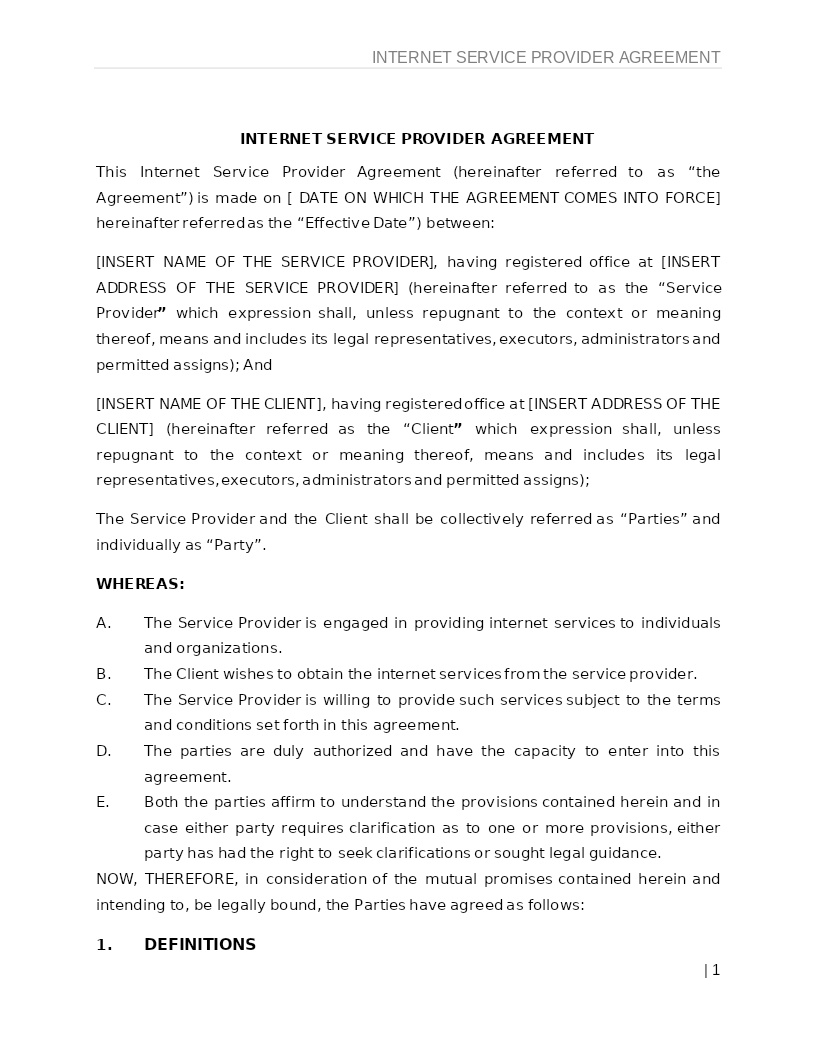
INTERNET SERVICE PROVIDER AGREEMENT
How does it work?
1. Choose this template
Start by clicking on "Fill out the template"
2. Complete the document
Answer a few questions and your document is created automatically.
3. Save - Print
Your document is ready! You will receive it in Word and PDF formats. You will be able to modify it.
Establishing Clear, Reliable, and Legally Sound Terms for Internet Services
When customers rely on an internet connection for business operations, communication, entertainment, or daily tasks, it becomes essential to have a clear framework that governs how those services will be delivered. An Internet Service Provider (ISP) Agreement offers that structure. It defines the services being provided, sets performance expectations, outlines customer responsibilities, and clarifies how issues like interruptions, security, or billing will be handled.
Having an Internet Service Provider Agreement in place builds trust between the Internet Service Provider and the customer, promotes transparency, and ensures that both parties clearly understand the terms under which internet access and related services are provided.
Where Internet Service Provider Agreements Are Commonly Used
Internet service contracts are standard across a wide range of residential, commercial, and enterprise environments, including:
- Homes, apartments, and residential complexes
- Businesses, startups, and corporate offices
- Schools, universities, and educational institutions
- Data centers, server facilities, and IT infrastructure environments
- Hospitality, retail, and customer-facing operations
- Public Wi-Fi systems, co-working spaces, and managed networks
- Cloud-based platforms, enterprise applications, and remote work systems
Any time an Internet Service Provider provides connectivity, bandwidth, or network-related features, an Internet Service Provider Agreement ensures clarity and consistency.
Different Types of Internet Service Provider Agreements You May Encounter
- Residential Internet Service Agreements: Designed for home users, covering bandwidth, data limits, installation, and equipment use.
- Business Internet Service Agreements: Provide advanced features such as static IPs, higher bandwidth, uptime commitments, and faster support.
- Managed Service Agreements: Include monitoring, cybersecurity protections, cloud storage, and hosted services.
- Dedicated or Leased Line Agreements: Offer dedicated bandwidth for mission-critical operations requiring guaranteed high-speed connectivity.
- Fair Use or Acceptable Use Policies: Define permissible and prohibited internet activity to protect network operations.
When Legal or Professional Guidance Becomes Helpful
While many Internet Service Provider Agreements are straightforward, legal advice can be important when:
- The service involves business-critical systems or enterprise-level uptime guarantees
- Data protection laws (such as CCPA or GDPR) apply to customer information
- The ISP provides cloud storage, hosting, or cybersecurity tools
- The agreement includes service credits, performance penalties, or complex SLAs
- Services span multiple jurisdictions or involve cross-border data transfers
- Installation involves property access, wiring changes, or regulated equipment
- The contract includes liability limitations or contentious termination rules
Legal review strengthens the agreement’s effectiveness and protects both parties.
How to Work with This Template
- Identify the parties receiving and providing internet services
- Clearly specify the service plan, bandwidth, equipment, and support levels
- Set payment terms, billing frequency, and penalties for late fees
- Define privacy protections, data security measures, and acceptable use rules
- Outline maintenance schedules, planned outages, and support procedures
- Choose governing state law and include dispute resolution processes
- Review the contract jointly and sign electronically or in hard copy
This framework follows widely recognized Internet Service Provider service standards in the United States.
Frequently Asked Questions
Q1. Why is an Internet Service Provider Agreement important for customers and ISPs?
An Internet Service Provider Agreement creates transparency by clearly defining the services offered, speeds, data limits, and support expectations. It protects both parties from misunderstandings and provides a legal foundation for addressing performance issues or disputes. Customers benefit from knowing what service level they can expect. ISPs benefit from having clear rules around billing, usage, and liability limitations. The agreement promotes a stable and reliable service relationship.
Q2. What types of services are usually included in an Internet Service Provider Agreement?
Services may include broadband internet access, installation, modem or router rental, email hosting, network security tools, and cloud-based features. The agreement outlines all included services so customers know exactly what they are paying for. Additional services may be offered at added cost. This clarity helps prevent disputes and allows customers to evaluate service quality. It also ensures alignment between customer needs and Internet Service Provider capabilities.
Q3. How do Internet Service Provider handle service interruptions or outages under this agreement?
Most Internet Service Provider Agreements include service level commitments describing expected uptime and response times during outages. They often provide procedures for reporting issues and timelines for resolution. Some agreements may include service credits for prolonged interruptions. Clear outage policies help customers understand their options and rights. They also ensure ISPs maintain accountability and professional service standards.
Q4. Does the agreement protect customer data and privacy?
Yes, Internet Service Provider Agreements typically include confidentiality clauses and comply with data protection laws like CCPA, GDPR, or state privacy statutes. These provisions ensure customer data is handled securely and not shared without authorization. ISPs must follow strict protocols to prevent unauthorized access, breaches, or misuse. Strong privacy terms promote customer trust. They also help ISPs maintain compliance with legal and industry standards.
Q5. Who owns the equipment provided under the Internet Service Provider Agreement?
Many Internet Service Providers retain ownership of routers, modems, and other hardware they provide, and customers agree to return the equipment at termination. The agreement details maintenance responsibilities and replacement rules. Customers may also have the option to purchase equipment separately. Understanding ownership prevents conflicts at the end of the service period. Clear terms ensure smooth installation, use, and return of equipment.
Q6. How does the agreement address acceptable and prohibited uses of the service?
The agreement includes an Acceptable Use Policy (AUP) that outlines permitted activities and prohibits misuse such as illegal downloading, spamming, or network attacks. These rules protect the integrity of the ISP’s network and reduce legal risks. Customers are responsible for ensuring compliant use by all household or business users. Clear guidelines prevent misuse and increase overall service quality. They also help ISPs enforce network safety protocols.
Q7. What happens if a customer fails to pay on time?
Most Internet Service Provider Agreements include late fees, service suspension terms, and timelines for reactivation after payment. Non-payment may eventually lead to termination of the agreement. These provisions encourage timely billing and protect the Internet Service Provider from financial losses. Customers benefit from knowing the exact consequences of missed payments. Clear billing rules minimize confusion and strengthen accountability.
Q8. Can the Internet Service Provider terminate or suspend service under certain conditions?
Yes. Internet Service Providers may suspend service for non-payment, policy violations, equipment misuse, or security threats. Termination provisions detail how either party may end the agreement and what conditions apply. These terms protect the ISP’s infrastructure and ensure safe network operation. Customers are given clear notice and timelines where required. Defined termination rules prevent unexpected disruptions and outline final obligations.