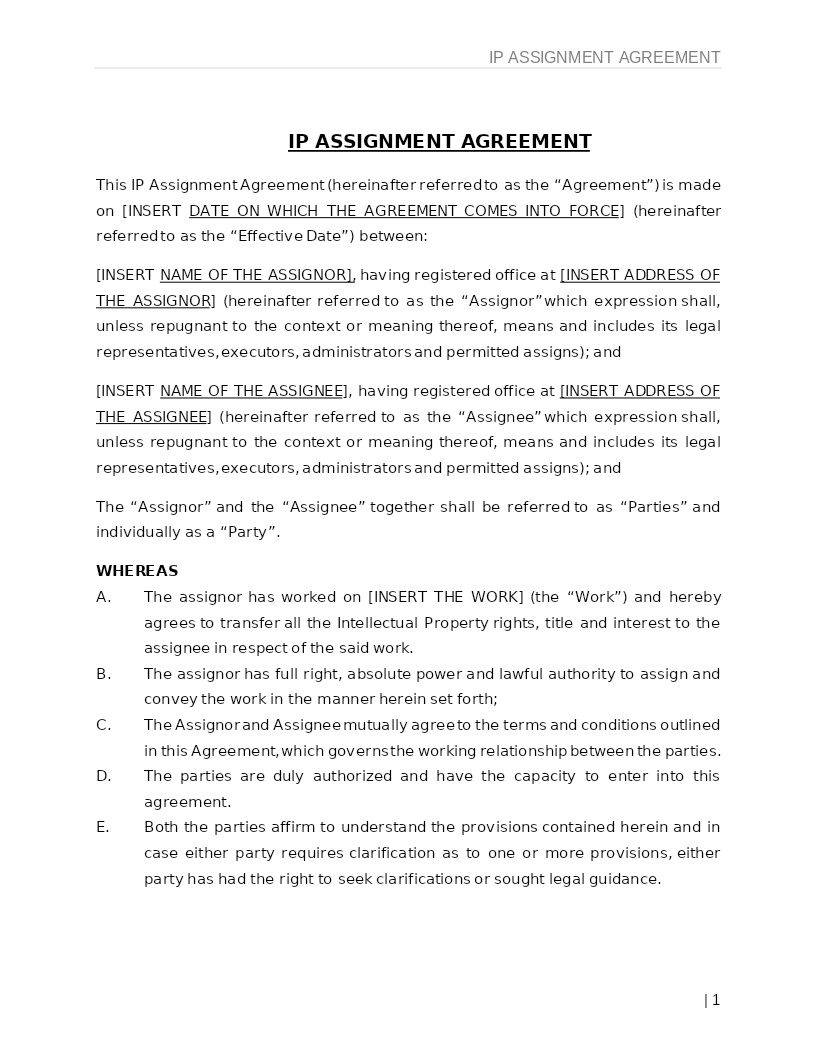
IP ASSIGNMENT AGREEMENT
How does it work?
1. Choose this template
Start by clicking on "Fill out the template"
2. Complete the document
Answer a few questions and your document is created automatically.
3. Save - Print
Your document is ready! You will receive it in Word and PDF formats. You will be able to modify it.
Understanding IP Assignment Agreements
An IP Assignment Agreement is a legally binding contract in which one party (the “Assignor”) transfers ownership of intellectual property such as inventions, designs, copyrights, trademarks, trade secrets, software code, products, or creative works to another party (the “Assignee”). This agreement clearly defines the type of intellectual property being transferred, the rights assigned, consideration or payment, warranties, confidentiality requirements, and legal protections.
In the United States, IP Assignment Agreements are governed by federal intellectual property laws (USPTO, Copyright Act, Patent Act, Lanham Act), state contract law, and industry specific regulations. This agreement ensures that ownership is properly transferred, recorded, enforceable, and recognized under U.S. law, making it essential for startups, businesses, creators, and technology developers.
Where IP Assignment Agreements Are Commonly Used
IP Assignment Agreements are widely used in business, creative, and technology sectors, including:
- Startups transferring IP from founders to the company
- Businesses acquiring patents, trademarks, or copyrights
- Software developers assigning ownership of source code
- Creative professionals transferring rights to clients
- Mergers, acquisitions, and investment transactions
- Employees or contractors transferring IP created during work
- Licensing transitions or sale of proprietary assets
- Joint ventures or collaborative innovation projects
Wherever intellectual property changes ownership, an IP Assignment Agreement ensures complete legal transfer and protection.
Different Types of IP Assignments You May Encounter
- Patent Assignment: Transfers ownership of inventions, patent rights, and applications filed with the USPTO.
- Copyright Assignment: Transfers ownership of creative works, including software, writing, music, designs, or media content.
- Trademark Assignment: Transfers ownership of brand names, logos, slogans, or product identifiers. Certain filings must be submitted to the USPTO.
- Trade Secret Assignment: Transfers proprietary information such as formulas, methods, processes, algorithms, and confidential business data.
- Technology or Software Assignment: Covers software programs, source code, APIs, digital assets, and related documentation.
When Legal Guidance Becomes Helpful
Legal review is recommended when:
- The IP involves valuable inventions, trademarks, or proprietary technology
- The parties need clarity on ownership rights or licensing restrictions
- The IP is part of a merger, acquisition, or investment transaction
- The transfer involves employees, contractors, or freelancers
- The assignment needs USPTO or Copyright Office filings
- The agreement includes warranties, indemnities, or non-compete requirements
- The IP includes open-source components, patented elements, or confidential data
Legal guidance ensures proper transfer, avoids future ownership disputes, and maintains compliance with U.S. IP laws.
How to Work with This Template
- Identify the Assignor and Assignee
- Describe the intellectual property being assigned
- Clarify whether the assignment is full, partial, or conditional
- Include warranties, representations, and consideration details
- Outline confidentiality, non-disclosure, and non-compete obligations
- Specify IP registration details and required federal filings
- Choose the governing U.S. state law
- Include clauses for future cooperation, updates, and documentation
- Sign electronically or physically following U.S. contract standards
This template follows common U.S. IP-transfer practices and works with all major e-signature platforms.
Frequently Asked Questions
Q1. What is an IP Assignment Agreement and why is it important?
An IP Assignment Agreement legally transfers ownership of intellectual property from one party to another. It is important because it ensures the receiving party has full ownership rights, the ability to enforce the IP, and clear legal title recognized under U.S. law.
Q2. Is an IP Assignment Agreement enforceable in the U.S.?
Yes. IP Assignments are enforceable under federal intellectual property laws and state contract laws. For patents and trademarks, assignments must often be recorded with the USPTO to ensure public notice and legal validity.
Q3. What types of intellectual property can be assigned?
Commonly assigned IP includes patents, inventions, copyrights, trademarks, trade secrets, software code, digital content, and proprietary technology. The agreement should clearly describe all assigned assets and related documentation.
Q4. Why do startups need IP Assignment Agreements?
Startups use IP Assignment Agreements to transfer ownership of inventions, code, branding, and creative work from founders and contractors to the company. This is essential for fundraising, valuation, and protecting the company’s core technology.
Q5. Are employees and contractors required to assign IP they create?
Often, yes. Many businesses require employees and contractors to sign IP assignment clauses to ensure that any work created during employment or engagement belongs to the company. This avoids future ownership disputes.
Q6. Does an IP Assignment Agreement include confidentiality obligations?
Yes. Most agreements include confidentiality, non-disclosure, and data protection requirements to ensure proprietary information remains secure even after the transfer.
Q7. Do IP Assignments need to be filed with any government office?
Certain types do. Patent and trademark assignments may need to be filed with the USPTO, while copyright assignments may be recorded with the U.S. Copyright Office to ensure clarity and legal enforceability.
Q8. Can an IP Assignment Agreement include compensation or royalties?
Yes. Assignments may involve one-time payments, ongoing royalties, or equity compensation, depending on the value of the IP and the terms negotiated between the parties.
Q9. Can an IP Assignment Agreement be revoked or modified?
Only if both parties agree in writing. Once IP is assigned and properly recorded, the transfer is typically permanent and cannot be revoked unilaterally.
Q10. Are electronic signatures valid for IP Assignment Agreements?
Yes. Under the U.S. ESIGN Act, electronic signatures are valid and legally binding. Many businesses and creators use digital platforms like Docu Sign for secure execution and recordkeeping.