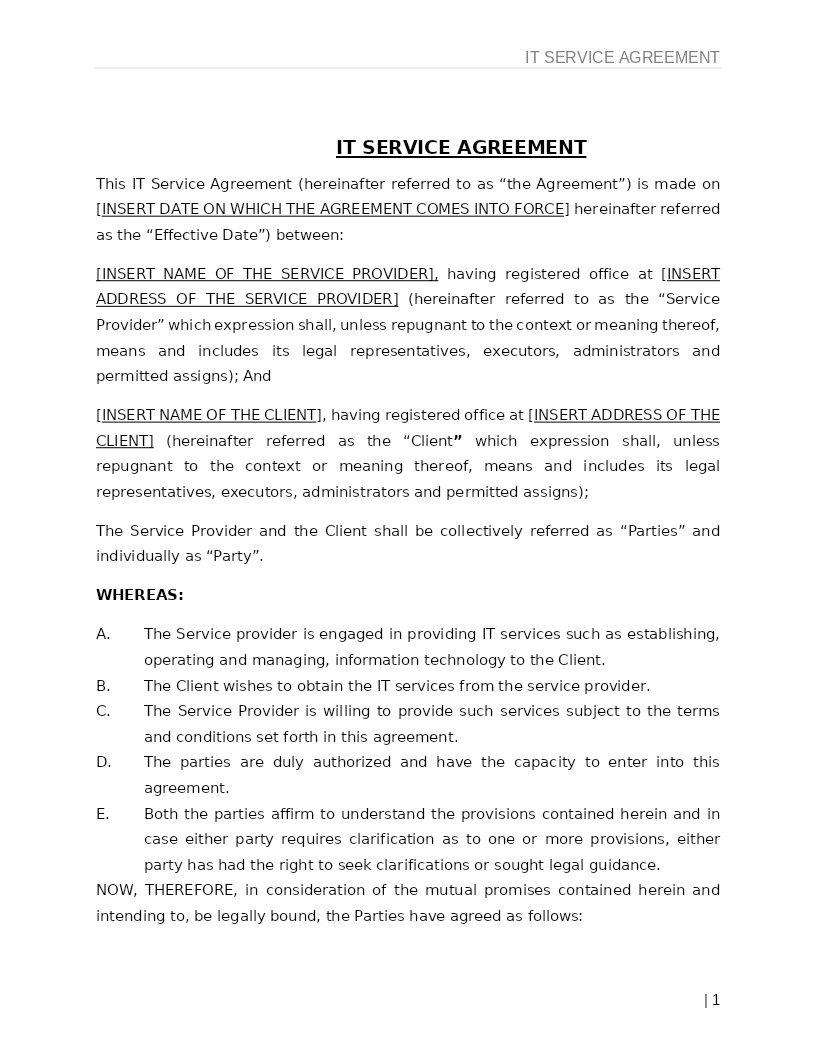
IT SERVICE AGREEMENT
How does it work?
1. Choose this template
Start by clicking on "Fill out the template"
2. Complete the document
Answer a few questions and your document is created automatically.
3. Save - Print
Your document is ready! You will receive it in Word and PDF formats. You will be able to modify it.
Understanding IT Service Agreements
An IT Service Agreement is a legally binding contract between a client and an information technology service provider that outlines the terms under which technical, software, infrastructure, cybersecurity, or support services will be delivered. This agreement defines service scope, performance standards, data protection obligations, response times, pricing structures, IP ownership, confidentiality, and compliance requirements.
In the United States, IT Service Agreements operate under state contract laws, federal cybersecurity guidelines, data privacy regulations, intellectual property statutes, and industry-specific compliance frameworks such as HIPAA, GLBA, FERPA, or PCI-DSS, depending on the nature of the services. A well-drafted IT Service Agreement protects both parties by defining expectations and reducing the risk of technical failures, data breaches, or service interruptions.
Where IT Service Agreements Are Commonly Used
IT Service Agreements are used across virtually all industries that rely on technology. These include:
- Software development and application maintenance
- Managed IT services, cloud hosting, and remote support
- Cybersecurity monitoring and incident response
- Hardware installation, system upgrades, and infrastructure setup
- Data backup, recovery solutions, and server management
- Network administration, firewalls, and IT consulting
- SaaS platforms, mobile application services, and API integrations
Any business that outsources technical operations relies on an IT Service Agreement to protect its systems, data, and operational continuity.
Different Types of IT Service Agreements You May Encounter
- Managed Services Agreement (MSA): Ongoing IT support, monitoring, and maintenance at fixed monthly or annual fees.
- Software Development Agreement: For designing, coding, testing, and delivering software or applications.
- Service Level Agreement (SLA): Specifies performance metrics, uptime guarantees, and response times.
- Cybersecurity Services Agreement: Covers threat monitoring, penetration testing, compliance audits, and security solutions.
- Cloud Services Agreement: Governs data storage, hosting, bandwidth use, virtualization, and cloud infrastructure.
- Technical Support Agreement: Defines helpdesk support, troubleshooting, and issue resolution processes.
When Legal Guidance Becomes Helpful
Legal review is especially valuable when:
- The provider will handle sensitive data, financial information, or personal information
- The contract involves complex software development or cloud infrastructure
- The business must comply with HIPAA, SOC-2, PCI-DSS, ISO, or other requirements
- Intellectual property ownership and licensing must be clearly defined
- The agreement includes indemnification, data breach liability, or encryption standards
- The IT provider uses subcontractors or offshore development teams
- The services impact critical systems, customer data, or operational security
Legal guidance helps reduce risks and ensures the agreement aligns with U.S. technology and privacy laws.
How to Work with This Template
- Identify the client and IT service provider
- Clearly define the scope of services and deliverables
- Outline pricing, service fees, and payment terms
- Add performance metrics, SLAs, and incident-response timelines
- Include confidentiality, data protection, and cybersecurity requirements
- Specify IP ownership, licensing terms, and software rights
- Choose the governing U.S. state law
- Add termination rules, dispute resolution, and renewal processes
- Sign electronically or physically following U.S. contract standards
This template is compatible with all major U.S. e-signature platforms and aligns with standard IT contracting practices.
Frequently Asked Questions
Q1. What is an IT Service Agreement and why is it important?
An IT Service Agreement defines how technical services will be provided and supported. It is important because it protects both the client and provider by outlining expectations, data-security rules, performance standards, and legal responsibilities.
Q2. Are IT Service Agreements legally enforceable in the U.S.?
Yes. These agreements are enforceable under state contract laws and must comply with federal data-security and privacy regulations. Clear contract terms protect businesses from service failures, cyber risks, and disputes.
Q3. What should be included in an IT Service Agreement?
A strong agreement includes service scope, fees, response times, confidentiality, cybersecurity standards, IP ownership, data handling rules, and termination rights. These ensure reliable and secure service delivery.
Q4. Who owns the intellectual property created under an IT Service Agreement?
Ownership depends on the agreement. Many contracts assign deliverables to the client, while the provider retains rights to pre-existing tools, frameworks, or proprietary software. Clear IP language prevents future conflicts.
Q5. Does an IT Service Agreement require a Service Level Agreement (SLA)?
Often, yes. SLAs set expectations for uptime, response times, and performance quality. They help ensure the provider meets measurable service standards and resolves issues promptly.
Q6. Are IT service providers responsible for data breaches?
Responsibility depends on the contract. Most agreements include data breach response obligations, security standards, and liability clauses. Strong cybersecurity provisions help protect the client from significant risks.
Q7. Can IT Service Agreements include remote support or offshore services?
Yes. Many agreements include remote support, cloud-based services, or offshore teams, but must address data privacy, export-control compliance, time-zone expectations, and confidentiality requirements.
Q8. Can the agreement be terminated early?
Yes. Most agreements allow early termination for breach of contract, non-performance, or security violations. The contract outlines notice periods, final payments, and return of data or equipment.
Q9. Are electronic signatures valid for IT Service Agreements?
Yes. Under the U.S. ESIGN Act, electronic signatures are legally valid. Most businesses use digital platforms like Docu Sign or Adobe Sign for faster execution.
Q10. Is an IT Service Agreement suitable for small businesses and startups?
Absolutely. Small businesses rely on IT providers for website management, cybersecurity, cloud services, and technical support. A clear agreement protects their operations and ensures reliable technology performance.