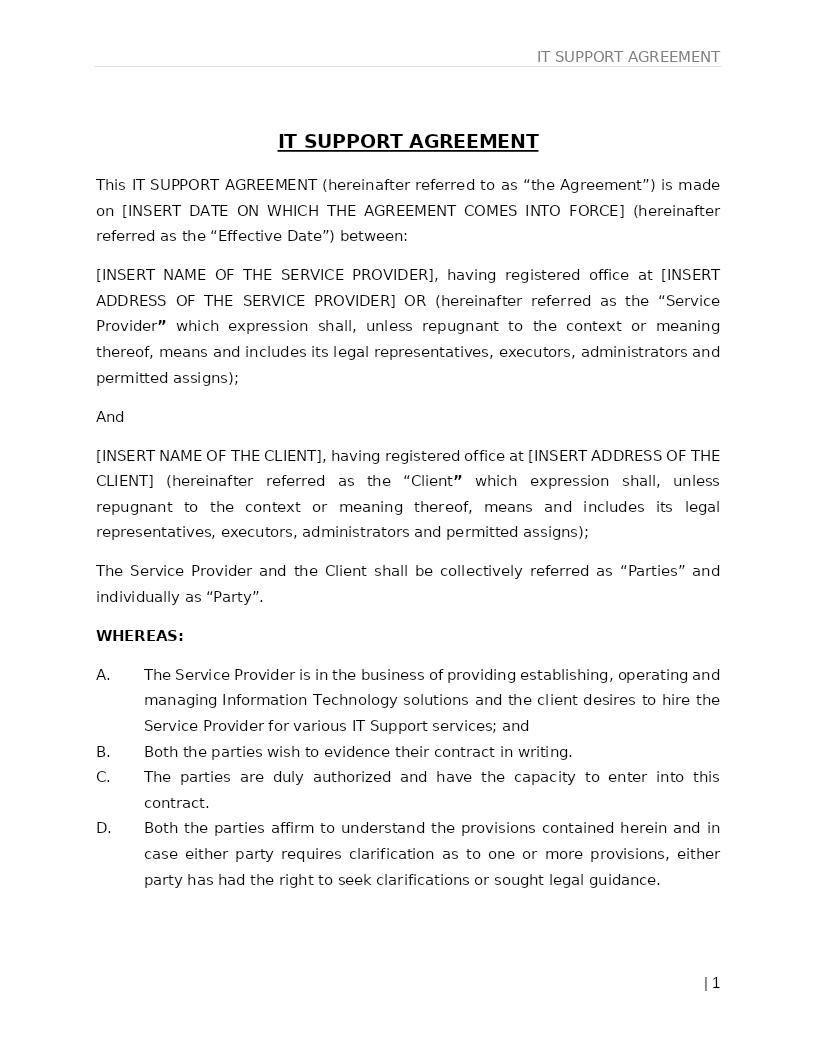
IT SUPPORT AGREEMENT
How does it work?
1. Choose this template
Start by clicking on "Fill out the template"
2. Complete the document
Answer a few questions and your document is created automatically.
3. Save - Print
Your document is ready! You will receive it in Word and PDF formats. You will be able to modify it.
Providing Technical Support and Maintenance Services in Commercial Operations
When parties enter an arrangement under which a service provider delivers ongoing technical support, maintenance, troubleshooting, monitoring, or system management services, it is essential to establish a clear contractual framework. An IT Support Agreement fulfills this function. It defines the terms under which the service provider furnishes information technology support to the client, including service levels, response times, system availability, confidentiality, payment obligations, and remedies, all in accordance with U.S. contract law, data protection regulations, and applicable industry standards.
By executing an IT Support Agreement, the parties create a legally enforceable understanding regarding the scope of support, service limitations, data handling obligations, and performance expectations. The agreement ensures that both parties can depend on predictable service delivery and adequate protection of system integrity, confidential data, and network security.
Where IT Support Agreements Are Commonly Used
IT support agreements are widely implemented in numerous commercial and organizational contexts, including:
- Managed IT services and outsourced technical support
- Helpdesk, troubleshooting, and remote assistance operations
- Network monitoring, cybersecurity support, and system maintenance
- Cloud services, SaaS platforms, and application support arrangements
- Hardware installation, configuration, and lifecycle management
- IT support for small businesses, startups, and corporate environments
- Data backup, disaster recovery, and continuity planning services
- Vendor support for specialized software or enterprise systems
Any time a business relies on a third party to support its technological infrastructure, an IT Support Agreement establishes the governing legal terms.
Different Types of IT Support Agreements You May Encounter
1. Managed Services Agreements (MSA): Provide ongoing, comprehensive support for networks, devices, servers, or cloud services.
2. Fix Support Agreements: Offer support services when issues arise, typically on an as-needed basis.
3. Service Level Agreements (SLA): Define performance metrics, response times, and system availability obligations.
4. Remote Support and On-Site Support Agreements: Specify whether services are delivered virtually or at the client’s premises.
5. Cybersecurity and Data Protection Support Agreements: Cover monitoring, threat management, security patching, and incident response.
When Legal Guidance Becomes Helpful
Legal review is often recommended when:
- The agreement involves access to sensitive, confidential, or regulated data
- The service includes cybersecurity, network security, or data storage obligations
- System downtime could result in substantial financial or operational losses
- The arrangement involves HIPAA compliance, financial data, or other regulated environments
- The parties need detailed performance metrics, escalation processes, or termination procedures
- Software licenses, third-party tools, or proprietary systems are included
- Intellectual property rights must be clarified regarding custom configurations or deliverables
Proper legal guidance ensures compliance with U.S. data and technology regulations, reduces risk, and prevents costly disputes.
How to Work With This Template
- Identify the Service Provider and the Client
- Describe the scope of IT services and systems covered
- Define service levels, response times, uptime requirements, and maintenance windows
- Establish payment terms, billing cycles, and service fees
- Outline data security, confidentiality, and compliance obligations
- Specify liability limitations and remedies for service interruptions
- Select governing law and jurisdiction
- Review the agreement to ensure accuracy and adherence to applicable U.S. standards
- Execute the agreement electronically or in writing
This template aligns with widely accepted U.S. IT contracting standards and is compatible with major e-signature platforms.
Frequently Asked Questions
1. What is an IT Support Agreement, and why is it important?
An IT Support Agreement is a legally binding contract that defines how a service provider delivers technical support, maintenance, and IT management services to a client. It is important because it clarifies service expectations, response times, fees, security requirements, and liability limitations, ensuring reliable operations and compliance with U.S. technology laws.
2. Does an IT Support Agreement require a Service Level Agreement (SLA)?
Many IT Support Agreements incorporate an SLA to define performance metrics such as uptime guarantees, response times, and issue-resolution standards. An SLA helps manage expectations and provides measurable service criteria.
3. What types of services are typically included in IT support?
Services often include helpdesk support, network monitoring, cybersecurity assistance, software updates, hardware maintenance, cloud management, system optimization, and backup or disaster recovery services.
4. How are fees structured under an IT Support Agreement?
Fees may be fixed monthly charges, hourly rates, package-based pricing, or per-device fees. Some arrangements include additional charges for after-hours support or specialized service requests.
5. Is the service provider responsible for data security?
Yes. Most IT Support Agreements include data protection, encryption, access control, and confidentiality obligations. Providers handling regulated data may also be required to comply with laws such as HIPAA, GLBA, or state privacy regulations.
6. Can the service provider access confidential business information?
IT service providers often require access to systems containing confidential or proprietary information. Therefore, the agreement should contain strong confidentiality and data-handling clauses to protect the client’s interests.
7. What happens if the service provider fails to meet service levels?
Consequences may include service credits, fee reductions, contractual penalties, or termination of the agreement. The specific remedies depend on the SLA and the terms agreed upon by the parties.
8. Are electronic signatures valid for IT Support Agreements?
Yes. Under the U.S. ESIGN Act, electronically signed IT Support Agreements are legally valid and enforceable.
9. Can either party terminate the IT Support Agreement?
Yes. Termination may occur for breach, non-performance, non-payment, or upon written notice as defined in the agreement. The agreement should specify termination rights and transition assistance obligations.
10. Does the agreement address intellectual property ownership?
It should. If the service provider creates custom scripts, configurations, or documentation, the agreement should specify whether the client or provider retains ownership or licensing rights.
11. Can IT Support Agreements cover cloud-based software?
Yes. Many agreements include cloud support, SaaS management, configuration services, and remote troubleshooting for hosted platforms.