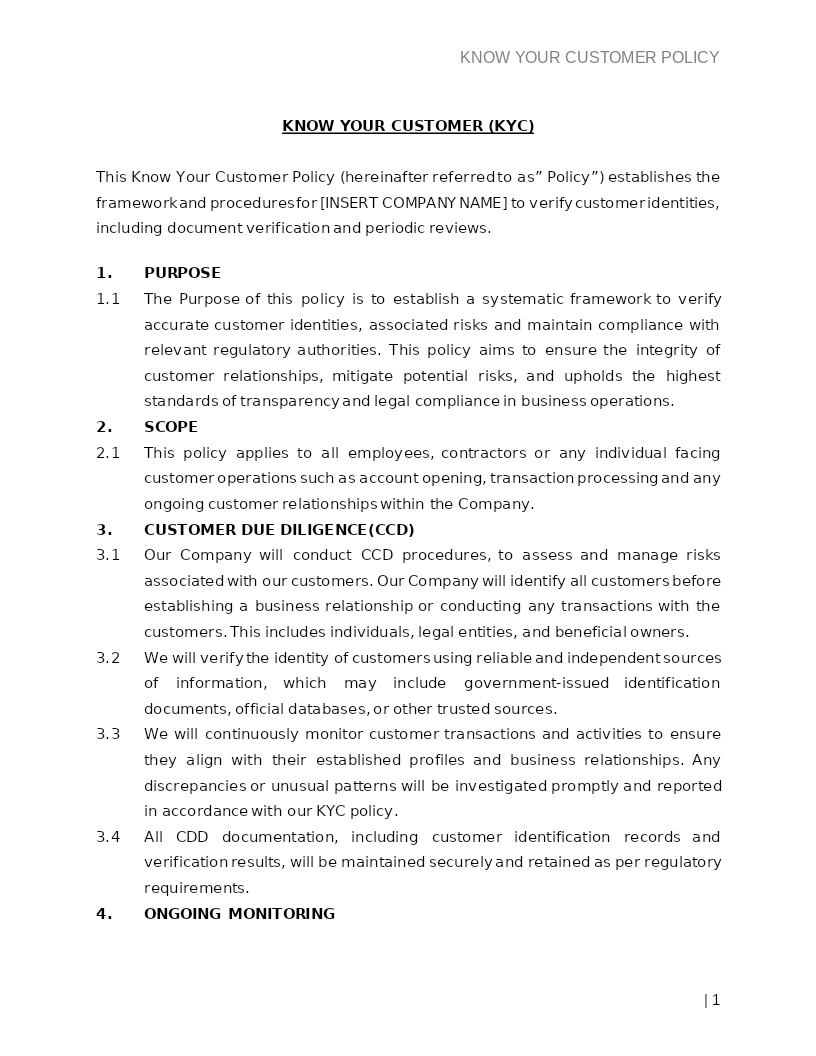
KNOW YOUR CUSTOMER (KYC)
How does it work?
1. Choose this template
Start by clicking on "Fill out the template"
2. Complete the document
Answer a few questions and your document is created automatically.
3. Save - Print
Your document is ready! You will receive it in Word and PDF formats. You will be able to modify it.
Understanding a Know Your Customer (KYC) Policy
A Know Your Customer (KYC) Policy establishes the framework an organization uses to verify the identity of its customers, assess risk, and comply with U.S. financial regulations. KYC policies are essential for preventing fraud, identity theft, money laundering, and unlawful financial activities.
This policy outlines identity verification standards, documentation requirements, onboarding procedures, risk-based due diligence, screening protocols, and ongoing monitoring practices. It ensures that the business handles customer information responsibly and maintains compliance with relevant federal laws such as the Bank Secrecy Act (BSA), USA PATRIOT Act, FinCEN rules, and other applicable regulatory standards.
A strong KYC Policy builds customer trust, protects the company from regulatory penalties, and supports safe, ethical business operations.
Where KYC Policies Are Commonly Applied
KYC requirements are standard across industries where financial, personal, or sensitive transactions occur, including:
• Banks, fintech companies, and lending institutions
• Cryptocurrency exchanges and digital asset platforms
• Investment advisors, brokers, and wealth-management firms
• Insurance providers and financial consultants
• Payment processors, merchant service providers, and online marketplaces
• Real estate firms, escrow agents, and property managers
• Businesses engaging in high-value or high-risk transactions
Any time a business must verify identity or evaluate customer legitimacy, a KYC Policy provides structured guidance.
Different Types of KYC You May Encounter
- Basic KYC: Collection of standard identification documents and customer information.
- Enhanced Due Diligence (EDD): A deeper level of verification used for high-risk customers, large transactions, or international activities.
- Ongoing KYC Monitoring: Continuous review of customer activity, red flags, transaction patterns, and risk assessments.
- Digital / e-KYC: Automated identity verification using biometric checks, database lookups, or third-party verification tools.
When Legal Guidance Becomes Helpful
Legal support may be valuable when:
• The business handles large, complex, or international financial transactions
• The organization is required to comply with AML (Anti-Money Laundering) rules
• New regulatory changes impact existing KYC processes
• The company handles cryptocurrency, digital payments, or virtual assets
• High-risk customers require enhanced due diligence
• The business stores or processes sensitive customer data
• The policy intersects with data-protection regulations such as the GLBA or state privacy laws
How to Work with This Template
• Identify which customers require identity verification
• Specify required documents (e.g., government ID, address proof, SSN/EIN)
• Define onboarding procedures, risk ratings, and screening protocols
• Clarify reporting obligations and red-flag escalation steps
• Choose governing U.S. state law
• Train employees on KYC responsibilities and compliance expectations
• Implement secure data-storage practices and monitoring systems
• Sign electronically or in hard copy where applicable
Frequently Asked Questions
Q1. What is a KYC Policy and why is it important?
A KYC Policy outlines how a business verifies customer identities and evaluates potential risks. It is critical for preventing fraud, meeting legal compliance requirements, and ensuring that the business does not unintentionally facilitate illegal financial activities.
Q2. Is a KYC Policy legally required in the United States?
Yes, for many industries. Under federal laws such as the Bank Secrecy Act and the USA PATRIOT Act, financial institutions and regulated businesses must implement KYC procedures. Even non-regulated businesses adopt KYC to enhance security and protect against fraud.
Q3. What information is typically collected during KYC?
Businesses may gather identity documents, personal details, proof of address, tax identification numbers, financial history, and information about the customer’s business or source of funds depending on the risk level.
Q4. What is the difference between KYC and AML?
KYC focuses on verifying customer identity and assessing risk, while AML (Anti-Money Laundering) involves monitoring and detecting suspicious activities. KYC is a core component of a broader AML compliance program.
Q5. How does a business determine which customers require Enhanced Due Diligence (EDD)?
EDD is required when customers present higher risks, such as international transactions, large cash flows, politically exposed persons (PEPs), or unusual activity patterns. The policy outlines criteria for identifying these customers.
Q6. Can KYC be completed digitally or remotely?
Yes. Many businesses use e-KYC technologies such as biometric verification, document scanning, and database cross-checks to authenticate identities securely and efficiently.
Q7. How long must customer records be kept for KYC compliance?
Under U.S. regulations, KYC records must typically be retained for five years after the customer relationship ends, though requirements may vary depending on the industry.
Q8. Does KYC apply to small businesses or only large financial institutions?
KYC is increasingly adopted by small businesses, online marketplaces, fintech startups, and service platforms to reduce fraud, protect customer data, and improve trust even when not legally mandated.
Q9. What happens if a company fails to implement proper KYC measures?
Businesses may face federal penalties, regulatory investigations, fraud exposure, financial loss, or reputational damage. Non-compliance with KYC obligations can lead to serious legal and operational risks.
Q10. How can a business keep its KYC Policy up to date?
Organizations should regularly review regulatory updates, use reliable verification tools, train employees, and perform periodic audits. Updating the policy ensures continued compliance with evolving U.S. regulations.