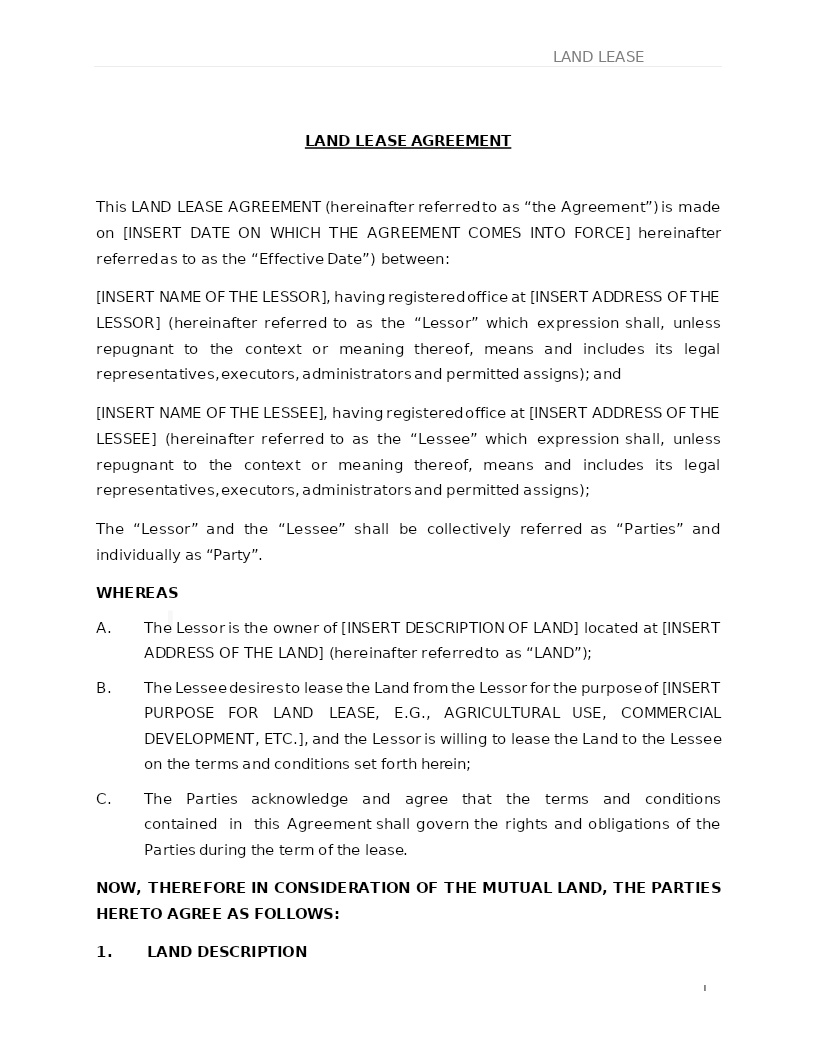
LAND LEASE AGREEMENT
How does it work?
1. Choose this template
Start by clicking on "Fill out the template"
2. Complete the document
Answer a few questions and your document is created automatically.
3. Save - Print
Your document is ready! You will receive it in Word and PDF formats. You will be able to modify it.
Providing Legal Clarity and Secure Land Use Rights Through Land Lease Agreements
When a landowner grants another party the right to use a piece of land for a defined purpose, a Land Lease Agreement (also called a Ground Lease) provides the legal structure governing that arrangement. It outlines the rental terms, permitted land use, lease period, maintenance duties, improvements, and conditions for renewal or termination.
Land Lease Agreements are widely used across the United States for agricultural operations, commercial development, industrial sites, solar farms, billboards, cell towers, and residential placements such as mobile home parks. Unlike a sale, ownership always remains with the landowner, while the tenant obtains lawful and exclusive use for the duration of the lease.
By documenting every expectation upfront, both parties avoid disputes, ensure lawful use of the property, and protect long-term investments.
Where Land Lease Agreements Are Commonly Used
Land Lease Agreements are essential in numerous U.S. real estate and business situations, including:
- Long-term commercial or industrial development
- Agricultural use such as farming, ranching, and crop production
- Renewable energy projects (solar farms, wind turbines, battery storage sites)
- Mobile home communities and RV parks
- Billboard installations and outdoor advertising placements
- Telecommunications towers and utility infrastructure sites
- Parking lots, storage yards, and logistics hubs
- Ground leases for retail, hospitality, or mixed-use construction
Whenever land is used without transferring ownership, a Land Lease Agreement provides structure, legal certainty, and security.
Different Types of Land Lease Agreements You May Encounter
- Agricultural Land Lease: Allows farming, ranching, grazing, or crop production for a defined rent or crop-share model.
- Commercial Ground Lease: Used for building retail spaces, offices, warehouses, or hospitality structures on leased land.
- Residential Land Lease: Applies to mobile home parks or tiny home communities where land is rented but the structure is owned by the tenant.
- Industrial or Infrastructure Lease: For factories, utilities, data centers, towers, or renewable energy installations.
- Short-Term Land Use Lease: For events, seasonal activities, storage, or temporary commercial use.
Each type clarifies usage, legal compliance, and each party’s rights and obligations.
When Legal Guidance Becomes Helpful
Land leases often involve long-term commitments and substantial financial investments. Legal review is especially important when:
- The lease involves development, construction, or major improvements
- Zoning, environmental, or permitting requirements apply
- The land is located in multiple jurisdictions or has shared boundaries
- The tenant intends to build permanent or semi-permanent structures
- Agricultural or commercial operations involve regulatory oversight
- Complex renewal, rent-escalation, or purchase option terms exist
- Liability, insurance, and environmental risks must be addressed
- The land will be used for utilities, telecom, or energy projects with unique legal needs
Professional guidance ensures compliance with U.S. state property laws, prevents disputes, and protects both lessor and lessee long term interest.
How to Work with This Template
- Identify the landowner (lessor) and tenant (lessee)
- Describe the land with legal boundaries or property details
- Define the permitted uses and any restrictions
- Specify the lease duration and renewal terms
- Outline rent, payment schedule, adjustments, and deposits
- Add maintenance, repair, and improvement responsibilities
- Define insurance, liability, and indemnification obligations
- Include environmental, zoning, and compliance requirements
- Choose governing state law and dispute resolution method
- Sign electronically or physically, valid under U.S. law
This template aligns with standard U.S. property leasing practices and supports both short-term and long-term land use arrangements.
Frequently Asked Questions
Q1. Why is a Land Lease Agreement important in the U.S.?
A Land Lease Agreement provides legal clarity by defining rights, responsibilities, rent, and permitted use. It helps prevent disputes, ensures compliance with state property laws, and protects both the landowner and the tenant throughout the duration of the lease.
Q2. What should a U.S. Land Lease Agreement include?
Essential components include the land description, lease term, rent, permitted uses, maintenance duties, improvements, insurance, liability terms, and renewal or termination procedures. These elements ensure predictable and secure land use.
Q3. Does a land lease transfer ownership rights?
No. Ownership remains with the landowner. The tenant gains lawful use of the land for the agreed period but does not acquire ownership or title rights unless separately negotiated.
Q4. Can land leases be long-term, such as 30–99 years?
Yes. Commercial and development ground leases in the U.S. often run for 30, 50, or even 99 years to support financing, construction, and long-term business planning.
Q5. What kinds of land uses typically require a formal agreement?
Agriculture, commercial buildings, solar farms, mobile home parks, billboard sites, telecom towers, and industrial operations all require written agreements to ensure legality, safety, and investment protection.
Q6. Are electronic signatures valid for land leases in the U.S.?
Yes. E-signatures are enforceable under the ESIGN Act and UETA, although some states may require notarization for specific real estate documents. Most land leases can be signed electronically.
Q7. What happens if the tenant wants to build or improve the land?
The agreement determines what improvements are allowed, who owns the structures, and who pays for construction. Many U.S. ground leases allow tenants to build, provided compliance and insurance requirements are met.