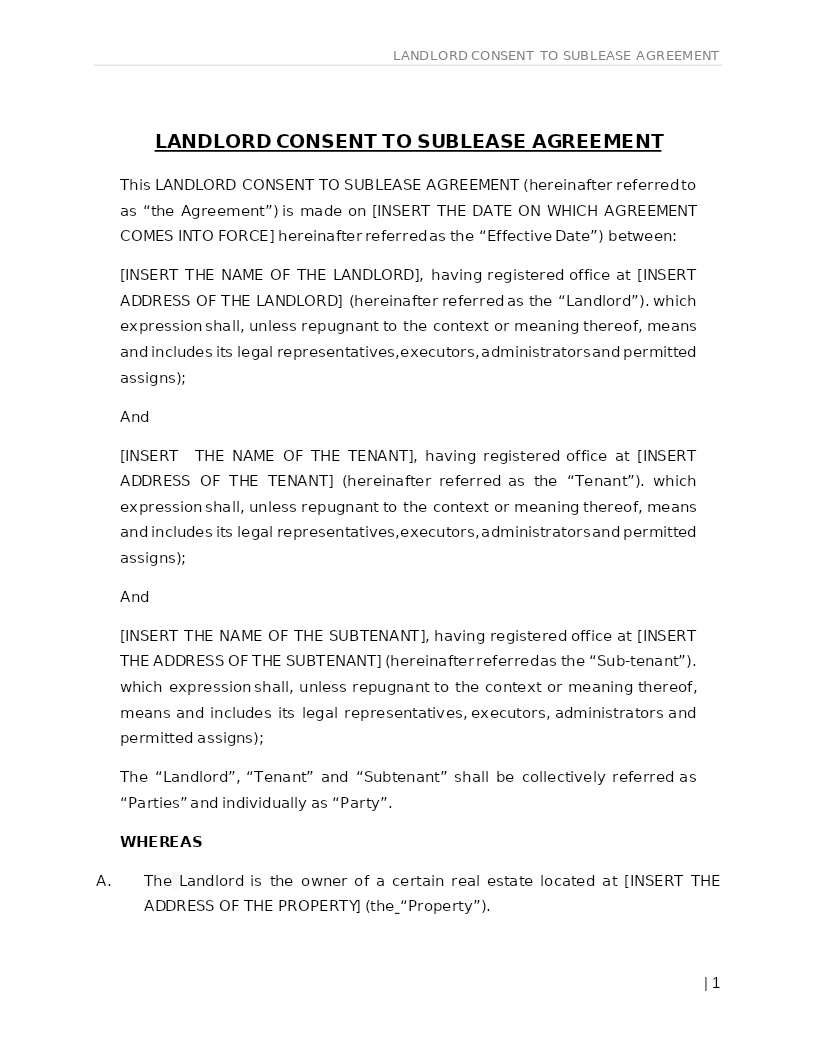
LANDLORD CONSENT TO SUBLEASE AGREEMENT
How does it work?
1. Choose this template
Start by clicking on "Fill out the template"
2. Complete the document
Answer a few questions and your document is created automatically.
3. Save - Print
Your document is ready! You will receive it in Word and PDF formats. You will be able to modify it.
Helps Landlords to avoid claims of unauthorized assignment or breach
In commercial and residential leasing arrangements, a tenant may occasionally wish to transfer part or all of their leased premises to a third party. Because most leases restrict or regulate such transfers, a Landlord Consent to Sublease Agreement provides the formal legal framework required for a tenant to sublease the property with the landlord’s authorization. It specifies the conditions under which consent is granted, sets out the rights and limitations of the subtenant, and reaffirms the continuing obligations of the original tenant under the primary lease.
This Agreement establishes a clear structure that preserves the landlord’s control over the premises while allowing the tenant to accommodate business changes, relocations, downsizing, or temporary vacancy issues. It identifies what aspects of the lease the subtenant must comply with, what limitations apply to their occupancy, and what responsibilities remain with the original tenant. The Agreement ensures the landlord’s interests are protected by defining acceptable uses of the premises, preserving operational standards, and preventing unauthorized or unsuitable subletting arrangements.
Landlord Consent to Sublease Agreements are widely used in commercial leasing (office, retail, industrial, hospitality) and residential rental contexts. Whenever the original tenant seeks to introduce a third party into the premises, this Agreement acts as a safeguard to ensure compliance with the primary lease, property rules, and legal requirements.
Where Landlord Consent to Sublease Agreements Are Commonly Used
These agreements are frequently utilized in situations such as:
- Commercial tenants subletting unused space due to downsizing or restructuring
- Businesses relocating but wishing to avoid early termination penalties
- Start-ups seeking affordable space through partial subletting
- Tenants granting temporary occupancy to subtenants during travel or relocation
- Retail or office tenants sharing space with complementary businesses
- Residential tenants subletting for a limited period (study abroad, temporary assignment, etc.)
- Joint ventures where a business partner occupies part of the leased premises
Any time a third party occupies the premises under the tenant’s lease rights, a written consent by the landlord ensures compliance and prevents future legal disputes.
Types of Landlord Consent to Sublease Agreements
- Full Sublease Consent: Allows the tenant to sublease the entire premises to a subtenant.
- Partial Sublease Consent: Covers situations where the tenant sublets only a portion of the property.
- Temporary or Fixed-Term Sublease Consent: Permits occupancy for a specific, limited duration.
- Commercial Sublease Consent: Used for office, industrial, retail, or specialized commercial use.
- Residential Sublease Consent: Used in apartment or housing rental scenarios subject to landlord policies.
When Legal Guidance Becomes Helpful
- Professional legal review is strongly recommended when:
- The premises are governed by complex commercial lease obligations
- Regulatory requirements apply (zoning rules, business licensing, residential restrictions)
- The subtenant will perform specialized or high-risk activities
- The original lease contains strict assignment or subletting clauses
- The landlord requires additional indemnities, insurance, or deposits
- Multiple parties, co-tenants, or corporate entities are involved
- The sublease alters permitted use, occupancy levels, or operational hours
Legal guidance from a legal counsel ensures that all parties’ rights are protected and that the Consent aligns with the primary lease, local laws, and landlord policies.
How to Work With This Template
- Identify the landlord, tenant, and proposed subtenant
- Attach or reference the original lease agreement
- Describe the area of the premises being subleased (full or partial)
- Specify the permitted use, duration, and rent
- List conditions the subtenant must comply with
- Clarify which obligations remain with the tenant (typically all)
- Select governing law and jurisdiction
- Sign electronically or in hard copy
This structure is consistent with recognized leasing and property management standards.
Frequently Asked Questions (FAQs)
Q1. Is landlord consent always required before subleasing?
In most commercial and residential leases, subleasing is expressly prohibited unless the tenant first obtains the landlord’s written consent. This requirement is designed to protect the landlord from unexpected or unsuitable third parties entering the premises. Even if the lease is silent, many jurisdictions impose a presumption against unauthorized assignments or subletting.
Failure to obtain consent may constitute a material breach of the lease, giving the landlord the right to terminate the lease, accelerate rent, initiate eviction proceedings, or seek damages for unauthorized occupancy.
Q2. Does landlord consent release the original tenant from their lease obligations?
No. Granting consent does not modify the primary lease, nor does it release the tenant from ongoing responsibilities. The tenant remains fully liable for rent payments, compliance with lease covenants, maintenance obligations, and any damage caused by the subtenant.
Unless the landlord explicitly agrees to a novation which substitutes the subtenant in place of the original tenant the original lease remains intact and enforceable against the tenant.
Q3. Can a landlord refuse consent to a sublease request?
A landlord may refuse consent if they have reasonable grounds, which may include:
- financial instability or insufficient credit history of the proposed subtenant
- intended use that is incompatible with the permitted use clause
- overcrowding or potential safety hazards
- potential violation of zoning laws or regulatory restrictions
- prior misconduct or litigation history of the subtenant
Many leases include a “not unreasonably withheld” clause, requiring the landlord to provide objective justification for refusal. Absent such language, landlords may have broader discretion.
Q4. Is a sublease valid if executed without the landlord’s written consent?
Generally, no. In many jurisdictions, a sublease executed without required consent is void, voidable at the landlord’s option, or deemed a violation of the lease.
The landlord may have remedies including eviction, termination of the main lease, penalty assessments, or claims for financial loss. The subtenant may also lose occupancy rights if the main lease is terminated.
Q5. Does a subtenant acquire the same rights as the original tenant?
A subtenant acquires only those rights expressly granted under the sublease and only to the extent they are permitted under the primary lease. A subtenant cannot obtain rights the original tenant does not possess, nor can they override restrictions in the primary lease. For example, if the lease prohibits retail operations, the subtenant cannot operate a storefront even if the tenant purports to allow it.
Q6. Are electronic signatures valid on a Landlord Consent to Sublease Agreement?
Yes. Under most e-signature statutes (such as the ESIGN Act and UETA), electronic signatures are legally binding provided that the parties consent to electronic execution, the parties have the ability to retain the electronic document, and the identity of each signatory can be authenticated. Platforms like DocuSign and Adobe Sign are widely accepted for this purpose.
Q7. Does the landlord owe any legal duties directly to the subtenant?
Generally, no. The landlord’s contractual duties typically remain limited to the original tenant. Unless the landlord enters into a direct agreement (often called a Recognition Agreement or Attornment Agreement), the subtenant has no contractual rights against the landlord. If the main lease terminates, the subtenant’s rights normally terminate as well.
Q8. Is the tenant responsible for the conduct or defaults of the subtenant?
Yes. The original tenant remains responsible for ensuring the subtenant complies with all lease terms, building rules, statutory obligations, and local ordinances. If the subtenant damages the property, fails to pay sublease rent, or violates noise, use, or zoning rules, the landlord may hold the tenant liable for damages or lease breaches.
Q9. What happens to the subtenant if the tenant defaults under the lease?
If the primary lease is terminated due to the tenant’s default, the sublease normally terminates automatically. The subtenant may be required to vacate the premises even if the subtenant was compliant with the sublease. Landlords may but are not necessariy required to offer the subtenant a direct lease to preserve occupancy and mitigate losses.
Q10. Can a subtenant further sublease the space?
Only if the original lease and the landlord’s consent permit it. Most leases prohibit “sub-subleasing” without further landlord approval to avoid uncontrolled occupancy chains. Engaging in further subletting without consent may void the sublease and breach the primary lease.
Q11. Can financial terms of the sublease differ from those in the main lease?
Yes, the parties may negotiate different terms, including higher or lower rent, different utility arrangements, separate maintenance responsibilities. However, financial terms cannot violate rent-regulation laws, “profit sharing” prohibitions, or clauses restricting assignment of rental benefits.
Q12. Does the landlord have inspection rights over the sublet premises?
Yes. Landlords retain all inspection rights granted in the primary lease, including entering the property to inspect for damage, check for compliance, perform repairs,
and show the property to prospective tenants or buyers.The subtenant must allow access consistent with lease terms.
Q13. Can consent be granted with conditions attached?
Absolutely. Landlords often impose conditions to ensure protection and compliance, such as requiring additional security deposits, mandating proof of insurance for the subtenant, restricting hours of operation, approving fit-outs or alterations and requiring the subtenant to sign building rules acknowledgements. Conditional consent is legally valid so long as conditions are reasonable and consistent with the lease.
Q14. What if the tenant wants to extend the sublease term?
An extension generally requires new or renewed landlord consent, unless the original consent expressly includes a right to renew or extend. Sublease extensions cannot exceed the term of the primary lease unless the landlord and tenant renegotiate the primary lease.
Q15. Must the subtenant comply with all terms of the primary lease?
Yes. Subtenants are typically obligated to comply with all covenants, restrictions, and rules in the primary lease. Any violation by the subtenant may be treated as a breach by the tenant, regardless of the tenant’s direct involvement or knowledge.
Q16. Does the landlord need to review the full sublease agreement?
Usually yes. Landlords commonly request the sublease draft for review to verify the identity of the subtenant, the intended use, compliance with lease restrictions, rent and occupancy periods and indemnity and insurance terms among other things. Some landlords require attaching the sublease as an exhibit to the consent Agreement.