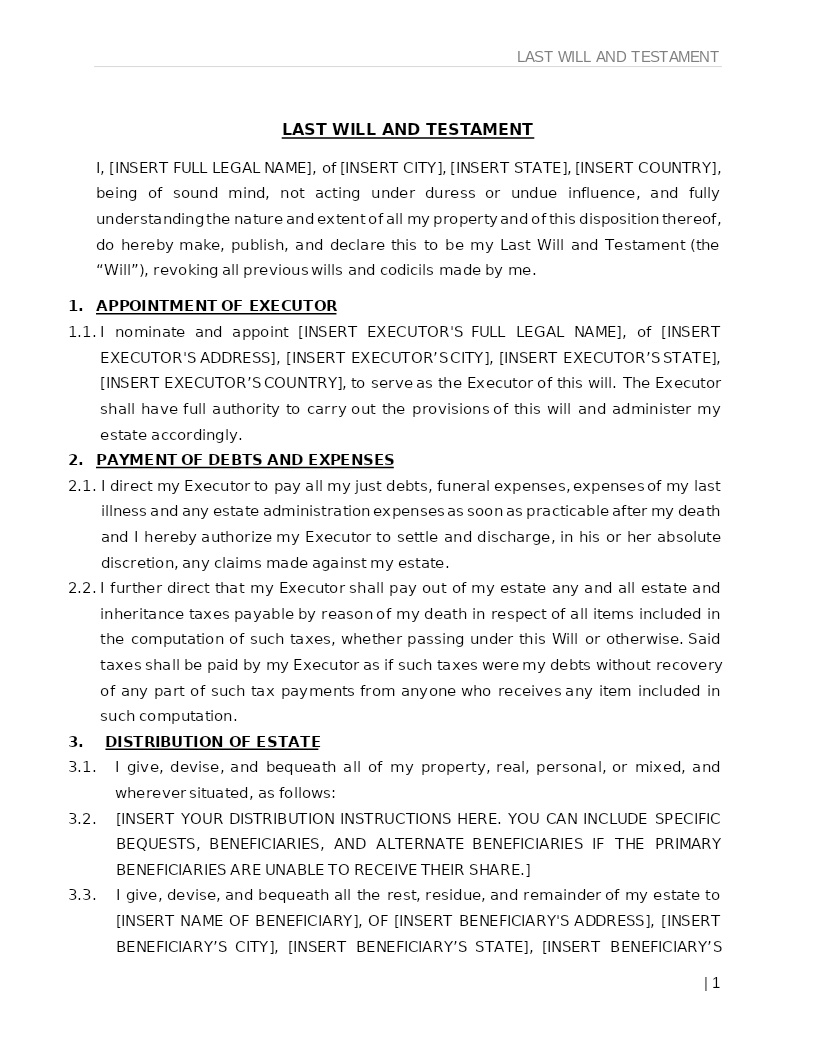
LAST WILL AND TESTAMENT
How does it work?
1. Choose this template
Start by clicking on "Fill out the template"
2. Complete the document
Answer a few questions and your document is created automatically.
3. Save - Print
Your document is ready! You will receive it in Word and PDF formats. You will be able to modify it.
Understanding a Last Will and Testament
When an individual wants to ensure their property, dependents, and personal affairs are handled according to their wishes after their passing, a Last Will and Testament provides that essential structure. It allows a person (the “testator”) to specify who will inherit assets, appoint guardians for minor children, and designate an executor to manage estate-related responsibilities.
Having a Will in place creates clarity and certainty. It helps family members understand the testator’s intentions, ensures the estate is handled efficiently, and prevents disputes at a time when loved ones are already dealing with emotional loss. Without a valid Will, state intestacy laws determine how assets are distributed often in ways that may not align with the individual’s wishes.
Where Last Wills and Testaments Are Commonly Used
Last Wills and Testaments are used across a wide range of personal and family situations in the United States, including:
- Individuals looking to determine how their personal and financial assets will be distributed
- Parents wanting to appoint guardians for minor children
- Business owners planning for the succession of their business interests
- Individuals with blended families to ensure fair distribution
- People wanting to leave charitable gifts or specific legacies
- Elderly individuals organizing their affairs to ease the burden on loved ones
- Anyone who wants to avoid intestacy and maintain control over their estate
Any time a person has property, dependents, or personal directives, a Will serves as the foundational document guiding how their estate will be managed.
Different Types of Last Wills and Testaments You May Encounter
- Simple Will: Outlines asset distribution and basic estate matters; ideal for individuals with straightforward estates.
- Testamentary Trust Will: Creates one or more trusts upon the testator’s death, often for minor children, dependents with disabilities, or long-term financial planning.
- Pour-Over Will: Used alongside a living trust, ensuring any assets not already in the trust at the time of death are transferred (“poured over”) into it.
- Holographic Will: A handwritten will recognized in some U.S. states; typically, valid only if it meets strict statutory requirements.
- Joint Will: A single Will executed by two people (usually spouses); less common today due to its inflexibility.
- Living Will (Advance Directive): Not a traditional Will but often used alongside one—it outlines healthcare decisions if the individual becomes incapacitated.
Why Individuals Need a Last Will and Testament
A Last Will and Testament is essential for ensuring that a person’s wishes are legally honored. It provides instructions for distributing assets, handling debts, appointing guardians, naming an executor, and addressing personal matters such as funeral preferences. It also minimizes probate complications, reduces family conflict, and ensures the testator not the state decides how their legacy is managed.
For families, business owners, and individuals with specific inheritance goals, having a Will in place brings stability, transparency, and long-term protection.
When Legal Guidance Becomes Helpful
While some individuals use templates to prepare simple Wills, legal guidance becomes especially important when:
- The estate includes real estate, business interests, intellectual property, or high-value assets
- The family structure is complex (remarriage, blended families, estranged relatives, dependent adults)
- The testator wants to set up trusts, long-term guardianships, or special distributions
- The estate may face significant taxes or requires asset protection strategies
- There is concern about potential challenges, disputes, or contested wills
- The testator has specific directives that require precise legal language
- The estate spans multiple states or involves international property
- A living trust is being coordinated with the Will
Legal review ensures the Will complies with U.S. state-specific laws, including signature requirements, witness rules, and formal validity standards.
How to Work with This Template
- Identify the testator and confirm legal capacity to create a Will
- List beneficiaries and specify how property should be distributed
- Appoint an executor to administer the estate and manage distributions
- Appoint guardians for minor children or dependents if applicable
- Provide instructions regarding debts, taxes, and outstanding obligations
- List specific bequests, charitable gifts, and personal legacy wishes
- Ensure the Will is signed and witnessed according to the governing state’s requirements
- Store the Will securely and inform trusted individuals of its location
- Review and update the Will periodically; life changes may require revisions
This template is designed to follow estate planning standards recognized across the United States and is compatible with common estate administration practices.
Frequently Asked Questions
Q1. What is a Last Will and Testament?
A Last Will and Testament is a legally enforceable document that outlines how a person’s assets, property, and responsibilities will be managed after their death. It specifies beneficiaries, appoints an executor, and provides guidance for family members and the court. Having a valid Will ensures that wishes are honored and reduces the likelihood of disputes during probate.
Q2. Why is having a Will important if I already have family who will inherit?
Without a Will, state intestacy laws determine how your assets are distributed and these laws may not match your personal wishes. A Will allows you to control who receives what, choose guardians for children, and name someone you trust to manage your estate, rather than leaving these decisions to the court system.
Q3. Who should I appoint as my executor?
An executor should be someone trustworthy, organized, and capable of managing financial tasks. Many people choose a spouse, adult child, close friend, or professional fiduciary. The executor handles probate filings, pays debts, manages property, and ensures beneficiaries receive their inheritances according to the Will.
Q4. Can I change or update my Will later?
Yes. You can amend your Will through a codicil or create a new Will entirely. Life events such as marriage, divorce, births, deaths, or significant asset changes often require updates. Keeping your Will current ensures accuracy and legal enforceability.
Q5. Does a Will avoid probate?
A Will does not avoid probate; rather, it guides the probate process. Probate ensures debts are paid, assets are distributed properly, and the Will is legally validated. For those seeking to avoid probate entirely, a living trust used alongside a Will may be the better approach.
Q6. What happens if someone contests my Will?
Contests typically arise from claims of undue influence, fraud, or questions about the testator’s capacity. A well-drafted Will, especially one prepared with legal guidance, reduces these risks by including proper execution formalities and clear instructions.
Q7. Can a Will direct who receives digital assets or online accounts?
Yes. Many modern Wills include provisions for digital property, such as social media accounts, cloud storage, cryptocurrencies, and online financial platforms. Assigning a “digital executor” helps ensure these assets are handled properly.
Q8. Do I need a lawyer to create a Last Will and Testament?
While simple estates may use templates, legal consultation is recommended especially when dealing with real estate, multiple beneficiaries, trusts, large assets, or complex family dynamics. Lawyers ensure your Will complies with state laws and reflects your wishes clearly and enforceably.