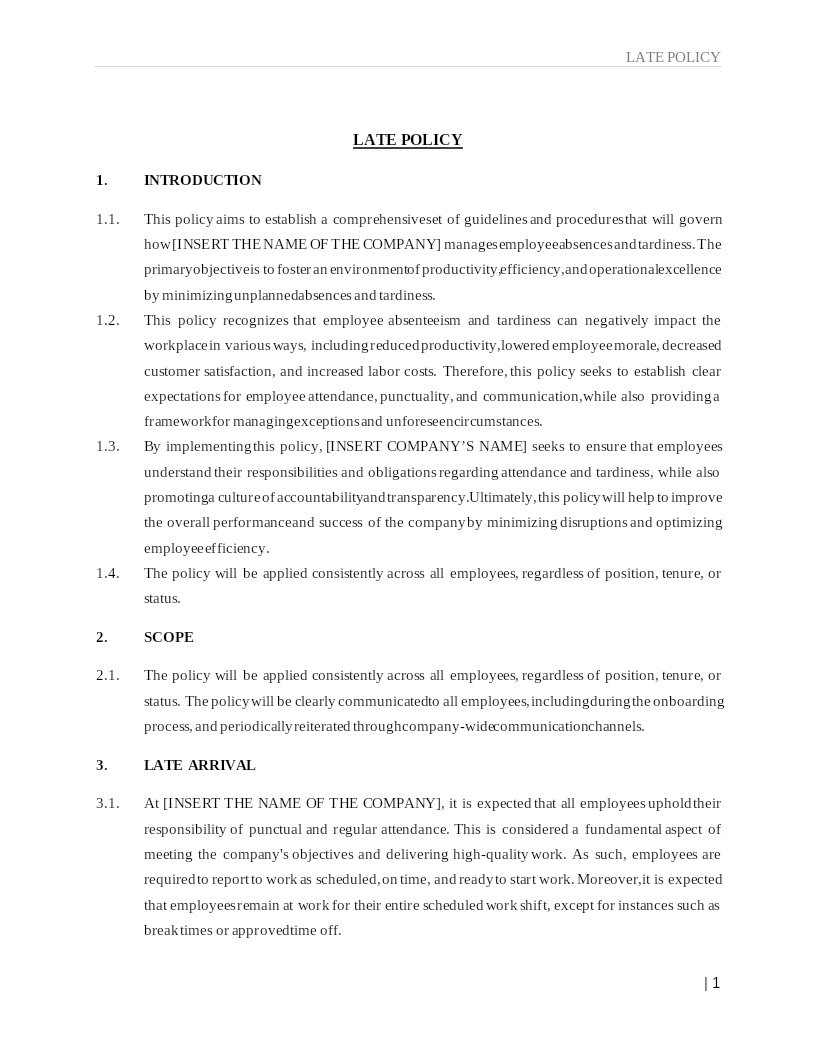
LATE POLICY
How does it work?
1. Choose this template
Start by clicking on "Fill out the template"
2. Complete the document
Answer a few questions and your document is created automatically.
3. Save - Print
Your document is ready! You will receive it in Word and PDF formats. You will be able to modify it.
Ensuring Timeliness, Accountability, and Smooth Workplace Operations
When an organization manages employee attendance, scheduling, and daily workflow, it becomes essential to implement a clear framework that governs how late arrivals are handled. A Late Policy provides this structure. It defines what constitutes lateness, outlines expectations for punctuality, and establishes procedures for documentation and corrective actions.
Putting a Late Policy in place creates consistency across the workplace, encourages responsible behavior, and supports fair treatment of all employees. It helps maintain productivity, minimizes disruptions, and reinforces professional standards.
Where Late Policies Are Commonly Used
Late policies are standard across many organizational environments, including:
- Corporate offices and administrative teams
- Retail, hospitality, and service-based businesses
- Manufacturing units and warehouse operations
- Schools, childcare centers, and educational institutions
- Transportation, delivery, and logistics roles
- Healthcare facilities, clinics, and caregiving environments
- Remote-work and hybrid-work arrangements
Any time employees or staff are expected to report at specific times or follow fixed schedules, a structured late policy helps maintain order and operational reliability.
Different Types of Late Management Approaches You May Encounter
- Grace Period Policies: Provide employees with a short window of acceptable lateness before penalties or notations are applied.
- Point-Based Attendance Systems: Assign points for late arrivals, early departures, or absences, which accumulate toward corrective actions.
- Progressive Discipline Policies: Implement structured steps—such as verbal warnings, written warnings, or suspension—based on repeated lateness.
- Adjusted Scheduling Policies: Allow flexible hours or staggered shifts to minimize chronic lateness issues.
- Documentation and Reporting Mechanisms: Require employees to notify supervisors or HR when they expect to be late, ensuring transparency and business continuity.
When Legal or HR Guidance Becomes Helpful
Most organizations can create general lateness rules without extensive support, but professional guidance becomes helpful when:
- Your business operates in multiple states with differing labor regulations
- Lateness ties into wage-and-hour compliance under FLSA
- Employees work in unionized environments governed by collective bargaining agreements
- Policies involve flexible schedules, remote work, or exempt vs. non-exempt roles
- Disciplinary actions may impact promotions, evaluations, or termination decisions
- You want to avoid claims of discrimination, unfair treatment, or inconsistent enforcement
Legal or HR review ensures the policy aligns with federal and state labor laws, prevents disputes, and promotes workplace fairness.
How to Work with This Template
- Define what counts as late (e.g., minutes past shift start)
- Establish notification procedures for employees who anticipate delays
- Outline documentation requirements and escalation steps
- Clarify how lateness affects payroll, attendance records, or productivity goals
- Ensure compliance with wage, hour, and break-time laws
- Review the policy with supervisors, HR staff, and management
- Communicate expectations clearly across the organization and provide ongoing updates
This structure aligns with widely recognized workplace standards and supports consistent, compliant attendance practices.
Frequently Asked Questions
Q1. Why is a Late Policy important for U.S. employers?
A Late Policy ensures consistent expectations for punctuality and reduces ambiguity around attendance requirements. It helps maintain workplace efficiency, minimizes disruptions to team workflows, and supports fairness across all staff. Clear guidelines also reduce conflict and protect employers from claims of inconsistent treatment.
Q2. What counts as being “late” under most workplace policies?
Lateness is typically defined as reporting to work after the scheduled start time or returning late from a break. Many employers include grace periods or reasonable exceptions for unavoidable delays. Clearly defining this prevents disputes and ensures all employees understand expectations. It also helps maintain accurate attendance records.
Q3. Can employers legally discipline employees for being late?
Yes. Employers may issue verbal warnings, written warnings, or other corrective actions, provided policies are applied consistently and comply with federal and state labor laws. Disciplinary measures must be reasonable, nondiscriminatory, and clearly outlined in the policy. Proper documentation helps avoid HR disputes.
Q4. Does a Late Policy apply to remote or hybrid employees?
Yes. Even remote staff must adhere to scheduled work hours, virtual meetings, and collaboration commitments. A Late Policy clarifies how late log-ins, delayed responses, or missed check-ins are handled. This ensures fairness between on-site and remote teams and keeps operations running smoothly.
Q5. Are grace periods common in U.S. workplaces?
Many employers offer a short grace period, often 5 to 10 minutes, to accommodate minor delays such as traffic or connectivity issues. However, excessive use of grace periods may still trigger disciplinary steps. This balance helps maintain productivity while respecting real-world challenges.
Q6. Can lateness affect an employee’s pay?
For hourly employees, employers may deduct pay for time not worked, as long as deductions comply with wage-and-hour laws. For salaried exempt employees, pay deductions are more restricted under FLSA rules. A Late Policy clarifies how pay is affected to avoid confusion and maintain compliance.
Q7. How can employees communicate anticipated lateness?
Most policies require employees to notify their supervisor or HR as soon as they know they will be late. Common methods include email, phone calls, or attendance portals. Early communication helps teams adjust workflows, reassign tasks, and maintain operational continuity.
Q8. Can chronic lateness lead to termination?
Yes, if supported by a clearly outlined, consistently enforced policy. Progressive discipline systems document repeated issues, giving employees opportunities to improve before stronger actions are taken. Transparent steps help employers avoid legal challenges and ensure fairness.