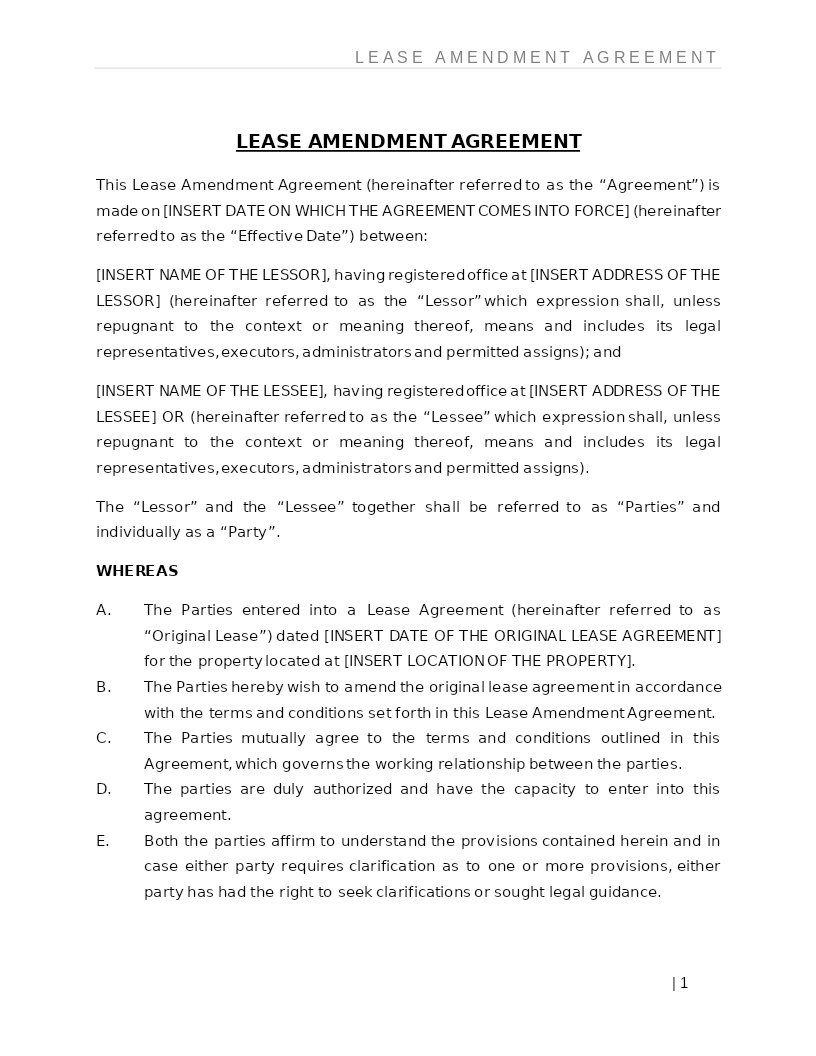
LEASE AMENDMENT AGREEMENT
How does it work?
1. Choose this template
Start by clicking on "Fill out the template"
2. Complete the document
Answer a few questions and your document is created automatically.
3. Save - Print
Your document is ready! You will receive it in Word and PDF formats. You will be able to modify it.
Understanding Lease Amendment Agreements
A Lease Amendment Agreement is a legally binding document that modifies or updates specific terms of an existing lease between a landlord (the “Lessor”) and a tenant (the “Lessee”). Instead of drafting an entirely new lease, this agreement allows the parties to make changes, additions, or clarifications to the current lease, such as adjusting rent, extending the lease term, adding occupants, modifying property rules, revising utility responsibilities, or updating legal compliance requirements.
In the United States, Lease Amendment Agreements are governed by state landlord–tenant laws, real estate regulations, contract law, and local housing codes. This agreement ensures that any modification to the original lease is properly documented, legally enforceable, and mutually agreed upon by both parties.
Where Lease Amendment Agreements Are Commonly Used
Lease Amendment Agreements are widely used for residential, commercial, and mixed-use properties, including:
- Rental homes, apartments, and multifamily housing
- Commercial office spaces and coworking units
- Retail stores, restaurants, and small business spaces
- Warehouses, industrial units, and storage properties
- Short-term and long-term rental arrangements
- Corporate leases and commercial facilities
Whenever a landlord or tenant needs to adjust an existing lease without replacing it entirely, a Lease Amendment Agreement provides a clear legal framework.
Different Types of Lease Amendments You May Encounter
- Rent Adjustment Amendment: Used to increase, decrease, or restructure rental payments, including late fees or due dates.
- Lease Term Extension or Reduction: Extends the lease for additional months/years or shortens the remaining term.
- Occupancy or Use Modification: Adds new occupants, authorizes pets, updates use of premises, or modifies business activities.
- Maintenance & Responsibility Amendment: Updates repair duties, utilities, landscaping, or property upkeep responsibilities.
- Policy or Rule Changes: Used when updating smoking rules, parking assignments, access hours, or compliance requirements.
- Commercial Lease Amendments: Includes CAM charges, signage rights, build-out allowances, and operational requirements.
When Legal Guidance Becomes Helpful
Legal review is beneficial when:
- The amendment involves financial changes, such as rent restructuring
- The property is subject to local housing ordinances or rent-control laws
- The landlord and tenant renegotiate commercial terms
- The amendment affects zoning, permitted use, or compliance obligations
- Tenant improvements, renovations, or structural changes are included
- The lease involves corporate entities, franchise locations, or multi-tenant buildings
- There are concerns about liability, insurance, or indemnity clauses
Legal guidance ensures that changes to the lease remain enforceable and compliant with U.S. state rules.
How to Work with This Template
- Identify the original lease and its execution date
- Specify the exact sections being amended or replaced
- Clearly state the updated terms, obligations, and effective dates
- Confirm that all other original lease terms remain unchanged
- Choose the governing U.S. state law
- Include signature blocks for the landlord, tenant, and any guarantors
- Sign electronically or physically according to applicable state requirements
This template follows standard U.S. leasing practices and is compatible with major digital signature platforms.
Frequently Asked Questions
Q1. What is a Lease Amendment Agreement?
A Lease Amendment Agreement is a written document that updates specific terms of an existing lease without replacing it entirely. It is used to make legally enforceable changes such as rent adjustments, extending the lease term, or updating property rules.
Q2. Is a Lease Amendment legally binding in the U.S.?
Yes. Once both parties sign the amendment, it becomes legally binding under state contract and landlord–tenant laws. Courts enforce lease amendments just as they enforce the original lease terms.
Q3. Do I need a new lease if I want to change the terms?
Not necessarily. A Lease Amendment Agreement allows you to modify only the sections that need updating while keeping the rest of the lease intact. This is faster and easier than drafting a new lease.
Q4. What changes can be made through a Lease Amendment?
Common amendments include rent changes, extending or shortening the lease term, updating occupancy rules, modifying maintenance duties, or adding new property policies. Commercial leases may also amend CAM fees, signage rights, or business operations.
Q5. Can a landlord change lease terms without tenant consent?
No. In the U.S., a landlord cannot unilaterally change lease terms during the active lease period. Both parties must agree to the new terms and sign the amendment for it to be enforceable.
6. Is it necessary to notarize a Lease Amendment?
Most states do not require notarization for residential lease amendments. However, some commercial leases or state-specific laws may require notarization or witnesses. Always check local requirements.
Q7. Are electronic signatures valid for lease amendments?
Yes. Under the U.S. ESIGN Act, electronic signatures are legally enforceable. Many landlords and tenants use Docu Sign or similar platforms to sign amendments digitally.
Q8. Does a Lease Amendment change the entire lease?
No. Only the sections specifically modified in the amendment are changed. All other original terms remain valid and enforceable unless stated otherwise.
Q9. Can multiple amendments be made over time?
Yes. Landlords and tenants may execute several amendments during the lease term. Best practice is to number each amendment clearly to maintain an organized record.
Q10. Is a Lease Amendment Agreement suitable for both residential and commercial leases?
Absolutely. Lease Amendment Agreements are commonly used for apartments, homes, commercial spaces, offices, and retail locations to update terms without renegotiating a full lease.