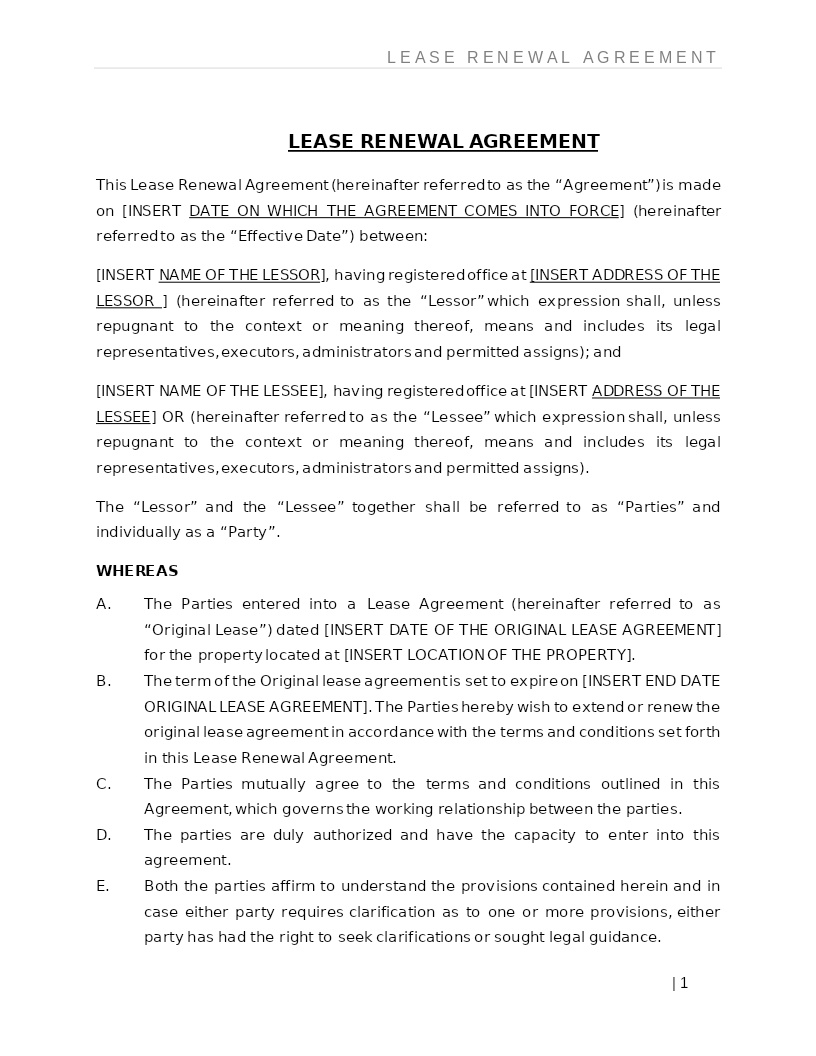
LEASE RENEWAL AGREEMENT
How does it work?
1. Choose this template
Start by clicking on "Fill out the template"
2. Complete the document
Answer a few questions and your document is created automatically.
3. Save - Print
Your document is ready! You will receive it in Word and PDF formats. You will be able to modify it.
Understanding Lease Renewal Agreements in the United States
A Lease Renewal Agreement is a formal document that extends the terms of an existing lease between a landlord and a tenant for a new period. Rather than starting an entirely new lease, a renewal builds on the original contract while updating key terms—such as rent adjustments, duration, maintenance obligations, and compliance requirements. This ensures continuity in tenancy and keeps both parties protected under a clear, legally recognized agreement.
A lease renewal agreement establishes clarity, stability, and enforceability in the ongoing landlord–tenant relationship. It prevents misunderstandings, keeps the rental process predictable, and outlines any changes in rights and responsibilities with transparent documentation.
Lease renewals are widely used across residential, commercial, and industrial rentals throughout the U.S., providing assurance that both parties can continue their arrangement without disruptions or legal uncertainty.
Where Lease Renewal Agreements Are Commonly Used
Lease renewal agreements are standard in many real-estate contexts, including:
- Residential Rentals – Apartments, condos, single-family homes, duplexes, and long-term rental properties.
- Commercial Spaces – Retail stores, offices, restaurants, warehouses, and small businesses that require uninterrupted operation.
- Industrial Properties – Manufacturing units, storage facilities, and distribution spaces with long-term operational needs.
- Mixed-Use and Multi-Tenant Buildings – Properties where stability and planning are essential for both landlords and tenants.
- Student Housing & Long-Term Rentals – Rentals that rely on predictable terms and consistent occupancy.
Any arrangement where both sides want to avoid turnover, maintain continuity, and lock in updated terms benefits from a structured renewal agreement.
Different Types of Lease Renewal Agreements You May Encounter
- Automatic Renewal Agreement: The lease renews automatically unless one party gives notice. Common in residential rentals where long-term stability is desired.
- Fixed-Term Renewal Agreement: The lease is extended for a specific period (e.g., 6 months or 12 months) with updated terms clearly outlined.
- Short-Term or Temporary Renewal: Used when the tenant needs a few extra months before moving or when the landlord plans future renovations or sales.
- Negotiated Renewal Agreement: Includes changes to rent, responsibilities, parking, utilities, or other provisions after mutual negotiation.
- Commercial Lease Renewal Amendment: Often customized for business tenants, including pricing escalations, operational requirements, tenant improvements, or changes to commercial use.
- Rent-Control or City-Regulated Renewal: Used in jurisdictions with rent caps or renewal-specific guidelines (e.g., New York, San Francisco, D.C.), ensuring compliance with local regulations.
When Legal Guidance Becomes Helpful
Although many lease renewals are straightforward, legal review becomes valuable when:
- Rent increases, penalties, or escalations require careful structuring.
- The property is in a rent-controlled or heavily regulated jurisdiction.
- The renewal involves commercial or industrial leases with complex operational needs.
- Maintenance duties, repairs, or improvements need detailed clarification.
- There are co-tenants, subtenants, guarantors, or corporate tenants involved.
- One party wants to modify key terms such as termination rights, use restrictions, or insurance requirements.
- The renewal may impact zoning, business uses, or compliance obligations.
Legal counsel ensures that the renewal terms are enforceable, compliant with state and city regulations, and aligned with long-term leasing goals.
How to Work with This Template
- Identify the parties and reference the original lease, including its start date and purpose.
- Specify the renewal period, whether short-term or long-term.
- Update key terms—rent amount, deposits, utility responsibilities, maintenance duties, or new rules.
- Clarify any modifications to the original lease to avoid conflicting interpretations.
- Choose the governing state law, especially important for multi-state property owners.
- Review the document together and negotiate any concerns before signing.
- Sign electronically or in hard copy, both valid under U.S. contract laws.
This ensures the renewal is transparent, enforceable, and properly documented for future reference.
Frequently Asked Questions
Q1. Is a Lease Renewal Agreement legally binding in the U.S.?
Yes. Once signed by both parties, a Lease Renewal Agreement becomes a legally enforceable extension of the original lease. Courts recognize renewal agreements as valid contracts as long as the terms are clear, voluntary, and compliant with state landlord-tenant laws. This protects both the landlord and the tenant from misunderstandings or disputes. It also ensures the tenancy continues under updated, mutually accepted conditions.
Q2. Do all lease renewals need to be in writing?
While some states may recognize oral renewals, a written Lease Renewal Agreement is always the safest and most enforceable option. It clearly outlines the new terms such as rent, duration, and responsibilities and prevents confusion between the parties. Written documentation also serves as proof in case of disagreements. Most landlords and tenants prefer written renewals for transparency and legal certainty.
Q3. Can a landlord increase rent in a lease renewal?
Yes. Rent adjustments are common during renewals unless restricted by rent-control laws or previously agreed terms. The new rent amount must be stated clearly in the renewal agreement to avoid misunderstandings. Providing written notice of the change ensures transparency and allows the tenant to plan financially. A documented increase also helps the landlord maintain compliant and consistent records.
Q4. What happens if a tenant remains in the property without a renewal?
If a tenant stays after the lease term ends without signing a renewal, they may become a holdover tenant under state law. This often converts the tenancy into a month-to-month arrangement with different rent or termination rules. Landlords may increase rent or decide not to continue the tenancy altogether. Having a proper renewal agreement avoids these uncertainties and protects both parties from unexpected changes.
Q5. Can tenants negotiate renewal terms?
Absolutely. Tenants can negotiate rent, lease duration, maintenance responsibilities, or additional amenities based on their needs. Renewal discussions give both parties a chance to make adjustments that improve the living or business arrangement. Documenting these negotiated terms in the renewal ensures clarity and prevents future disputes. It also supports a positive landlord–tenant relationship.
Q6. Are electronic signatures valid for lease renewals?
Yes. Under the federal ESIGN Act, electronic signatures are fully valid and enforceable across the United States. This makes the lease renewal process fast, convenient, and accessible especially for tenants or landlords who are travelling or located out of state. E-signatures reduce paperwork and ensure accurate record-keeping. Both parties simply need to agree to sign electronically.
Q7. When should a lease renewal be offered or signed?
Most landlords initiate renewal discussions 30–90 days before the lease expires to avoid vacancies or last-minute negotiations. Early communication gives tenants enough time to review terms, request changes, or plan their next steps. It also helps landlords maintain continuous occupancy and predictable income. Signing the renewal promptly ensures a seamless transition into the next lease term.
Q8. Can a landlord refuse to renew a lease?
Yes, landlords can refuse renewal as long as the decision complies with local and federal laws, including anti-discrimination regulations. Reasons may include planned renovations, sale of the property, repeated tenant violations, or a shift in business use. Landlords must provide proper notice based on state-specific requirements. A clear communication timeline helps both parties prepare for the transition.
Q9. What if either party wants to modify specific clauses from the original lease?
Any modifications, such as new rent terms, updated rules, or additional responsibilities, can be added directly into the renewal agreement if both parties agree. Each change should be written clearly to prevent conflicts with the original lease language. Reviewing revised terms ensures accuracy and mutual understanding. For major changes, legal guidance can help ensure enforceability.
Q10. Is a lease renewal the same as a lease extension?
Not exactly. A lease renewal creates a new lease term, often with updated conditions, while a lease extension simply lengthens the current lease without major changes. Renewals are ideal when adjusting rent or modifying key terms, whereas extensions are used for temporary or short-term arrangements. Understanding the difference helps both parties choose the option that best fits their needs.