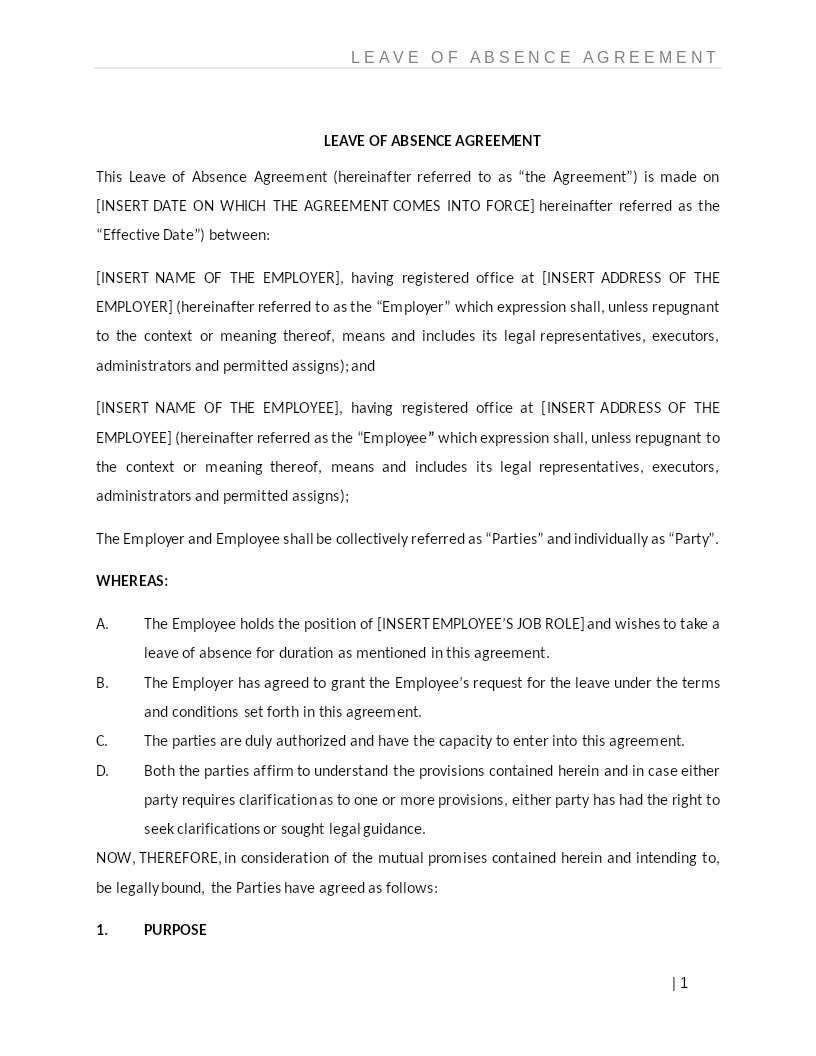
LEAVE OF ABSENCE AGREEMENT
How does it work?
1. Choose this template
Start by clicking on "Fill out the template"
2. Complete the document
Answer a few questions and your document is created automatically.
3. Save - Print
Your document is ready! You will receive it in Word and PDF formats. You will be able to modify it.
Formalizing Employee Leave Entitlements Through Leave of Absence Agreements
Employers frequently encounter circumstances in which employees require time away from work for medical, personal, family, educational, or other qualifying reasons. To safeguard the rights of both parties and ensure regulatory compliance, it is essential to document the terms governing such leave in a written agreement. A Leave of Absence Agreement serves this purpose. It establishes the conditions, procedures, protections, and obligations associated with a temporary leave of employment, consistent with U.S. federal law, including the Family and Medical Leave Act (FMLA), Americans with Disabilities Act (ADA), state-mandated leave statutes, and applicable company policies.
By entering into a Leave of Absence Agreement, the employer and employee create a formal record that clarifies the duration of leave, job-protection standards, benefit continuation rules, confidentiality requirements, medical-certification procedures, and return-to-work expectations. This agreement allows the leave to proceed in an organized, lawful manner while minimizing misunderstandings, promoting workforce stability, and ensuring that both employer and employee fully understand their respective roles and responsibilities throughout the leave period.
Where Leave of Absence Agreements Are Commonly Used
Leave of Absence Agreements are widely utilized across workplaces of all sizes, including:
- Companies managing FMLA-eligible medical or family care leave
- Employers offering discretionary personal leave, bereavement leave, or extended unpaid leave
- Businesses addressing accommodation-related leave under ADA or state disability laws
- Organizations permitting educational leave or professional development-related absence
- Workplaces offering maternity, paternity, bonding leave, or adoption-related leave
- Employers dealing with military leave, jury duty leaves, or emergency family leave
- Human resources departments managing short-term or long-term disability coordination
- Businesses seeking written acknowledgment of expectations during the employee’s absence
Whenever an employee temporarily steps away from their responsibilities, a Leave of Absence Agreement ensures that all terms are clearly defined and enforceable.
Different Types of Leave of Absence Agreements You May Encounter
1. Medical Leave Agreements (FMLA and Non-FMLA): Cover absences due to serious health conditions, surgical recovery, medical treatment, or chronic illness.
2. Family Care Leave Agreements: Address employees leave to care for an ill spouse, child, parent, or qualifying family member.
3. Parental or Bonding Leave Agreements: Apply to childbirth, adoption, foster placement, and caregiver bonding periods.
4. Personal Leave or Discretionary Leave Agreements: Grant unpaid or employer-approved leave not required by law.
5. ADA-Accommodation Leave Agreements: Provide medical leave as a reasonable accommodation for disability under ADA.
6. Military Leave Agreements: Govern absences under USERRA for military service, training, or deployment.
When Legal Guidance Becomes Helpful
Legal review may be necessary when:
- The leave duration triggers FMLA job-protection obligations
- The leave request relates to disability, requiring ADA accommodation evaluation
- State-specific leave laws (e.g., paid family leave, sick leave mandates) apply
- An employee disputes eligibility, documentation, or leave duration
- There is uncertainty about fitness-for-duty requirements or reinstatement rights
- Confidential medical information must be managed in accordance with HIPAA rules
- Employee benefits such as health insurance, paid leave balances, or seniority are affected
- Company policy requires harmonization with union contracts or employee handbooks
Legal counsel ensures the agreement complies with federal and state employment laws, appropriately protects employer interests, and mitigates the risk of discrimination or wrongful-termination claims.
How to Work with This Template
- Identify the employee, employer, position, and requested leave period
- State whether the leave is protected under FMLA, ADA, state laws, or company policy
- Describe documentation requirements, including medical certifications or legal notices
- Outline employee obligations during leave, such as periodic check-ins or document updates
- Address benefit continuation, premium payments, and use of paid or unpaid time
- Specify job-restoration rights, reinstatement conditions, and transitional arrangements
- Include clear expectations regarding return-to-work requirements and deadlines
- Select governing law based on jurisdiction and applicable federal statutes
- Have both parties sign electronically or in writing to formalize the agreement
This template reflects widely accepted U.S. employment-law standards and integrates seamlessly with HR policies, employee handbooks, and compliance frameworks.
Frequently Asked Questions
Q1. What is a Leave of Absence Agreement, and why is it necessary?
A Leave of Absence Agreement is a formal document that outlines the terms under which an employee temporarily steps away from work. It is necessary because it clarifies eligibility, responsibilities, benefit implications, and job-protection rights while ensuring compliance with FMLA, ADA, and state law requirements.
Q2. Does a Leave of Absence Agreement guarantee job protection?
Job protection depends on the type of leave. FMLA-protected leave guarantees reinstatement to the same or an equivalent position. Other types of leave such as discretionary personal leave may not include guaranteed job protection unless the employer voluntarily provides it.
Q3. Can employers require medical certification?
Yes. For medical-related leave, employers may request documentation verifying the need for leave, provided the request complies with FMLA rules, ADA confidentiality, and other applicable laws.
Q4. Are employees paid during a leave of absence?
Payment varies. Leaves may be paid if covered by employer policies, state paid leave programs, or accrued PTO. Many leaves, however, are unpaid unless specifically designated otherwise.
Q5. What happens to benefits during a leave of absence?
FMLA requires continuation of group health insurance under the same terms. For non-FMLA leave, employers may set benefit-continuation rules. Employees may need to pay premiums during extended unpaid leave.
Q6. Are electronic signatures valid for Leave of Absence Agreements?
Yes. Under the ESIGN Act, electronically executed agreements are legally binding and widely accepted by HR departments across the United States.
Q7. Can an employer deny a leave request?
Employers may deny leave only when the employee is not legally entitled to it or when the request violates company policy. However, denial of protected leave such as FMLA or ADA-required leave may create legal exposure.
Q8. What if the employee cannot return by the agreed date?
Employees should notify the employer promptly. Employers may extend leave, require updated certifications, or evaluate whether additional leave is a reasonable accommodation under the ADA.
Q9. Does a Leave of Absence Agreement replace FMLA rights?
No. An agreement cannot override an employee’s statutory rights. Instead, it documents how those rights apply in the specific situation.
Q10. Can an employee work another job during leave?
This depends on the agreement and employer policy. Certain types of leave especially medical leave may prohibit outside work if it conflicts with the stated reason for leave.