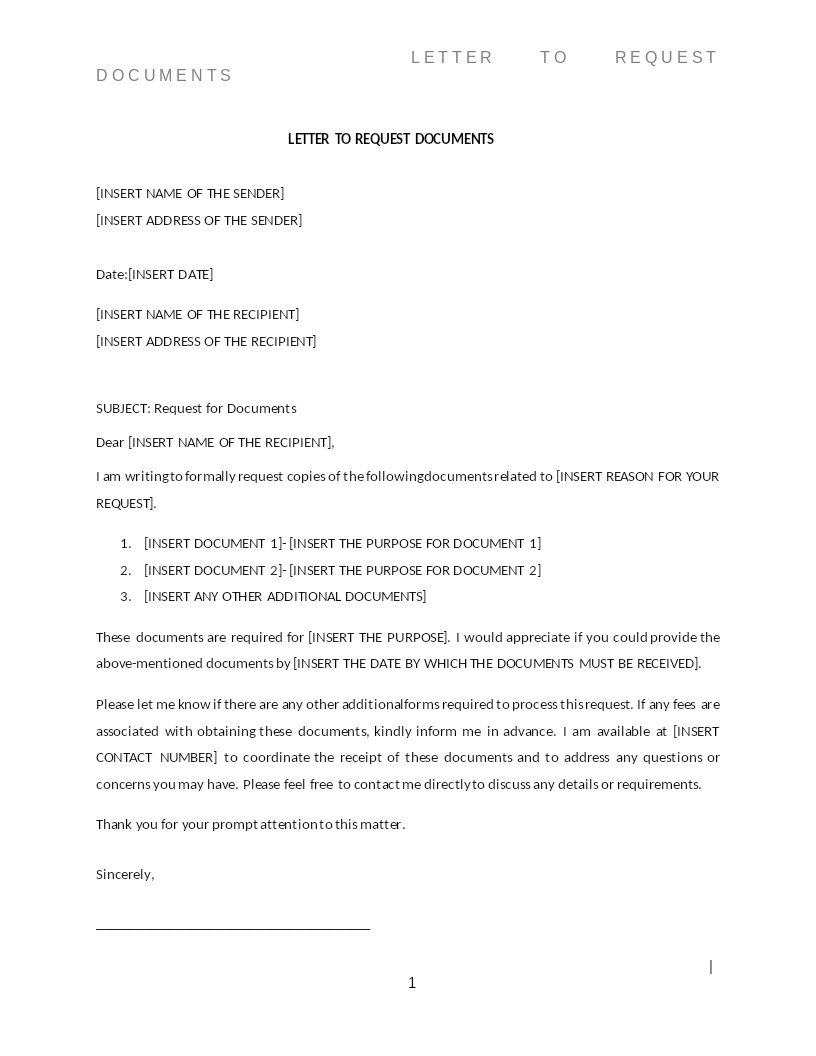
LETTER TO REQUEST DOCUMENTS
How does it work?
1. Choose this template
Start by clicking on "Fill out the template"
2. Complete the document
Answer a few questions and your document is created automatically.
3. Save - Print
Your document is ready! You will receive it in Word and PDF formats. You will be able to modify it.
Formally Requesting Records and Documentation Through Written Notice
Businesses and individuals often require access to documents held by another party to verify contractual obligations, support legal rights, or maintain compliance. When such records are not readily provided, a formal written request becomes necessary. A Letter to Request Documents serves this purpose. It outlines the requesting party’s legal or contractual basis for seeking the documents, specifies the records needed, and establishes reasonable deadlines for delivery, consistent with U.S. contract law, consumer protection statutes, privacy regulations, and applicable federal and state record-access rules.
By issuing a Letter to Request Documents, the party creates a clear, written communication that documents the request, ensures proper notice, and provides an opportunity for voluntary compliance before further action is taken. This letter helps avoid disputes, maintains transparency, and supports compliance with statutory and contractual obligations.
Where Letters to Request Documents Are Commonly Used
Document-request letters are used in a wide range of legal, business, and administrative contexts, including:
- Requesting contracts, receipts, or billing records
- Obtaining payroll, employment, or HR-related documentation
- Requesting medical, insurance, or benefits-related records
- Seeking bank statements, loan agreements, or financial documents
- Requesting tenant, landlord, or property-management records
- Obtaining corporate governance, compliance, or policy documents
- Requesting academic, enrollment, or educational records
- Seeking copies of communications, notices, or prior agreements
Whenever one party requires documentation held by another, a formal letter ensures a proper record of the request.
Different Types of Document Request Letters You May Encounter
1. Contractual Document Request Letters: Seek documents required under a contract or business agreement.
2. Employment or HR Document Request Letters: Involve pay records, personnel files, or workplace documentation.
3. Financial or Banking Document Requests: Address statements, account records, or loan documentation.
4. Legal or Compliance Document Requests: Support regulatory audits, disputes, or attorney-requested information.
5. Tenant or Property-Related Document Requests: Apply to leases, notices, deposit statements, or maintenance records.
When Legal Guidance Becomes Helpful
Legal consultation may be advisable when:
- The documents are needed for litigation, arbitration, or dispute resolution
- Federal or state record-access laws impose specific deadlines or procedures
- Confidential, proprietary, or protected information is involved
- The other party refuses to provide documents or disputes your right to them
- The request concerns employment, medical, or consumer records subject to regulation
- The letter may later be used as evidence in court
Legal review ensures the request is lawful, properly worded, and effective in supporting your rights.
How to Work with This Template
- Identify both the requesting party and the record holder
- Describe the documents being requested with specificity
- Provide legal authority or the basis for requesting the records
- Set a reasonable deadline for the documents to be produced
- Include acceptable delivery formats (electronic, printed, certified copies)
- Offer contact information for clarification or follow-up
- Deliver the letter in writing, preferably using trackable methods
- Maintain copies of all correspondence for future reference
This template aligns with U.S. document-access practices and may be used by individuals, businesses, attorneys, or compliance professionals.
Frequently Asked Questions
Q1. What is a Letter to Request Documents, and why is it important?
A Letter to Request Documents is a formal written communication seeking copies of records or information from another party. It is important because it creates a documented request, establishes deadlines, and supports compliance with legal or contractual obligations.
Q2. When is a document request letter used?
These letters are used whenever one party requires access to information held by another such as financial records, employment documents, contracts, or communications to verify rights, resolve disputes, or meet regulatory requirements.
Q3. What should be included in a document request letter?
The letter should identify the parties, describe the requested documents, provide a legal basis (if applicable), outline deadlines, and specify preferred delivery methods.
Q4. How should the letter be delivered?
Delivery should be verifiable. Certified mail, courier, or email with read receipts ensures a clear record of the request in case the matter escalates.
Q5. Can a business refuse to provide documents?
Yes, in some cases particularly when documents are confidential, privileged, or outside the requesting party’s legal rights. However, refusal must comply with applicable laws, and the reason for non-disclosure should be communicated.
Q6. What happens if the requested documents are not provided?
If the other party ignores or refuses the request, the requesting party may escalate the matter through legal notice, formal discovery, administrative filings, or litigation, depending on the situation.
Q7. Are there laws requiring certain documents to be provided?
Yes. Employment, consumer, tenant, financial, educational, and insurance records are often subject to federal or state access laws that mandate timely production upon request.
Q8. Are electronic signatures valid for document request letters?
Yes. Under the ESIGN Act, electronic signatures and digitally issued letters are valid and enforceable.
Q9. How long should the party be given to respond?
A typical timeframe is 7–14 business days, though certain laws require shorter or longer deadlines. The letter should state a reasonable and legally compliant response period.
Q10. Can this letter be used as evidence?
Yes. A well-drafted document request letter can serve as evidence of notice, good-faith effort, or compliance with pre-litigation requirements.