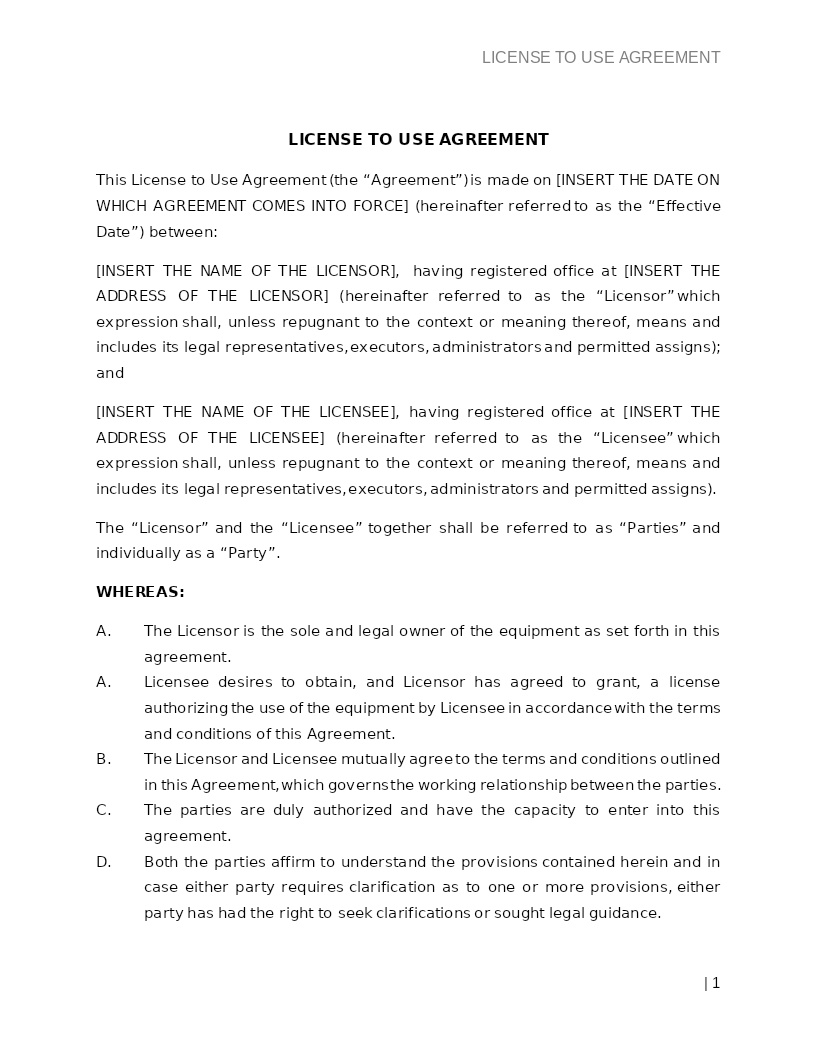
LICENSE TO USE AGREEMENT
How does it work?
1. Choose this template
Start by clicking on "Fill out the template"
2. Complete the document
Answer a few questions and your document is created automatically.
3. Save - Print
Your document is ready! You will receive it in Word and PDF formats. You will be able to modify it.
Understanding the Purpose and Use of a License to Use Agreement
When a business intends to grant controlled access to its intellectual property, software, brand assets, digital content, or other proprietary materials, it becomes essential to establish a clear framework that governs how these assets may be used. A License to Use Agreement provides that structure. It defines what rights are granted to the licensee, what restrictions apply, and what responsibilities both parties must follow during the term of the license.
Having this agreement in place allows parties to collaborate, share technology, distribute products, or expand into new markets while preserving ownership rights. It provides clarity, reduces legal risks, and ensures the licensed material is used only within the boundaries agreed upon by both parties.
Where License to Use Agreements Are Commonly Used
Licensing arrangements are standard in diverse U.S. commercial and technological contexts, including:
- Software-as-a-Service (SaaS) and digital platforms
- Licensing of patents, inventions, and proprietary technology
- Use of copyrighted works, images, videos, and creative assets
- Distribution of brand logos, trademarks, and marketing material
- Access to proprietary tools, dashboards, and internal systems
- Collaboration agreements, joint ventures, and R&D partnerships
Any time intellectual property or proprietary content is shared outside its original environment, a written license agreement sets clear boundaries around how the recipient may use it.
Different Types of License to Use Agreements You May Encounter
- Software License: Grants users access to software under terms such as single-user, multi-user, or enterprise licenses.
- Intellectual Property License: Allows use of patents, trademarks, copyrights, or trade secrets for defined purposes.
- Content or Media License: Covers photographs, videos, articles, designs, or digital content for personal or commercial use.
- Commercial Use License: Permits the licensee to use a product, content, or IP for commercial gain under specified terms.
- Limited or Non-Exclusive License: Provides permission to use an asset without granting full ownership or exclusivity.
When Legal Guidance Becomes Helpful
Most basic licensing arrangements are straightforward, but legal and in-house counsel review becomes valuable when:
- Licensing involves high-value intellectual property, technology, or patented innovations.
- Usage terms require restrictions on modification, redistribution, or sublicensing.
- Multiple jurisdictions or cross-border digital licensing issues are involved.
- The licensed asset belongs to a regulated industry like healthcare, finance, or education.
- Revenue-sharing models, royalty structures, or subscription payments must be defined clearly.
- Confidential, proprietary, or trade secret information is embedded within the licensed material.
Legal review ensures that rights are properly granted, protected, and enforceable, while reducing the risk of misuse, infringement, or financial disputes.
How to Work with This Template
- Identify the licensor, licensee, and the specific material being licensed.
- Clearly define usage rights, limitations, and prohibitions (e.g., no resale, no modification).
- Specify payment terms, royalty fees, or subscription charges if applicable.
- Select governing state law and ensure compliance with IP and digital content regulations.
- Review the terms together (legal review is optional).
- Sign electronically or in hard copy for enforceability.
This template follows commonly accepted licensing standards recognized throughout the United States and supports both digital and traditional licensing arrangements.
Frequently Asked Questions
Q1. Why is a License to Use Agreement important in the United States?
It provides a legal framework that protects ownership rights while granting controlled usage of intellectual property, software, or content. Without this agreement, licensors risk unauthorized use, modification, or distribution of their assets. It also helps avoid disputes by clearly defining roles and limitations.
Q2. Does the licensee gain ownership of the licensed material?
No. A license grants usage rights, not ownership. The licensor retains full ownership and may restrict modification, resale, or redistribution. The agreement ensures that all rights not explicitly granted remain with the licensor.
Q3. Can licensing agreements be customized for different industries?
Yes. Licensing terms differ widely across software, media, manufacturing, and technology sectors. Customization ensures compliance with industry standards, regulatory requirements, and commercial objectives while protecting intellectual property from misuse.
Q4. Are electronic signatures valid for signing this agreement?
Yes. Under U.S. federal and state laws, electronic signatures are legally valid and enforceable. This makes digital execution convenient for SaaS contracts, online content licensing, and IP transfers.
Q5. Can a license include fees or royalties?
Absolutely. Licenses often include upfront fees, subscription charges, or recurring royalties based on sales or usage. Clear payment terms help both parties manage expectations and ensure timely compensation for the licensor.
Q6. Can the licensee sublicense the material to others?
Only if the agreement explicitly permits it. Most licenses prohibit sublicensing to prevent unauthorized distribution. Restricting sublicensing ensures that the licensed material remains within approved channels.
Q7. What happens if the licensee breaches the agreement?
The licensor may terminate the license, demand cessation of use, and pursue damages or injunctive relief. Clear dispute-resolution terms make enforcement efficient and reduce litigation risks. Properly drafted terms protect both parties.
Q8. Does this agreement work for digital or online content?
Yes. Digital licensing is one of the most common use cases, covering software, images, videos, online courses, templates, and digital tools. The agreement ensures compliance with copyright laws and sets boundaries around online usage, copying, or redistribution.