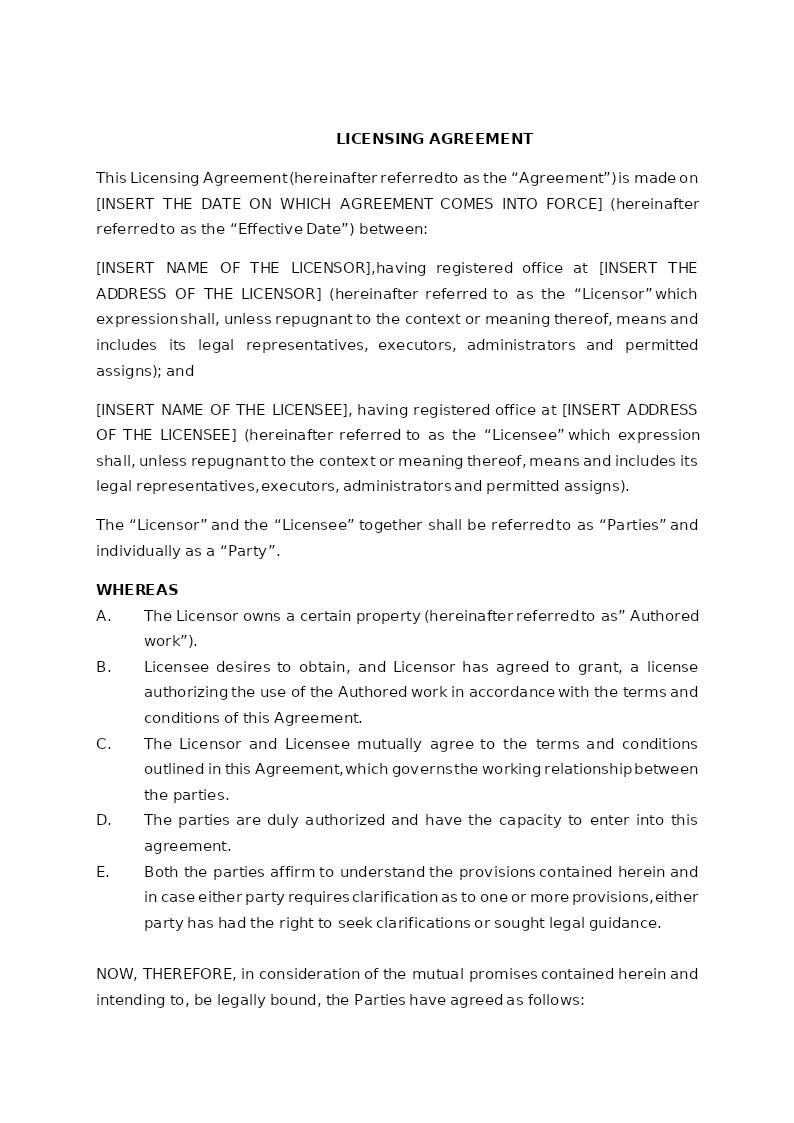
LICENSING AGREEMENT
How does it work?
1. Choose this template
Start by clicking on "Fill out the template"
2. Complete the document
Answer a few questions and your document is created automatically.
3. Save - Print
Your document is ready! You will receive it in Word and PDF formats. You will be able to modify it.
Establishing Authorized Use of Intellectual Property Through Licensing Arrangements
Companies, creators, and rights-holders frequently authorize third parties to use intellectual property such as trademarks, copyrighted works, patents, software, digital assets, or proprietary content. To ensure such use is lawful, controlled, and commercially beneficial, the parties must document their relationship through a formal written agreement. A Licensing Agreement serves this purpose. It outlines the scope, limitations, and terms under which a licensee may access, use, distribute, or commercialize the licensor’s intellectual property in accordance with U.S. contract law, federal IP statutes, USPTO and Copyright Office regulations, and applicable state licensing rules.
By entering into a Licensing Agreement, the parties create an enforceable legal framework that details permitted uses, quality-control requirements, payment structure, exclusivity parameters, duration of rights, confidentiality obligations, and compliance standards. This ensures that the intellectual property is protected, the licensee’s use is clearly regulated, and the licensor’s commercial interests are preserved.
Where Licensing Agreements Are Commonly Used
Licensing Agreements are widely used across creative, technological, and commercial industries, including:
- Trademark licensing for brand extensions, franchise arrangements, and merchandising
- Copyright licensing for artwork, written materials, music, photography, or multimedia assets
- Technology and software licensing for SaaS platforms, digital tools, and proprietary systems
- Patent licensing for inventions, manufacturing rights, and product commercialization
- Product distribution and private-label licensing arrangements
- Publishing and entertainment rights, including film, music, and literary content
- Academic or research-based licensing involving institutional intellectual property
- Content licensing for marketing assets, templates, or digital libraries
Whenever intellectual property is shared or monetized, a Licensing Agreement governs the legal and commercial terms of use.
Different Types of Licensing Agreements You May Encounter
1. Exclusive Licensing Agreements: Grant the Licensee exclusive rights within a defined territory or market, prohibiting the Licensor from granting similar rights to others.
2. Non-Exclusive Licensing Agreements: Permit the licensor to license the same intellectual property to multiple licensees.
3. Sole Licensing Agreements: Allow the licensor and one licensee to use the intellectual property simultaneously but restrict third-party licensing.
4. Technology or Software Licensing Agreements: Govern the use of source code, software platforms, apps, or digital tools.
5. Trademark and Branding Licensing Agreements: Regulate how brand elements may be used in advertising, product packaging, or commercial settings.
6. Royalty-Based or Revenue-Sharing Agreements: Compensate the licensor based on sales, usage, or performance metrics.
When Legal Guidance Becomes Helpful
Legal consultation is strongly advisable when:
- Intellectual property is valuable, complex, or high-risk
- The agreement includes exclusivity, sublicensing, or territorial rights
- Royalty structures, minimum sales obligations, or audits are involved
- The IP relates to regulated industries (healthcare, finance, technology, pharmaceuticals)
- The rights granted may impact ongoing business operations or branding
- The Licensor requires strict quality-control rights to prevent dilution or misuse
- Cross-border licensing or international distribution is contemplated
Legal review helps ensure the agreement complies with U.S. IP laws, does not inadvertently transfer ownership, and mitigates the risk of infringement or misuse.
How to Work with This Template
- Identify the Licensor, Licensee, and the intellectual property subject to the license
- Define the permitted uses, distribution channels, and geographic restrictions
- Specify payment obligations such as royalties, fixed fees, or minimum guarantees
- Establish quality-control standards, approval procedures, and reporting obligations
- Address confidentiality, data protection, and prohibited conduct
- Clarify ownership, infringement procedures, and enforcement rights
- Decide governing law and dispute-resolution methods
- Review compliance with federal and state licensing rules
- Execute the agreement electronically or in written form
This template reflects standard U.S. industry practice and is suitable for businesses, creators, publishers, developers, and intellectual-property owners.
Frequently Asked Questions
Q1. What is a Licensing Agreement, and why is it important?
A Licensing Agreement is a legally binding document that authorizes a licensee to use specific intellectual property under defined conditions. It is important because it protects the licensor’s ownership rights, prevents unauthorized use, and outlines the financial and operational terms governing the IP’s use.
Q2. Does a Licensing Agreement transfer ownership of the intellectual property?
No. A licensing arrangement grants the right to use the IP but does not transfer ownership unless explicitly stated. Ownership remains with the licensor.
Q3. What types of intellectual property can be licensed?
Copyrights, trademarks, patents, software, digital content, trade secrets, branding elements, and proprietary materials may all be licensed under properly drafted agreements.
Q4. Are royalties mandatory in a Licensing Agreement?
Not necessarily. Some licenses involve fixed fees, subscription charges, minimum guarantees, or cost-recovery payments instead of royalties. Compensation should be clearly defined.
Q5. Can the licensee modify or adapt the licensed material?
Only if permitted. Many agreements prohibit modification, reverse engineering, or derivative works unless expressly authorized by the licensor.
Q6. Are sublicensing rights allowed?
Sublicensing may be permitted or prohibited depending on the licensor’s preference. Clear language is required to avoid unintended transfer of rights.
Q7. Are electronic signatures enforceable for Licensing Agreements?
Yes. Under the ESIGN Act, electronically signed Licensing Agreements are valid and enforceable in the United States.
Q8. What happens if the licensee violates the Licensing Agreement?
The Licensor may terminate the agreement, revoke the granted rights, demand damages, or pursue legal remedies for breach, infringement, or misuse.
Q9. Can a Licensing Agreement be limited to certain markets or territories?
Yes. Many agreements restrict use of the intellectual property to a specific geographic area, industry, or distribution channel.
Q10. How long does a Licensing Agreement last?
The term depends on the negotiated agreement. Some licenses are short-term, while others last for multiple years or renew automatically based on performance criteria or royalty payments.