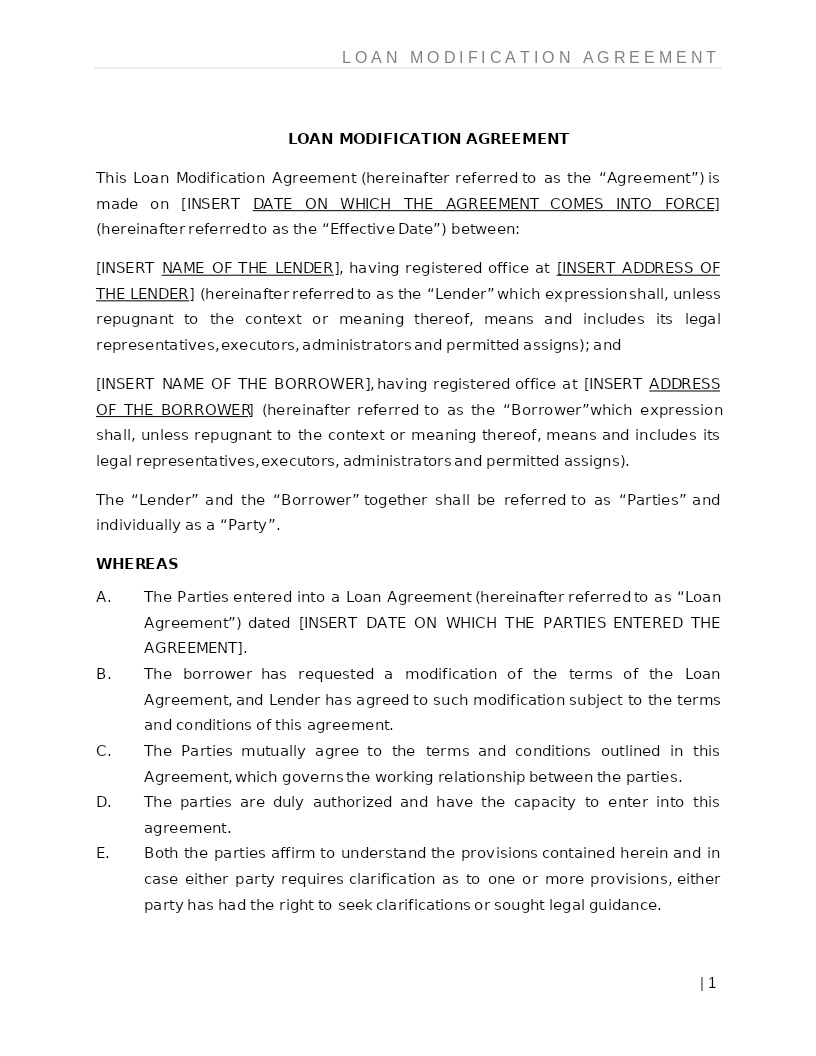
LOAN MODIFICATION AGREEMENT
How does it work?
1. Choose this template
Start by clicking on "Fill out the template"
2. Complete the document
Answer a few questions and your document is created automatically.
3. Save - Print
Your document is ready! You will receive it in Word and PDF formats. You will be able to modify it.
Modifying Existing Loan Terms Through Formal Loan Modification Agreements
Borrowers and lenders sometimes encounter financial or operational circumstances that necessitate an adjustment to the terms of an existing loan. When repayment challenges arise, interest rates fluctuate, or contractual provisions require refinement, the parties may agree to revise certain terms through a Loan Modification Agreement. This legally binding document outlines the new conditions governing the loan while preserving the core structure of the original agreement, in accordance with U.S. lending laws, mortgage servicing standards, consumer-protection regulations, and state and federal contract principles.
A Loan Modification Agreement ensures that all changes including adjustments to interest rates, repayment schedules, principal balances, escrow requirements, maturity dates, and default provisions are clearly documented and enforceable. By executing this agreement, both parties protect their financial interests, maintain regulatory compliance, and formally acknowledge their mutual consent to the updated terms.
Where Loan Modification Agreements Are Commonly Used
Loan Modification Agreements are widely utilized in both consumer and commercial lending, including:
- Modifying mortgage terms to assist borrowers experiencing financial hardship
- Adjusting commercial loan repayment structures due to business cash-flow changes
- Revising interest rates following changes in market conditions
- Renegotiating the maturity date or extending the term of the loan
- Adjusting payment schedules to reflect new income patterns or refinancing arrangements
- Revising covenant requirements in business credit facilities
- Addressing delinquent accounts to avoid foreclosure, repossession, or legal action
- Implementing restructuring arrangements between private lenders and borrowers
Loan modification is a common and essential tool for resolving financial strain while maintaining the continuity of a lending relationship.
Different Types of Loan Modification Agreements You May Encounter
1. Interest Rate Modification Agreements: Adjust the interest rate, often lowering it to help the borrower manage payments.
2. Term Extension Agreements: Extend the repayment period, decreasing monthly obligations.
3. Principal Forbearance or Deferred Principal Agreements: Allow a portion of the principal to be deferred, payable at a later date or upon loan maturity.
4. Repayment Plan Modifications: Restructure the frequency or amount of payments to better align with the borrower’s financial situation.
5. Variable-to-Fixed Rate Conversion Agreements: Convert adjustable interest rates into fixed-rate terms.
6. Loan Consolidation or Restructuring Agreements: Replace several existing obligations with an adjusted single-loan structure.
When Legal Guidance Becomes Helpful
Legal counsel may be advisable when:
• The modification involves mortgage loans regulated by federal servicing rules
• The lender is federally regulated and subject to CFPB compliance standards
• Complex commercial loans require adjustments to financial covenants
• The borrower risks default or foreclosure without modification
• There are disputes regarding interest calculations, escrow balances, or arrears
• The modification may trigger tax consequences or reporting requirements
• The original loan contains clauses restricting changes without lender approval
• State-specific lending, usury, or consumer-protection laws must be evaluated
An attorney ensures the modification complies with U.S. lending regulations, mitigates liability, and accurately reflects both parties’ intent.
How to Work with This Template
• Identify the original loan agreement by date, parties, and principal amount
• Clearly describe all modifications, including revised interest rates, terms, or payment schedules
• Cite which portions of the original agreement are replaced or supplemented
• Confirm that all other unchanged provisions remain in effect
• Address escrow adjustments, late-fee waivers, or default remedies if applicable
• Specify whether additional collateral, guarantees, or disclosures are required
• Detail the effective date, enforcement terms, and governing law
• Execute the agreement through written or electronic signatures and retain for records
• Ensure compliance with federal, state, and local lending regulations
This template aligns with standard U.S. loan-servicing practices and may be used by banks, mortgage servicers, credit unions, private lenders, and commercial financial institutions.
Frequently Asked Questions
Q1. What is a Loan Modification Agreement, and why is it necessary?
A Loan Modification Agreement is a legal document that formally revises the terms of an existing loan. It is necessary because it clarifies new repayment obligations, prevents misunderstandings, and helps lenders and borrowers avoid default or legal disputes.
Q2. Does a loan modification create a new loan?
Not usually. A modification alters specific terms but keeps the original loan in place. Only refinancing creates a new loan obligation.
Q3. Will a loan modification affect my credit?
It may. Some modifications have neutral effects, while hardship-related modifications may be reported differently. The agreement may specify how the modification will be communicated to credit bureaus.
Q4. Can interest rates be reduced through a modification?
Yes. Lenders often reduce interest rates as part of a modification to help borrowers maintain repayment capability, particularly during financial hardship.
Q5. Are electronic signatures enforceable on Loan Modification Agreements?
Yes. Under the ESIGN Act, electronic signatures are valid and enforceable for loan modifications and related financial documents.
Q6. Does a loan modification require additional collateral?
Sometimes. If the lender believes additional security is necessary, the agreement may require new guarantees, collateral adjustments, or reaffirmation of existing security interests.
Q7. Can a borrower be denied a loan modification?
Yes. Lenders may deny modification requests based on eligibility criteria, insufficient documentation, credit risk, or regulatory constraints.
Q8. What happens if a borrower defaults after modification?
The lender may pursue remedies under the original agreement and the modified terms, including foreclosure, repossession, or collection actions depending on the loan type.
Q9. Are there tax consequences to modifying a loan?
Potentially. Forbearance, debt forgiveness, or principal reduction may trigger tax obligations. Borrowers should seek tax advice.
Q10. Is legal review recommended before signing a modification?
Yes. Because modifications can significantly alter financial obligations, legal review can help ensure that the borrower’s rights are protected and the agreement is compliant with federal and state lending rules.