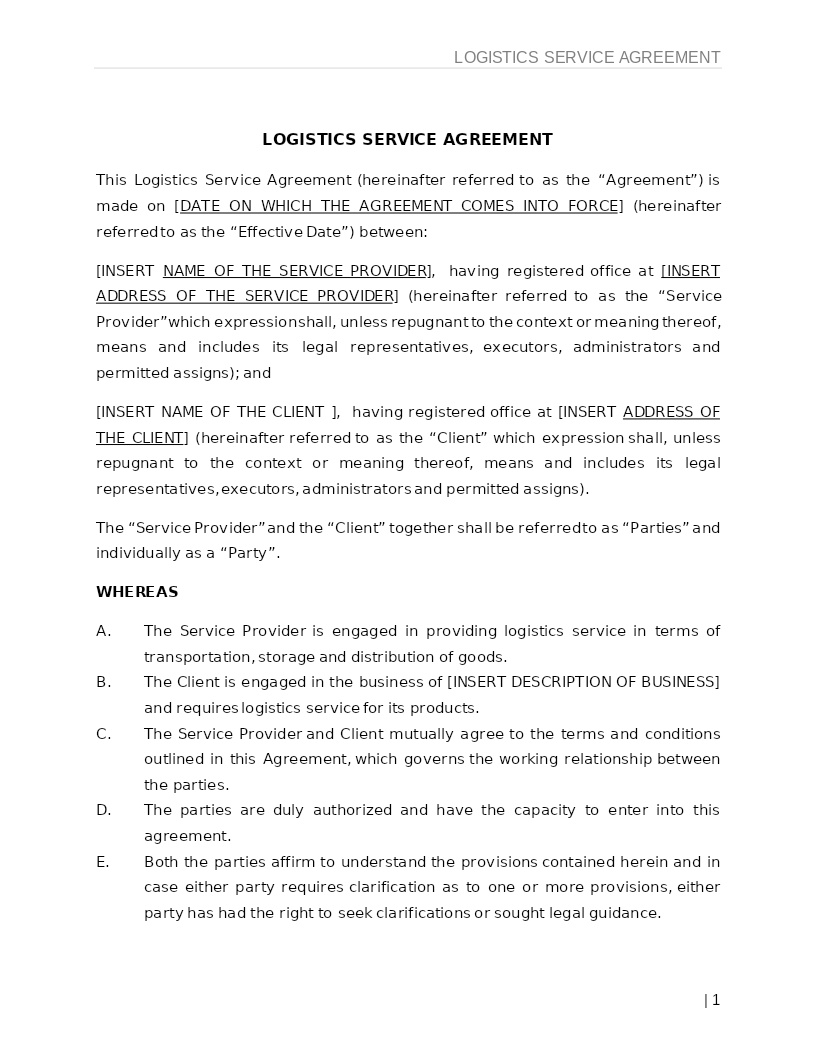
LOGISTICS SERVICE AGREEMENT
How does it work?
1. Choose this template
Start by clicking on "Fill out the template"
2. Complete the document
Answer a few questions and your document is created automatically.
3. Save - Print
Your document is ready! You will receive it in Word and PDF formats. You will be able to modify it.
Understanding Logistics Service Agreements
A Logistics Service Agreement is a contract that defines how a logistics provider will handle the transportation, warehousing, distribution, and delivery of goods on behalf of a client. It outlines performance expectations, service levels, data reporting, responsibilities for freight handling, timelines, insurance requirements, and liability coverage.
In the United States, these agreements help ensure compliance with federal transportation laws, DOT safety standards, FMCSA regulations, import/export requirements, and state commercial regulations. A clear Logistics Service Agreement brings transparency to operations, aligns expectations, reduces disputes, and protects both parties throughout the supply chain.
Where Logistics Service Agreements Are Commonly Used
These agreements are widely used across industries that rely on the movement or storage of goods, including:
• E-commerce brands and online retail operations
• Manufacturers and industrial supply chains
• Third-party logistics (3PL) and freight forwarding
• Food, beverage, and cold-chain logistics
• Importers, exporters, and customs-regulated shipments
• Wholesale distributors and fulfillment centers
• Technology and electronics companies
• Retailers with multi-location distribution networks
Different Types of Logistics Agreements You May Encounter
- Transportation Agreement: Focuses on freight movement by road, rail, air, or sea.
- Warehousing Agreement: Covers storage, inventory handling, and facility operations.
- 3PL / Fulfillment Agreement: Comprehensive services including receiving, packing, shipping, and returns.
- Freight Forwarding Agreement: Manages international shipments, documentation, and customs processes.
- Last-Mile Delivery Agreement: Designed for consumer deliveries and e-commerce distribution.
When Legal Guidance Becomes Helpful
Legal review is valuable when:
• Services involve international shipping, customs clearance, or hazardous materials
• You need clarity on liability limits under federal laws like the Carmack Amendment
• The logistics provider uses subcontractors or independent carriers
• The agreement includes strict KPIs, service-level penalties, or delivery guarantees
• Freight value is high and requires specialized insurance
• Data sharing, tracking systems, or EDI integrations are involved
• Multi-state operations require consistent compliance
How to Work with This Template
• Identify the logistics provider and the customer
• Define the scope of services: transport, warehousing, fulfillment, or all
• Set service levels, timelines, and performance metrics
• Describe freight handling procedures, packaging requirements, and documentation
• Choose governing state law and reference applicable federal regulations
• Include insurance requirements and liability limitations
• Add data reporting, tracking, and electronic communication terms
• Review the terms jointly (legal review optional)
• Sign physically or electronically using standard U.S. e-signature methods
Frequently Asked Questions
Q1. What is a Logistics Service Agreement?
A Logistics Service Agreement outlines how a logistics provider will transport, store, or distribute goods. It sets expectations for quality, delivery timelines, liability, insurance, and operational responsibilities, ensuring smooth supply-chain operations.
Q2. Why is a Logistics Service Agreement important for businesses?
It ensures transparency, reduces shipping errors, prevents disputes over delays or damages, and defines service levels so that both parties understand their responsibilities throughout the logistics process.
Q3. Does the agreement cover damaged or lost shipments?
Yes. Most agreements include liability terms, insurance requirements, and claims procedures. These terms outline what happens if goods are lost, delayed, or damaged during transportation or storage.
Q4. Are logistics agreements legally enforceable in the U.S.?
Absolutely. They are enforceable under state contract laws and federal transportation regulations such as FMCSA rules and the Carmack Amendment for freight liability.
Q5. What types of services can be included in a Logistics Service Agreement?
The agreement may cover warehousing, inventory management, transportation, order fulfillment, customs processing, freight forwarding, and last-mile delivery.
Q6. Can the logistics provider use subcontractors?
Yes, but the agreement should clearly outline subcontractor authorization, compliance requirements, and liability responsibilities so the client remains protected.
Q7. How are service levels measured?
KPIs like delivery accuracy, on-time performance, fill rates, inventory accuracy, and claims ratios may be included to maintain accountability.
Q8. Who is responsible for insurance coverage?
Typically, the logistics provider must hold liability insurance for freight handling, while the client insures the value of the goods unless stated otherwise. The agreement explains these responsibilities clearly.
Q9. Can either party terminate the agreement early?
Yes. Most agreements outline termination conditions, notice periods, and obligations upon exit ensuring operational continuity during transitions.
Q10. Are electronic signatures valid for logistics agreements?
Yes. Under the U.S. ESIGN Act, electronic signatures are legally enforceable, making digital contract execution simple for logistics partners across different locations.