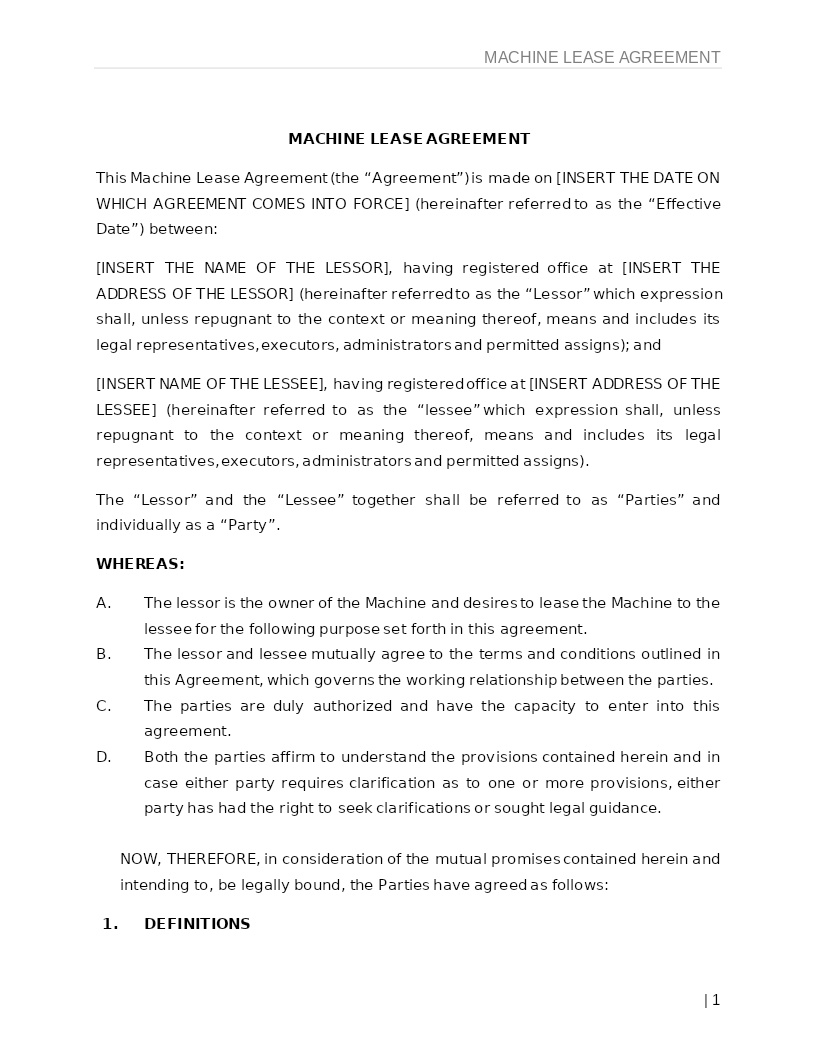
MACHINE LEASE AGREEMENT
How does it work?
1. Choose this template
Start by clicking on "Fill out the template"
2. Complete the document
Answer a few questions and your document is created automatically.
3. Save - Print
Your document is ready! You will receive it in Word and PDF formats. You will be able to modify it.
Understanding Machine Lease Agreements
A Machine Lease Agreement is a legally binding contract used when one party (the “Lessor”) rents machinery or equipment to another party (the “Lessee”) for business or operational use. The agreement establishes the terms of the lease, including usage conditions, payment schedules, maintenance responsibilities, insurance requirements, and return obligations.
A written Machine Lease Agreement provides clarity, reduces financial risk, and prevents disputes over damage, downtime, or misuse. It ensures that both parties understand the condition of the equipment, the duration of the lease, and what happens if repairs or unexpected issues arise.
Where Machine Lease Agreements Are Commonly Used
Machine leases are widely used in industries where equipment is essential to operations, such as:
- Construction and heavy machinery (excavators, loaders, cranes)
- Manufacturing plants and production facilities
- Agricultural equipment leasing (tractors, harvesters)
- Medical and laboratory equipment rentals
- Printing, textile, and fabrication industries
- Transportation, logistics, and warehousing
- Tech and IT hardware installations
Different Types of Machine Lease Agreements You May Encounter
- Operating Lease: Short-term use where ownership remains completely with the lessor.
- Finance Lease: Long-term lease with an option to purchase at the end.
- Service-Integrated Lease: Includes maintenance, repairs, or operational support from the lessor.
- Usage-Based Lease: Payment is based on hours used, output produced, or mileage.
- Seasonal or Short-Term Lease: Ideal for industries with seasonal demand or temporary project needs.
When Legal Guidance Becomes Helpful
Legal review is especially useful when:
• The machinery is expensive, specialized, or mission-critical
• The lease involves complex maintenance or service obligations
• The equipment must comply with safety or environmental regulations
• Insurance, liability, or damage responsibilities must be clearly defined
• The Lessee uses the machine across multiple states or job sites
• Ownership, upgrades, or attachments must be documented
• The lease includes penalties, early termination fees, or financing components
How to Work with This Template
• Identify the Lessor and Lessee
• Describe the machine, including model numbers and condition
• State the lease term, payment schedule, and deposit requirements
• Define maintenance, repair duties, and allowed usage
• Outline liability, insurance standards, and replacement obligations
• Select governing U.S. state law
• Include return conditions and inspection procedures
• Review and sign electronically or in hard copy
Frequently Asked Questions
Q1. What is a Machine Lease Agreement and why is it important?
A Machine Lease Agreement is a contract defining how machinery will be rented, used, maintained, and returned. It protects both parties by clearly outlining responsibilities, payment terms, and liability, reducing the risk of disputes or unexpected costs.
Q2. What types of machines can be leased under this agreement?
Nearly any commercial equipment can be leased construction machines, manufacturing equipment, agricultural tools, medical devices, IT hardware, and more. The agreement is flexible and can be adapted to suit nearly any industry.
Q3. Who is responsible for maintenance and repairs?
Responsibility depends on the terms of the contract. Some leases require the Lessee to handle routine maintenance, while others include full-service support from the Lessor. Clear documentation prevents misunderstandings.
Q4. Do machine leases require insurance?
Most do. Insurance protects both the Lessor and the Lessee if the equipment is damaged, lost, or involved in an accident. The agreement specifies the type of coverage and who must carry the policy.
Q5. Can a Lessee modify or attach new parts to the machine?
Only if allowed by the agreement. Unauthorized modifications may invalidate warranties, cause safety issues, or create liability. Most contracts require written approval for alterations.
Q6. What happens if the machine breaks down during the lease?
The agreement outlines whether the Lessee or Lessor is responsible for repairs and what happens in case of mechanical failure. It may also specify downtime procedures or replacement equipment options.
Q7. Are there penalties for early termination?
Yes, many machine leases include early termination fees to cover remaining payments, transportation, or depreciation. These details should be reviewed before signing.
Q8. Can the machine be used at multiple job sites?
Some agreements allow relocation with notification, while others limit equipment to a specific site. This protects the Lessor and ensures the machine remains safe and properly monitored.
Q9. Is a machine lease more beneficial than purchasing equipment?
Leasing reduces upfront costs, provides flexibility, and helps businesses access updated machinery without long-term financial commitment. It is ideal for temporary needs or rapidly advancing technologies.
Q10. Are electronic signatures accepted for machine lease agreements?
Yes. Electronic signatures are legally enforceable under U.S. e-signature laws, making it easy for parties to complete the agreement remotely.