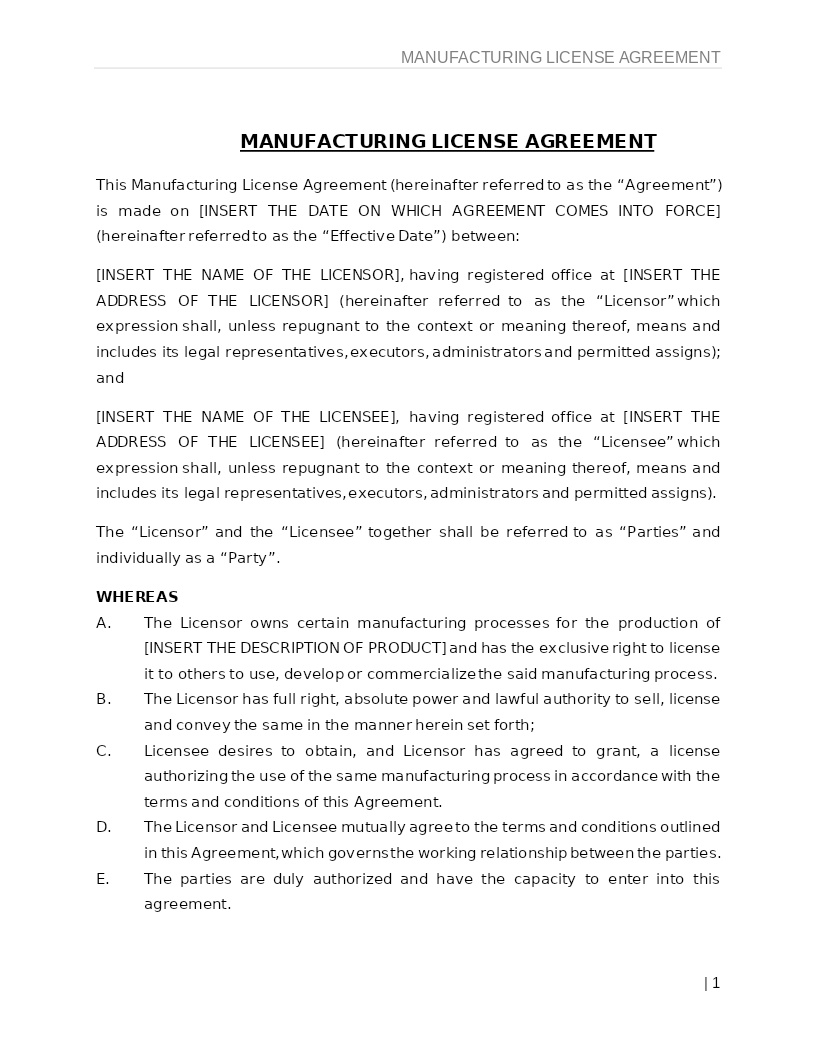
MANUFACTURING LICENSE AGREEMENT
How does it work?
1. Choose this template
Start by clicking on "Fill out the template"
2. Complete the document
Answer a few questions and your document is created automatically.
3. Save - Print
Your document is ready! You will receive it in Word and PDF formats. You will be able to modify it.
Understanding Manufacturing License Agreements
A Manufacturing License Agreement is a legally binding contract in which the owner of a product, technology, trademark, or proprietary process (the “Licensor”) grants a third-party manufacturer (the “Licensee”) the right to manufacture, produce, or assemble goods under specific terms. It establishes the scope of the license, quality control requirements, manufacturing standards, intellectual property rights, payment structures, confidentiality obligations, and regulatory compliance duties.
In the United States, Manufacturing License Agreements operate under federal IP laws, state contract law, trademark regulations, export controls, product safety standards, and industry-specific manufacturing regulations. This agreement ensures that the Licensee follows strict production guidelines while protecting the Licensor’s intellectual property, brand reputation, and proprietary technology.
Where Manufacturing License Agreements Are Commonly Used
Manufacturing License Agreements are widely used across multiple industries, especially where proprietary products, formulas, or processes are involved. They are commonly used in:
- Consumer goods, beauty products, and personal care manufacturing
- Pharmaceuticals, medical devices, and FDA-regulated products
- Electronics, hardware, and technology-based products
- Apparel, textiles, and branded merchandise
- Automotive components and industrial equipment
- Food and beverage products subject to federal and state compliance
- Startup and product-based businesses scaling production through third-party manufacturers
Any business looking to outsource production while retaining ownership of its designs, IP, and brand identity relies on Manufacturing License Agreements.
Different Types of Manufacturing Licenses You May Encounter
- Exclusive Manufacturing License: Grants only one manufacturer the right to produce the licensed product within a defined territory.
- Non-Exclusive Manufacturing License: Allows multiple manufacturers to produce the product simultaneously.
- Territorial or Regional Licenses: Limit production rights to specific states, regions, or international markets.
- Technology or Process License: Allows the Licensee to use proprietary formulas, software, or technologies to manufacture goods.
- Co-Manufacturing or Contract Manufacturing License: Used when the Licensor partners with multiple manufacturers under shared standards and quality protocols.
When Legal Guidance Becomes Helpful
Legal review is especially valuable when:
- The agreement involves patented inventions, proprietary formulas, or trade secrets
- Manufacturing requires compliance with FDA, FTC, OSHA, EPA, or other regulatory standards
- The product will be distributed across multiple U.S. states or exported internationally
- The parties must establish detailed quality-control and inspection obligations
- The license includes royalty structures, minimum order quantities, or performance requirements
- The agreement covers indemnity, product liability, or consumer safety risks
- The Licensor needs strong protections to prevent misuse or copying of IP
Legal guidance ensures the agreement protects intellectual property, maintains manufacturing integrity, and complies with U.S. regulatory obligations.
How to Work with This Template
- Identify the Licensor and Licensee, including business details
- Describe the products, technology, or processes being licensed
- Define the scope of rights—exclusive, non-exclusive, or territory-based
- Include manufacturing standards, quality requirements, and inspection rights
- Outline royalty payments, licensing fees, reporting duties, and payment schedules
- Add IP protections, confidentiality obligations, and non-disclosure requirements
- Choose the governing U.S. state law and applicable federal regulations
- Address product liability, warranties, and compliance certifications
- Sign electronically or in hard copy following U.S. contract execution rules
This template is compatible with major U.S. e-signature platforms and follows widely accepted manufacturing and licensing standards.
Frequently Asked Questions
Q1. What is a Manufacturing License Agreement and why is it used?
A Manufacturing License Agreement allows a third-party manufacturer to legally produce a product using the Licensor’s intellectual property. It ensures production is carried out safely, consistently, and in compliance with the Licensor’s quality standards while protecting the owner’s IP rights.
Q2. Are Manufacturing License Agreements enforceable under U.S. law?
Yes. These agreements are enforceable under state contract law and federal intellectual property laws, including patent, copyright, and trademark regulations. Clear terms regarding IP usage, product standards, and payment structures help ensure enforceability.
Q3. What intellectual property can be licensed for manufacturing?
Manufacturing licenses may cover patents, trade secrets, proprietary formulas, technology, trademarks, branding elements, designs, and production processes. The agreement clearly outlines what IP is included and how it may be used.
Q4. How are royalties or fees structured in a manufacturing license?
Royalties may be based on per-unit sales, a percentage of revenue, flat fees, or minimum order quantities. The agreement will specify reporting requirements, audit rights, and payment schedules to keep financial obligations transparent.
Q5. What quality-control requirements are included in these agreements?
Quality-control standards ensure products meet the Licensor’s specifications. Agreements often include inspection rights, manufacturing protocols, testing requirements, facility audits, compliance certifications, and ongoing reporting obligations.
Q6. Can the manufacturer use the licensed technology for other products?
No, unless explicitly permitted. Most Manufacturing License Agreements prohibit the use of the Licensor’s technology, formulas, or designs for any purpose outside the licensed products. This protects against IP misuse or unauthorized copies.
Q7. What happens if the manufacturer fails to meet quality standards?
If the Licensee violates quality requirements, the Licensor may issue corrective notices, require remediation, terminate the agreement, or pursue legal remedies. Consistent non-compliance may also trigger financial penalties or loss of licensing rights.
Q8. Can a Manufacturing License Agreement be terminated early?
Yes. Most agreements include termination clauses for breach of contract, non-payment, regulatory violations, IP misuse, or failure to meet production standards. The agreement may also allow termination for convenience with prior notice.
Q9. Are electronic signatures valid for Manufacturing License Agreements?
Yes. Under the U.S. ESIGN Act, electronic signatures are fully enforceable. Many companies use digital signing platforms to streamline the execution of licensing and manufacturing contracts.
Q10. Is a Manufacturing License Agreement suitable for small businesses or startups?
Absolutely. Startups often use manufacturing licenses to scale production without investing in their own facilities. These agreements help protect intellectual property, maintain quality, and ensure the product is manufactured consistently at commercial scale.