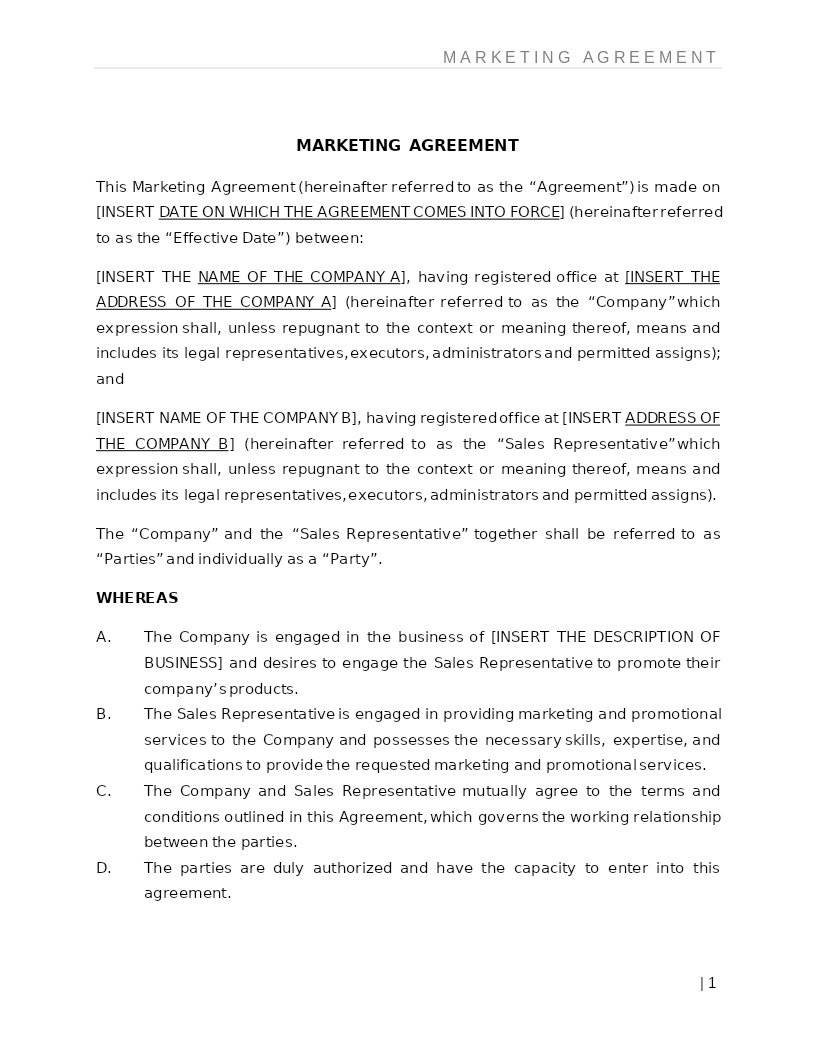
MARKETING AGREEMENT
How does it work?
1. Choose this template
Start by clicking on "Fill out the template"
2. Complete the document
Answer a few questions and your document is created automatically.
3. Save - Print
Your document is ready! You will receive it in Word and PDF formats. You will be able to modify it.
Managing Marketing Services and Promotional Partnerships
A Marketing Agreement is a legally binding contract between a business and a marketing service provider, consultant, agency, or promotional partner that defines how marketing and advertising activities will be carried out. It outlines the scope of services, performance standards, payment terms, intellectual property rights, confidentiality expectations, and the dispute resolution process governing the engagement.
For organizations operating in the United States, a Marketing Agreement acts as the operational blueprint for the relationship. It creates clarity in deliverables, ensures accountability for results, and safeguards the company’s brand, data, and creative assets throughout the engagement.
Where Marketing Agreements Are Commonly Used
Marketing Agreements are widely used across the U.S. business landscape in situations such as:
- Outsourcing social media management, digital marketing, SEO, or PPC campaigns.
- Hiring agencies for branding, design, or creative production.
- Engaging consultants for strategic planning, market research, or lead generation.
- Managing influencer collaborations, affiliate partnerships, and promotional events.
- Bringing on freelancers for copywriting, media buying, or content creation.
- Contracting agencies for website development, analytics, or advertising services
Any time marketing efforts involve external providers, a Marketing Agreement sets clear expectations and protects both parties.
Types of Marketing Agreements You May Encounter
- Service-Based Marketing Agreement: Used when hiring agencies or freelancers to provide specific services such as social media management or advertising.
- Campaign-Specific Marketing Agreement: Tailored for a particular campaign, project, or promotional period with defined goals and timelines.
- Performance-Based Marketing Agreement: Includes KPIs, benchmarks, and performance-linked compensation structures (e.g., pay-per-lead or revenue-share models).
- Influencer or Brand Ambassador Agreement: Used for partnerships involving content creators, influencers, or affiliates promoting a business.
When Legal Guidance Becomes Helpful
Most marketing engagements are straightforward, but legal input is especially useful when:
- Your campaigns involve high-value ad spend, multi-channel strategies, or long-term partnerships.
- The project includes creative IP, software, or proprietary tools.
- You operate in regulated industries (healthcare, finance, education, insurance).
- Cross-border or multi-jurisdictional compliance is required.
- You need strong data protection due to customer data handling.
- Negotiations involve complex payment schedules, KPIs, or termination clauses
Legal review ensures the agreement is enforceable and aligned with federal and state advertising, data privacy, and IP regulations.
How to Work with This Template
- Identify the parties and define marketing services clearly.
- Outline KPIs, deliverables, and reporting expectations.
- Set payment terms, billing cycles, and reimbursement rules.
- Clarify ownership of creative materials and campaign data.
- Establish confidentiality, data protection, and compliance obligations.
- Choose governing state law and dispute resolution mechanisms.
- Sign electronically or in hard copy
This template is compatible with major e-signature platforms and follows contract standards recognized throughout the United States.
Frequently Asked Questions
Q1. Why do businesses need a Marketing Agreement?
A Marketing Agreement protects both the company and the service provider by clearly defining what services will be delivered, how performance will be measured, and what happens if expectations are not met. It reduces misunderstandings by outlining deliverables, timelines, and responsibilities, which is especially important in digital marketing, where multiple tasks and platforms are involved. The agreement also ensures legal protection for brand assets, data, and intellectual property.
Q2. What should be included in the scope of services?
The scope should clearly detail every marketing activity the provider is responsible for such as campaign management, content creation, SEO, advertising, analytics, or brand strategy. A defined scope helps prevent “scope creep,” ensures both parties understand the expected deliverables, and provides a basis for evaluating performance. Including timelines, platforms, and approval processes enhances clarity and accountability.
Q3. How do performance standards and KPIs work in a Marketing Agreement?
KPIs provide measurable benchmarks to evaluate the success of marketing efforts. These may include lead generation targets, engagement metrics, website traffic increases, or conversion goals. Including KPIs helps align both parties on expected outcomes and ensures transparency throughout the engagement. While marketing agencies cannot guarantee specific results, KPIs create a framework for tracking progress and assessing value.
Q4. Who owns the creative content and assets created during the engagement?
Intellectual property ownership is a crucial part of a Marketing Agreement. In most U.S. agreements, the client retains ownership of all brand assets, creative content, data, and materials created under the contract—unless the contract specifies otherwise. The agreement may grant the agency a limited license to use materials for executing campaigns. Clear IP terms prevent disputes and protect long-term brand interests.
Q5. Why is confidentiality important in marketing engagements?
Marketing partners often receive access to sensitive business information, customer data, budgets, analytics, and strategic plans. Strong confidentiality and data protection clauses ensure compliance with U.S. privacy laws such as the FTC Act and state regulations like the CCPA. These clauses safeguard against unauthorized disclosure, misuse of brand assets, and data security risks, which are essential when external providers interact with internal systems or consumer information.
Q6. What happens if the marketing provider fails to meet expectations or deadlines?
A well-structured agreement outlines remedies such as corrective action, revision requirements, fee adjustments, or termination rights if performance falls short. The agreement may also detail dispute resolution options, negotiation, mediation, arbitration, or litigation, depending on the governing law. These provisions ensure that the client can seek appropriate remedies while maintaining a fair and professional process.
Q7. Can a Marketing Agreement be used for freelancers, agencies, and influencers?
Yes. Marketing Agreements are flexible and can be adapted for agencies, independent consultants, freelancers, and even influencers or brand ambassadors. While the structure remains similar, the terms, especially payment, KPIs, and IP ownership, may vary depending on the nature of the marketing relationship.
Q8. Are electronic signatures valid for Marketing Agreements in the U.S.?
Yes. Under U.S. federal law (ESIGN Act) and state laws (UETA), electronic signatures are legally enforceable. Businesses can execute Marketing Agreements using platforms like DocuSign, Adobe Sign, HelloSign, or any trusted e-sign tool. This makes remote onboarding and multi-state collaboration seamless and efficient.
Q9. How does termination work in a Marketing Agreement?
Termination clauses specify how either party can end the relationship whether for convenience, breach, or performance failure. The agreement defines notice periods, final deliverables, refunds (if applicable), and obligations upon termination. Clear termination procedures help avoid conflict and ensure a smooth transition if the partnership ends.
Q10. When should I seek legal counsel before signing a Marketing Agreement?
Legal advice is recommended when the agreement involves significant ad spend, complex intellectual property, long-term commitments, or sensitive consumer data. Attorneys can also help modify liability limits, refine performance standards, and ensure compliance with U.S. advertising and privacy laws. For cross-border engagements, legal guidance becomes even more critical to address jurisdictional and regulatory issues.