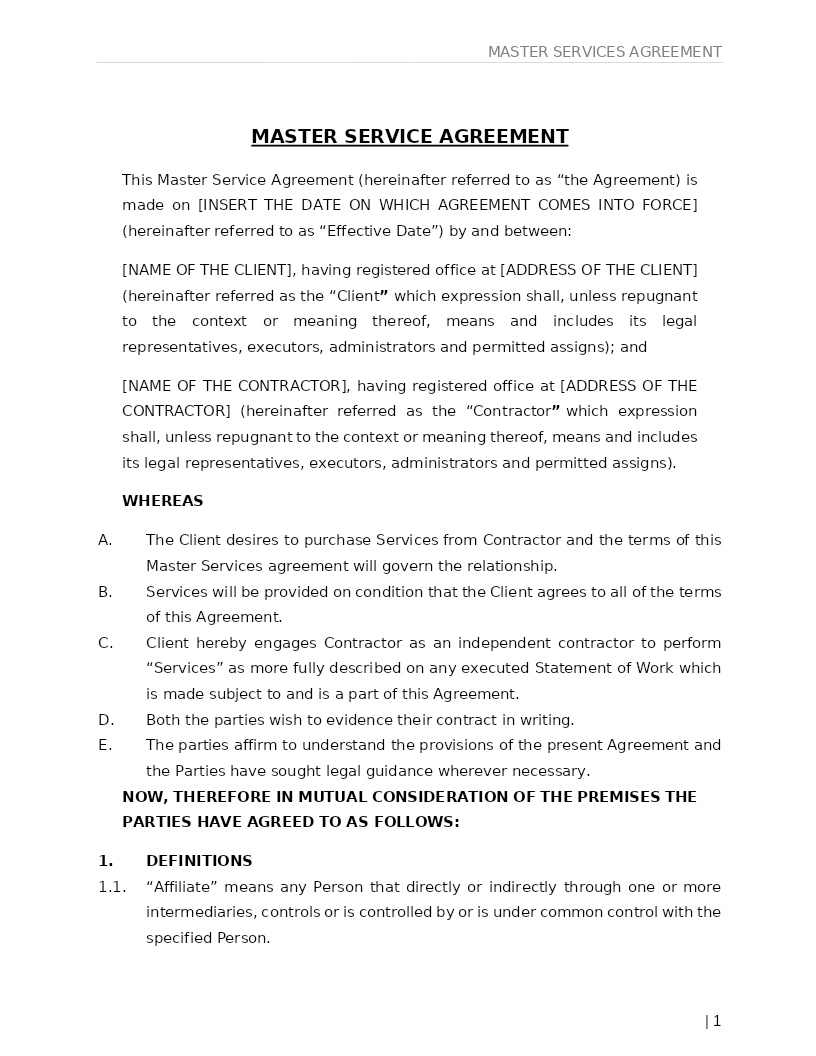
MASTER SERVICE AGREEMENT
How does it work?
1. Choose this template
Start by clicking on "Fill out the template"
2. Complete the document
Answer a few questions and your document is created automatically.
3. Save - Print
Your document is ready! You will receive it in Word and PDF formats. You will be able to modify it.
Understanding Master Service Agreements
A Master Service Agreement (MSA) is a legally binding contract that sets the foundational terms between two parties for an ongoing business relationship involving services. Instead of drafting a new contract for every project, the MSA establishes the general terms, responsibilities, payment structures, intellectual property ownership, confidentiality obligations, service standards, risk allocation, and dispute-resolution procedures that will govern all future work. Individual projects are then documented through task orders, statements of work (SOWs), or work orders.
In the United States, MSAs operate under state contract laws, federal regulations, data protection standards, and industry-specific compliance requirements. MSAs streamline business operations by creating a consistent legal framework that reduces negotiation time, prevents misunderstandings, and clarifies expectations for long-term service partnerships.
Where Master Service Agreements Are Commonly Used
MSAs are widely used across industries where ongoing or multi-phase services are required, such as:
- Technology services, SaaS platforms, and software development
- Marketing, creative design, and digital advertising
- Professional services like consulting, legal work, and financial services
- Maintenance, repair, installation, and field services
- Manufacturing and supply-chain support
- Telecommunications and network support
- Construction, engineering, and architecture services
- Outsourcing, staffing, and BPO services
Any business that provides recurring or long-term services benefits from a Master Service Agreement to maintain consistency and reduce contract overhead.
Different Types of MSAs You May Encounter
- Professional Services MSA: For consulting, financial advisory, legal, or business support services.
- Technology or IT MSA: Covers software development, cloud services, technical support, and cybersecurity.
- Creative Services MSA: For design studios, marketing agencies, content creators, and media production teams.
- Maintenance & Operations MSA: Used for facility management, equipment servicing, installation, and on-site support.
- Vendor or Supplier MSA: Defines terms for ongoing supply-chain services and materials procurement.
When Legal Guidance Becomes Helpful
Legal assistance is recommended when:
- The agreement involves intellectual property, licensing rights, or proprietary software
- Data protection or cybersecurity rules (such as HIPAA, FERPA, FINRA, or GDPR) apply
- The contract includes warranties, indemnification, or limitation-of-liability clauses
- Multiple states or jurisdictions are involved
- Pricing involves complex fee structures or recurring billing
- The relationship includes subcontractors or third-party service providers
- The parties want clarity on termination rights, renewals, and service-level obligations
Legal review ensures compliance with federal and state laws while protecting both parties from foreseeable risks.
How to Work with This Template
- Identify both parties and specify the nature of the service relationship
- Set general terms governing all future projects or statements of work
- Define responsibilities, performance standards, and delivery requirements
- Establish pricing models, payment terms, and invoicing schedules
- Include confidentiality, IP ownership, and licensing provisions
- Add warranties, liability limitations, insurance requirements, and indemnity clauses
- Choose the governing U.S. state law
- Add processes for dispute resolution, renewals, and termination
- Sign electronically or in hard copy following U.S. contract standards
This template aligns with widely accepted U.S. business practices and is compatible with major digital signing platforms.
Frequently Asked Questions
Q1. What is a Master Service Agreement and why is it important?
A Master Service Agreement sets the overall rules for a long-term service relationship. It is important because it eliminates the need to renegotiate common terms for every project, reduces administrative burden, and ensures a consistent legal structure across all engagements.
Q2. Are MSAs legally enforceable in the U.S.?
Yes. MSAs are enforceable under state contract laws. They become fully active when paired with a Statement of Work (SOW) or project order, which contains the specific deliverables, deadlines, and fees.
Q3. What should a Master Service Agreement include?
An effective MSA includes scope of services, payment terms, confidentiality obligations, intellectual property ownership, warranties, liability limitations, dispute resolution procedures, and termination rights. These provisions protect both parties and create operational clarity.
Q4. How does an MSA differ from a Statement of Work (SOW)?
The MSA provides the general legal framework, while the SOW outlines project-specific details such as deliverables, deadlines, milestones, and pricing. They work together to create a complete service contract.
Q5. Can an MSA cover multiple projects?
Yes. That is the primary benefit of an MSA. Once signed, it governs all current and future services without needing a new contract each time. Only a new SOW is required for new work.
Q6. Who owns the intellectual property created under an MSA?
This depends on the agreement. Some MSAs assign ownership to the client, while others allow the service provider to retain rights with licensing granted to the client. IP clauses should be clearly stated to avoid conflicts.
Q7. What happens if a party fails to meet service expectations?
The MSA typically includes service standards, remedies for non-performance, and escalation procedures. These may include correction timelines, fee adjustments, or termination rights for repeated failures.
Q8. Are electronic signatures valid for MSAs?
Yes. Under the U.S. ESIGN Act, electronic signatures are legally enforceable. Most businesses use digital signing tools like Docu Sign or Adobe Sign to execute Master Service Agreements.
Q9. Can subcontractors be used under an MSA?
Yes, but the agreement should specify whether subcontracting is allowed and ensure subcontractors comply with the same legal, confidentiality, and performance requirements.
Q10. Is a Master Service Agreement suitable for small businesses?
Absolutely. Small businesses benefit greatly from MSAs because they streamline ongoing service relationships, minimize legal costs, and ensure consistent terms across multiple projects.