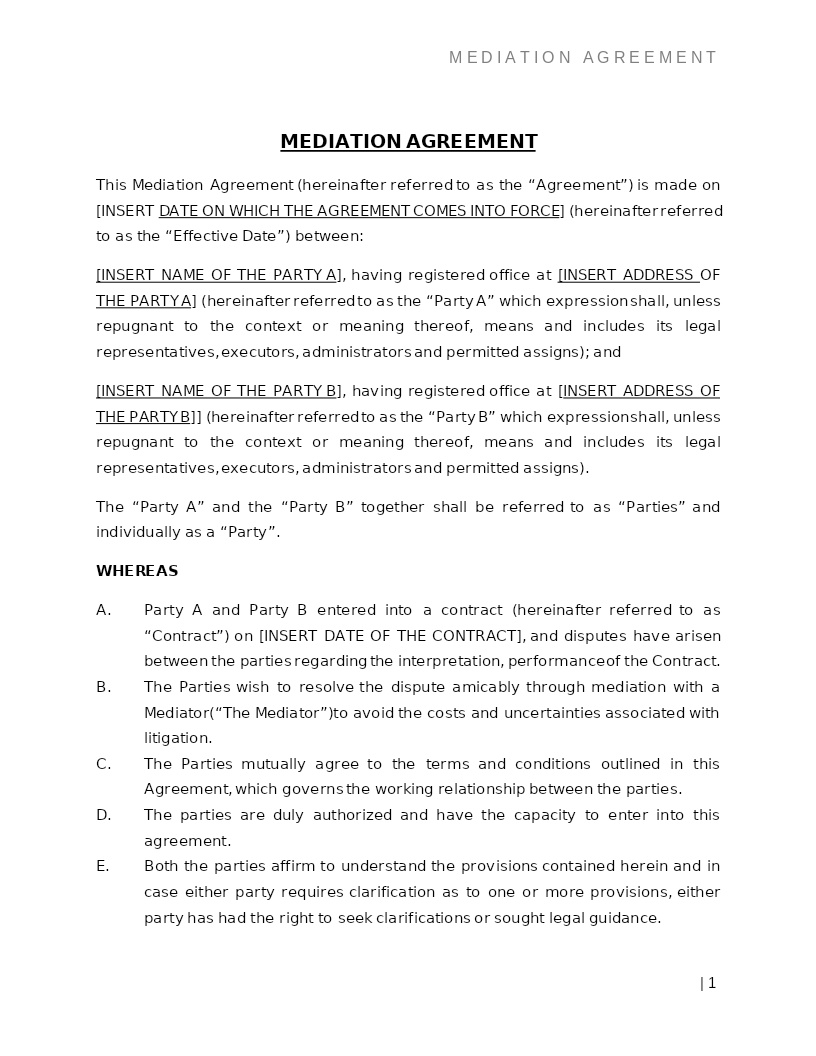
MEDIATION AGREEMENT
How does it work?
1. Choose this template
Start by clicking on "Fill out the template"
2. Complete the document
Answer a few questions and your document is created automatically.
3. Save - Print
Your document is ready! You will receive it in Word and PDF formats. You will be able to modify it.
Understanding Mediation Agreements in the United States
When people face a dispute whether in family issues, workplace conflicts, commercial disagreements, or community matters, mediation offers a structured, private, and cooperative way to resolve the problem. A Mediation Agreement is the written outcome of this process. Once the parties talk through their concerns with the help of a neutral mediator, the agreement records the commitments each person makes, the actions they will take, and any timelines or responsibilities that were mutually accepted.
A mediation agreement creates clarity, structure, and enforceability around the resolution reached. Depending on the state and the nature of the dispute, a mediation agreement can become legally binding once signed, giving both sides confidence that the resolution will be honored.
Mediation is widely used across the U.S. as a practical alternative to litigation because it reduces conflict, protects privacy, and provides more personalized solutions than the court system can offer.
Where Mediation Agreements Are Commonly Used
Mediation agreements are standard in various U.S. conflict-resolution contexts, including:
- Family Law Matters – Divorce settlements, parenting plans, custody arrangements, and financial disputes.
- Workplace & HR Conflicts – Employee–employer disagreements, harassment issues, team disputes, and performance concerns.
- Business & Commercial Disputes – Partnership disagreements, contract conflicts, client–vendor disputes, and payment issues.
- Community & HOA Issues – Neighborhood conflicts, boundary disagreements, and association disputes.
- Civil Disputes – Property damage, small claims, and consumer issues.
- Schools & Educational Institutions – Student–teacher conflicts, disciplinary discussions, and campus disputes.
Anytime parties want to avoid litigation and work toward a cooperative outcome, a mediation agreement provides a structured, written record of the resolution.
Different Types of Mediation Agreements You May Encounter
- Full Settlement Agreement: Used when all issues are fully resolved during mediation and the parties agree to a complete, final set of terms.
- Partial Settlement Agreement: Used when only some issues are resolved through mediation and additional steps (further mediation or litigation) are needed for the remaining issues.
- Parenting or Family Mediation Agreement: Specifically tailored for matters involving custody, visitation, co-parenting schedules, communication rules, and financial responsibilities.
- Business or Commercial Mediation Agreement: Focused on resolving disputes between business partners, clients, suppliers, or contractors with clear terms on payment, obligations, and future conduct.
- Workplace Mediation Agreement: Used in HR-related disputes, outlining behavioral commitments, communication expectations, restorative actions, or policy compliance.
- Court-Referred Mediation Agreement: A mediation outcome reached in cases that courts require the parties to mediate before trial. The resulting agreement may be submitted to the court for enforcement.
When Legal Guidance Becomes Helpful
Many mediation agreements are straightforward, but legal advice becomes valuable when:
- The agreement involves complex financial, business, or property terms that require precision.
- You want to ensure the agreement is legally enforceable under your state’s mediation laws.
- The mediation covers child custody, spousal support, or significant family law issues.
- The dispute involves multiple parties, cross-state concerns, or high-risk outcomes.
- One party wants to include confidentiality, non-disparagement, or future conduct restrictions.
- The agreement may be filed in court or incorporated into a legal order.
Legal review ensures your rights are protected, the terms are enforceable, and the agreement reflects your best interests.
How to Work with This Mediation Agreement Template
- Identify the parties and clarify the nature of the dispute resolved in mediation.
- Clearly state the agreed-upon terms, responsibilities, deadlines, and behavioral expectations.
- Specify confidentiality obligations if the parties want to keep the outcome private.
- Choose which state’s laws will govern the enforceability of the agreement.
- State whether the agreement may be filed in court or remain private.
- Review the terms jointly, making edits until both sides agree.
- Sign electronically or in hard copy, both of which are recognized under U.S. law.
The final signed document becomes a reliable reference point for both parties moving forward.
Frequently Asked Questions
Q1. Is a mediation agreement legally binding in the United States?
Yes, if the agreement is written clearly, voluntarily signed by all parties, and compliant with state laws, it can become legally binding. In many states, signing a mediation agreement creates an enforceable contract, and in court-connected cases, it may even become part of the final court order.
Q2. What should a mediation agreement include to be enforceable?
A strong mediation agreement includes specific obligations, deadlines, payment terms (if any), behavioural commitments, and a clear statement that the parties reached the agreement voluntarily. Including governing law, enforcement clauses, and signatures strengthens enforceability and avoids future disputes.
Q3. Can a mediation agreement remain private?
Yes. Unlike court orders, mediation agreements are generally confidential, and the terms do not become public unless the parties choose to file them with the court. This is why mediation is popular for sensitive family, workplace, and commercial matters.
Q4. Do I need a lawyer to review a mediation agreement?
While not mandatory, legal review is highly recommended when the agreement involves finances, child-related decisions, long-term commitments, or significant legal rights. A lawyer ensures the terms protect your interests and comply with your state’s laws.
Q5. What happens if one party violates the mediation agreement?
The non-breaching party may seek enforcement through court, depending on whether the agreement is legally binding. Courts can order compliance, financial remedies, or additional dispute-resolution steps. Having clear, specific terms makes enforcement faster and more effective.
Q6. Can a mediation agreement cover future behaviour or communication rules?
Yes. Many mediation agreements especially in workplace and family disputes, include expectations for communication, cooperation, decision-making, and conflict-prevention. These terms help support long-term stability after the dispute is resolved.
Q7. Can I modify a mediation agreement later?
Yes, but only if all parties agree to the changes in writing. Some agreements include built-in review periods or modification processes, which help parties adapt the terms if circumstances change.
Q8. Can mediation agreements be used in business disputes?
Absolutely. Mediation is widely used in commercial conflicts to avoid costly litigation and protect business relationships. Agreements may cover payments, ownership issues, performance obligations, or future cooperation terms.