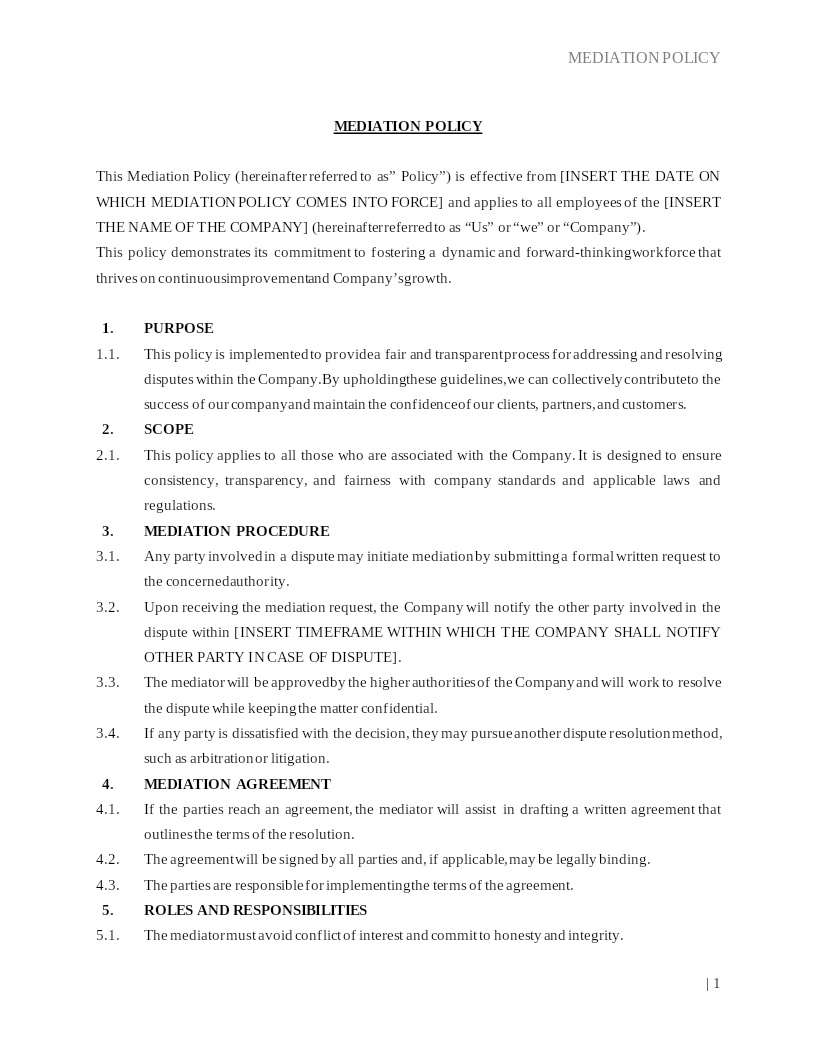
MEDIATION POLICY
How does it work?
1. Choose this template
Start by clicking on "Fill out the template"
2. Complete the document
Answer a few questions and your document is created automatically.
3. Save - Print
Your document is ready! You will receive it in Word and PDF formats. You will be able to modify it.
Promoting Respectful Conflict Resolution in the Workplace
In any organization, disagreements, misunderstandings, and interpersonal tensions can arise. A Mediation Policy provides a clear framework for addressing internal conflicts in a structured, fair, and confidential way. It outlines how employees and managers can request mediation, the role of a mediator, and the steps to be taken to resolve disputes constructively.
A well-implemented Mediation Policy builds trust, reduces workplace stress, and promotes collaboration. It gives everyone a safe opportunity to clarify issues, express their concerns, and explore mutually acceptable solutions without fear of retaliation.
Where Mediation Policies Are Commonly Used
Mediation is used across a wide range of workplace situations, including:
- Conflicts between coworkers or team members
- Tensions involving supervisors and direct reports
- Misunderstandings about roles, responsibilities, or communication styles
- Disputes involving behavior, respect, or workplace conduct
- Early-stage issues that could escalate into formal HR actions
- Post-investigation matters to restore working relationships
Any time workplace conflict affects communication, productivity, or morale, a mediation policy helps set appropriate expectations and encourages resolution in a structured, neutral environment.
Different Types of Mediation Processes You May Encounter
- Informal Mediation: A manager or HR representative helps employees resolve the issue through guided conversation.
- Formal Mediation: A trained mediator facilitates structured discussions, often involving multiple sessions.
- Third-Party or External Mediation: Used when neutrality is essential, or when internal efforts have not been effective.
- Post-Conflict Mediation: Helps restore trust and working relationships after an HR complaint, investigation, or disciplinary action.
When Legal Guidance Becomes Helpful
Most workplace conflicts do not require legal involvement. However, professional guidance can be beneficial when:
- Complaints involve harassment, discrimination, or safety violations
- Conflicts escalate despite multiple attempts at resolution
- Mediation is part of a larger compliance or legal risk-management process
- Employees request representation or accommodations
- The organization wants to ensure neutrality and fairness across jurisdictions
Legal review is not required, but it helps ensure the policy aligns with U.S. workplace regulations and employee-relations best practices.
How to Work with This Template
- Identify who can request mediation
- Define when mediation is appropriate (and when it is not)
- Outline the mediator’s role and confidentiality expectations
- Describe the steps of the mediation process, from request to outcome
- Set expectations for participation and respectful communication
- Select applicable governing state or federal guidelines
- Review the policy internally before adoption
- Share the policy with all employees and include it in handbooks or onboarding materials
The template is compatible with digital distribution and follows widely accepted U.S. workplace standards.
Frequently Asked Questions
Q1. When should employees consider mediation?
Employees should consider mediation when communication breaks down or when a disagreement impacts teamwork, comfort, or productivity. Mediation is ideal for early conflict resolution before problems escalate.
Q2. Is mediation confidential?
Yes. Mediation sessions are confidential unless safety issues or legal obligations require disclosure. Confidentiality helps participants speak openly and work toward genuine solutions.
Q3. Who participates in mediation?
Typically, the individuals involved in the conflict and the mediator participate. In some cases, HR professionals may attend to support policy compliance or documentation needs.
Q4. Does mediation replace formal HR procedures?
Not necessarily. Mediation is a voluntary process intended to resolve issues informally. If serious policy violations are involved, HR may still initiate formal procedures alongside or instead of mediation.
Q5. What happens if mediation does not resolve the issue?
If mediation is unsuccessful, HR or management may explore other resolution options, including performance guidance, reassignment, or formal disciplinary measures, depending on the situation.
Q6. Can employees refuse mediation?
Mediation is typically voluntary, but organizations may strongly encourage it to restore communication. Refusing mediation is allowed unless a separate policy or agreement requires participation.
Q7. Are mediators always internal employees?
No. Some organizations use trained third-party mediators to ensure neutrality, especially for sensitive or high-impact conflicts.
Q8. Is mediation legally binding?
Mediation itself is not legally binding, but any written agreements reached during mediation can be documented and incorporated into workplace expectations or performance plans.