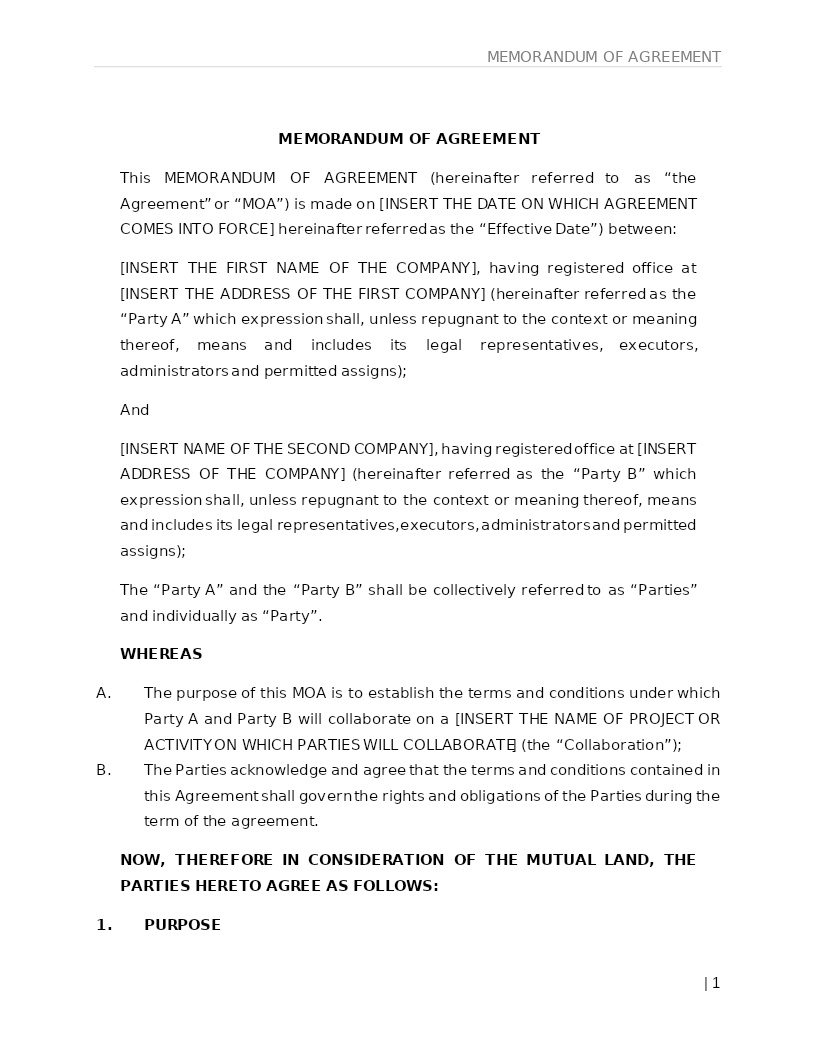
MEMORANDUM OF AGREEMENT
How does it work?
1. Choose this template
Start by clicking on "Fill out the template"
2. Complete the document
Answer a few questions and your document is created automatically.
3. Save - Print
Your document is ready! You will receive it in Word and PDF formats. You will be able to modify it.
Understanding a Memorandum of Agreement (MOA)
When two or more parties decide to collaborate, share responsibilities, or jointly execute a project, they need a structured document that clearly defines how the partnership will function. A Memorandum of Agreement (MOA) provides this framework. It lays out the project purpose, each party’s obligations, performance expectations, timelines, deliverables, and any financial or resource-related commitments.
While similar to a Memorandum of Understanding (MOU), an MOA tends to be more detailed, specific, and may include binding obligations making it a widely used document in U.S. businesses, government agencies, universities, nonprofits, and multi-party collaborations.
Creating an MOA ensures clarity, enhances accountability, and allows all parties to work together confidently, without uncertainty around roles or expectations.
Where MOAs Are Commonly Used
MOAs are used across industries, especially when partnerships require defined responsibilities or shared resources. Common scenarios include:
- Business partnerships, vendor collaborations, or operational alliances
- Government–agency partnerships, including federal, state, and local programs
- University and research institutions working jointly on studies, grants, and innovation projects
- Nonprofits partnering with donors, agencies, or community organizations
- Technology and development collaborations involving shared data, systems, or tools
- Public–private initiatives involving infrastructure, social programs, or training
- Consortiums or multi-organization projects requiring coordinated responsibilities
Any time a partnership requires structure and accountability, an MOA establishes a clear operational blueprint.
Different Types of MOAs You May Encounter
- Project-Specific MOA: Defines the terms for a single project with defined goals, timelines, deliverables, and responsibilities.
- Interagency or Interdepartmental MOA: Used by government bodies or large organizations when two or more departments collaborate on a shared mission.
- Grant or Funding MOA: Outlines how funds will be disbursed, monitored, reported, and accounted for.
- Resource-Sharing MOA: Defines how personnel, equipment, data, facilities, or technology will be shared.
- Public–Private Partnership MOA: Used when private companies and public institutions jointly carry out projects or services.
When Legal Guidance Becomes Helpful
While many MOAs can be created using a template, legal consultation becomes important when:
- The collaboration involves binding commitments, funding, liabilities, or resource transfers
- Multiple states, agencies, or international entities participate
- The partnership operates in a regulated sector—education (FERPA), healthcare (HIPAA), finance, cybersecurity, or scientific research
- The MOA contains intellectual property, licensing, data-sharing, or publication terms
- The project spans long durations with evolving obligations
- Performance expectations, penalties, or compliance requirements must be customized
- Internal governance, audit requirements, or donor rules apply
- The MOA needs to align with federal or state regulations
Legal review ensures the MOA is enforceable, aligned with regulatory frameworks, and tailored to the real-world needs of the project.
How to Work with This Template
- Identify all participating parties and their roles
- Clearly define the purpose, scope, and goals
- Specify responsibilities, performance standards, and timelines
- Clarify funding, payments, cost-sharing, or reimbursements
- Outline resource contributions (personnel, facilities, equipment, or data)
- Set terms for amendments, termination, reporting, and dispute resolution
- Select the governing state law
- Review collaboratively (legal review optional but recommended for complex collaborations)
- Sign electronically or physically
The template aligns with widely recognized U.S. contracting standards and works with all major e-signature platforms.
Frequently Asked Questions
Q1. What is the main purpose of a Memorandum of Agreement (MOA)?
A Memorandum of Agreement serves as a formal, structured document that outlines how two or more parties will collaborate to achieve a shared objective. Its purpose is to clearly define what each party will contribute whether it is funding, personnel, equipment, data, or expertise and establish expectations for roles, timelines, deliverables, and performance standards. By setting these terms in writing, the MOA reduces misunderstandings, provides a roadmap for execution, and strengthens accountability throughout the partnership.
Q2. Is a Memorandum of Agreement legally binding in the United States?
Yes, an MOA can be legally binding if it includes language indicating that the parties intend to be bound by its terms. U.S. courts treat MOAs similarly to contracts when they include concrete obligations, deadlines, responsibilities, and enforcement clauses. Although some MOAs are designed to be non-binding, many, especially those involving public agencies, grants, shared resources, or business deliverables, function as enforceable agreements. The binding nature ultimately depends on the wording and structure of the document.
Q3. How is an MOA different from a Memorandum of Understanding (MOU)?
An MOU is generally preliminary and outlines broad intentions, whereas an MOA is more specific and operational. An MOA includes defined roles, performance requirements, timelines, resources, and sometimes legal remedies. It is used when parties want to formalize a partnership with clear commitments rather than simply express interest or intent. In short, an MOU establishes goodwill; an MOA establishes responsibilities and expectations.
Q4. What types of partnerships typically require an MOA?
MOAs are used for collaborations that need structure, coordination, and accountability. This includes government-agency partnerships, business joint ventures, university research projects, grant-funded programs, nonprofit initiatives, technology collaborations, workforce training programs, and multi-stakeholder consortiums. Whenever parties must work together and share duties, resources, or funding, an MOA sets the operational terms necessary for smooth execution.
Q5. What elements should be included in a strong MOA?
A well-drafted MOA should include: a clear statement of purpose; roles and responsibilities; financial terms; resource-sharing details; performance expectations; timelines and deliverables; monitoring or reporting requirements; confidentiality or IP clauses (if applicable); amendment procedures; and dispute-resolution mechanisms. Including these elements ensures transparency and reduces operational risks throughout the collaboration.
Q6. Can an MOA include intellectual property, data rights, or confidentiality terms?
Yes. Many MOAs, especially in research, technology, education, or healthcare, contain detailed provisions regarding IP ownership, licensing rights, data-sharing protocols, privacy safeguards, and publication rights. These clauses prevent disputes over ownership or use of materials developed during the collaboration. When sensitive or proprietary information is exchanged, confidentiality obligations may also be included or incorporated by reference to a separate NDA.
Q7. Are electronic signatures permissible for MOAs in the U.S.?
Absolutely. Under the ESIGN Act and the Uniform Electronic Transactions Act (UETA), electronic signatures carry the same legal weight as handwritten signatures. Organizations across the U.S. routinely use e-signature platforms to execute MOAs quickly, especially when parties are in different states or working remotely.
Q8. What happens if one party does not fulfill its responsibilities under the MOA?
If a party fails to meet its obligations, the MOA’s enforcement and dispute-resolution clauses determine next steps. These may include corrective action plans, renegotiation, mediation, or formal remedies if the MOA is legally binding. Having these processes written into the agreement helps the parties resolve issues efficiently without escalating into litigation unless necessary.
Q9. Can an MOA be amended or updated later?
Yes. One of the strengths of an MOA is its flexibility. As circumstances change, such as project scope, timelines, funding, or responsibilities, the MOA can be updated through a written amendment signed by all participating parties. This ensures the agreement stays relevant and aligned with the evolving needs of the collaboration.
Q10. How long does a Memorandum of Agreement remain in effect?
The duration depends entirely on the project. Some MOAs last a few months, while others span multiple years for long-term initiatives. The agreement should clearly state its effective date, expiration date, renewal options, and termination conditions to avoid confusion. For ongoing partnerships, the MOA may include automatic renewal provisions or require periodic review.