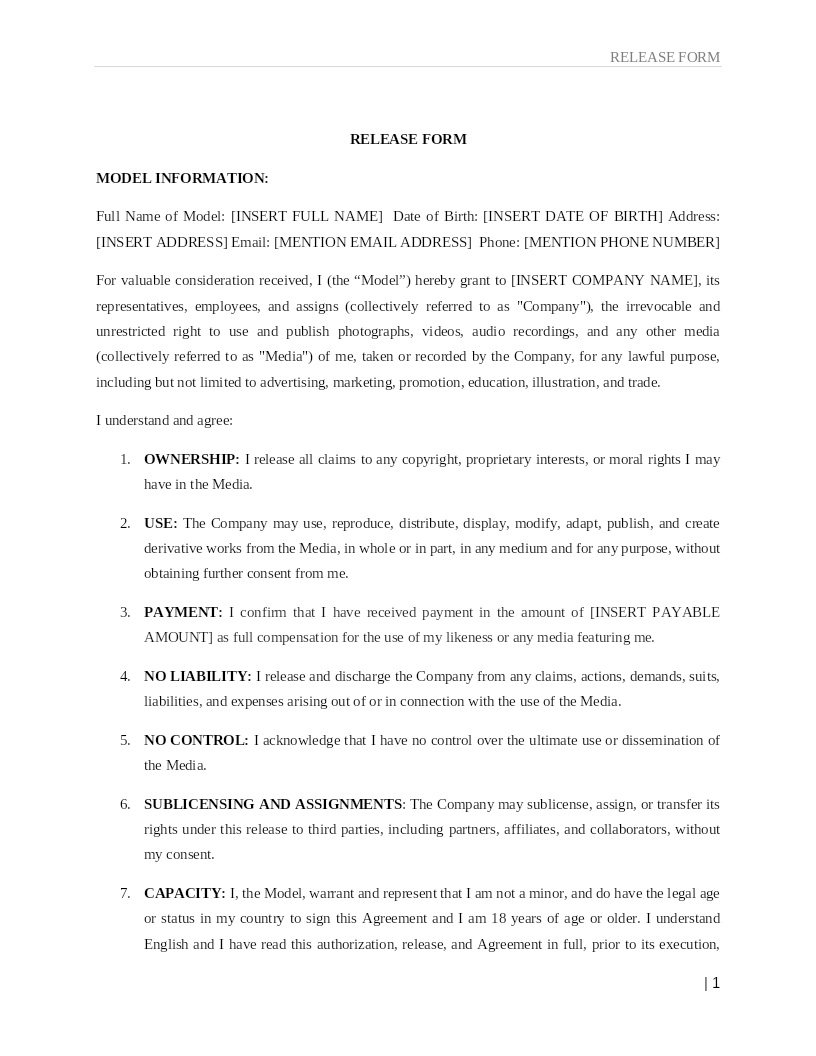
MODEL RELEASE FORM
How does it work?
1. Choose this template
Start by clicking on "Fill out the template"
2. Complete the document
Answer a few questions and your document is created automatically.
3. Save - Print
Your document is ready! You will receive it in Word and PDF formats. You will be able to modify it.
Understanding Release Form In U.S.
When an individual participates in an event, permits the use of their image, or engages in an activity involving inherent risks, it is essential to establish a clear agreement outlining the rights being released. A Release Form provides that structure. It defines what claims the individual (the “Releasor”) agrees to waive and what permissions are granted to the organization or individual receiving the release (the “Releasee”).
By signing a Release Form, both parties gain clarity and legal protection, enabling activities, productions, or events to run smoothly without future disputes over liability or rights of use.
Where Release Forms Are Commonly Used
Release Forms are standard in various personal, commercial, and creative contexts, including:
• Photography, videography, and content creation, where individuals’ likenesses may be used publicly
• Recreational, sports, or high-risk activities, involving potential physical injury
• Events, workshops, or public gatherings, requiring liability protection
• Media productions, commercials, interviews, or documentaries
• User-generated content, testimonials, and marketing features
• Facility or equipment use, where participants assume certain risks
A Release Form ensures all parties understand what rights are being granted and what liabilities are being waived.
Different Types of Release Forms You May Encounter
- Liability Release Form: Used when an individual participates in an activity that involves physical, financial, or property-related risk. The form protects the Releasee from lawsuits arising from injuries or damages.
- Media / Photo / Video Release Form: Allows an organization to capture, publish, and distribute a person’s image, voice, or likeness across various media platforms.
- General Release Form: Used to waive broad claims, often in settlement situations, service disputes, or contract closures.
- Minor Release Form: Signed by a parent or legal guardian to grant permission and waive liability on behalf of a minor child.
- Model or Talent Release Form: Used in fashion, advertising, and entertainment where a person’s appearance will be commercialized.
When Legal Guidance Becomes Helpful
Most standard releases can be completed without intensive legal assistance, but professional advice becomes valuable when:
• The activity involves high liability risks, such as extreme sports or hazardous environments
• The release includes ongoing commercial rights, such as perpetual image use
• Multiple states or multi-jurisdictional issues are involved
• Complex IP rights or long-term licensing matters apply
• The release supports a settlement, dispute resolution, or high-value transaction
• The participant is a minor, requiring compliance with strict child-rights laws
• The agreement must comply with specific industry regulations, such as entertainment or healthcare
Legal review helps ensure the release is enforceable under applicable U.S. state laws and that both parties’ rights are properly safeguarded.
How to Work With This Template
• Identify the Releasor and Releasee clearly
• Specify the nature of the activity, event, or media use
• Outline the exact claims or rights being released
• Select the governing U.S. state law
• Clarify whether the release is limited, perpetual, or revocable
• Review the form with the participant (legal review optional)
• Sign digitally or physically
This template is compatible with major e-signature platforms and aligns with U.S. legal standards for waivers and releases.
Frequently Asked Questions
Q1. Why is a Release Form necessary?
A Release Form protects the organization from future claims, lawsuits, or disputes by ensuring the participant understands the risks or permissions involved. It establishes clear consent and prevents misunderstandings, helping businesses and creators operate without fear of legal exposure.
Q2. Is a Release Form legally enforceable in the United States?
Yes. Most states recognize Release Forms as legally enforceable when they are clear, voluntary, and not misleading. Courts generally uphold releases that explicitly outline the risks and rights being waived. However, enforceability may vary slightly depending on state laws and the nature of the activity.
Q3. Do Release Forms cover negligence?
In many states, a Release Form can waive claims related to ordinary negligence, but cannot waive gross negligence or intentional misconduct. The validity depends on state-specific laws, so wording must be clear and unambiguous to ensure enforceability.
Q4. Can a Release Form be revoked after signing?
Generally, once a Release Form is signed and consideration is provided (such as participation in an event or permission to use media), it becomes binding. Revocation may only occur if both parties agree or if allowed under the specific terms of the form.
Q5. Is a separate Release Form needed for minors?
Yes. Minors cannot legally sign contracts on their own. A parent or legal guardian must sign a Minor Release Form on their behalf. Some states have additional protections or restrictions regarding minors’ image rights and liability waivers.
Q6. Does a Media Release Form allow unlimited use of my images or videos?
This depends on the wording. Many forms grant perpetual, royalty-free, and unrestricted usage rights across all media channels. Review the scope carefully to understand how your likeness may be used, modified, distributed, or shared.
Q7. Can this Release Form be used across different U.S. states?
Yes. The form remains valid nationwide as long as it specifies which state’s law governs the agreement. This approach is common for businesses, agencies, and digital platforms operating across multiple states.
Q8. What happens if someone violates the terms of the Release Form?
If the Releasee uses the content or information beyond the permitted scope, the Releasor may seek legal remedies such as removal of content, monetary damages, or injunctive relief. Clear terms in the Release Form make enforcement easier and strengthen the Releasor’s position.