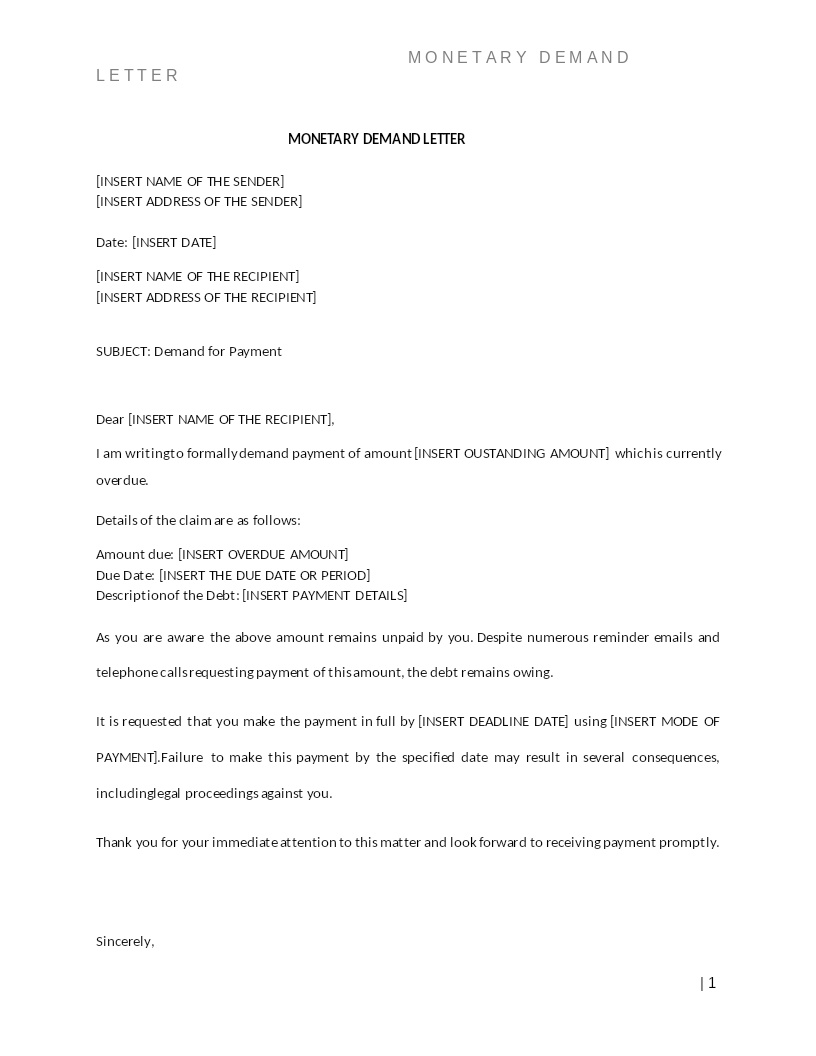
MONETARY DEMAND LETTER
How does it work?
1. Choose this template
Start by clicking on "Fill out the template"
2. Complete the document
Answer a few questions and your document is created automatically.
3. Save - Print
Your document is ready! You will receive it in Word and PDF formats. You will be able to modify it.
Formally Asserting Financial Claims Through Written Monetary Demands
When an individual or business seeks to recover funds owed under a contract, invoice, loan, service arrangement, or other financial obligation, it is essential to issue a formal written notice that clearly asserts the amount due and the legal basis for the claim. A Monetary Demand Letter serves this function. It outlines the creditor’s position, identifies the debt owed, provides supporting documentation, and offers the debtor an opportunity to resolve the matter prior to legal action, all in accordance with U.S. contract law, debt-collection standards, and applicable state notice requirements.
By issuing a Monetary Demand Letter, the creditor creates a documented, legally significant record that communicates outstanding obligations, deadlines for payment, potential remedies, and dispute-resolution procedures. This often facilitates voluntary settlement and may be required or strongly recommended before initiating litigation.
Where Monetary Demand Letters Are Commonly Used
Monetary Demand Letters are widely used in numerous commercial and personal financial contexts, including:
- Unpaid invoices, service fees, or outstanding account balances
- Breach of contract or non-performance disputes
- Loan repayment issues between individuals or businesses
- Security deposit return disputes
- Property damage, negligence, or insurance-related claims
- Personal loans or informal lending arrangements
- Unpaid wages, commissions, or employment-related compensation
- Vendor, subcontractor, or freelancer payment disputes
Any situation involving unpaid or disputed monetary obligations may require a Monetary Demand Letter to formally notify the debtor of the amount owed.
Different Types of Monetary Demand Letters You May Encounter
1. Contractual Debt Demand Letters: Assert claims arising from breach of contract, unpaid invoices, or failure to perform.
2. Loan Repayment Demand Letters: Seek repayment of personal or business loans.
3. Employment or Wage Demand Letters: Address unpaid wages, bonuses, or commissions.
4. Damage or Reimbursement Demand Letters: Recover amounts associated with property damage or reimbursable expenses.
5. Security Deposit Demand Letters: Commonly used by tenants seeking return of deposits withheld unlawfully.
When Legal Guidance Becomes Helpful
Legal review may be advisable when:
- The amount owed is substantial or disputed
- The creditor intends to initiate litigation if payment is not made
- The debtor denies liability or raises competing claims
- State notice requirements or pre-litigation procedures apply
- The issue involves employment law, landlord-tenant law, or consumer protection statutes
- The letter may be used as evidence in court
- The creditor wants to avoid violating debt-collection laws such as the FDCPA
Legal counsel ensures the letter is compliant, persuasive, and properly structured to support future legal action.
How to Work with This Template
- Identify the creditor, debtor, and relationship between the parties
- State the amount owed and describe the basis for the debt
- Attach or reference relevant documentation (invoices, contracts, receipts)
- Set a deadline for payment and acceptable payment methods
- Outline consequences of non-payment, including potential legal remedies
- Provide contact information for questions or negotiation
- Confirm compliance with federal and state notice requirements
- Deliver the letter in writing preferably by certified mail or verifiable electronic methods
This template aligns with U.S. pre-litigation communication practices and may be used by individuals, businesses, or legal representatives.
Frequently Asked Questions
Q1. What is a Monetary Demand Letter, and why is it important?
A Monetary Demand Letter is a formal written request for payment of money owed. It is important because it clearly states the creditor’s legal position, outlines the amount due, provides supporting facts, and offers the debtor an opportunity to resolve the matter before legal action becomes necessary.
Q2. Is a Monetary Demand Letter required before filing a lawsuit?
Not always, but many states and courts strongly encourage or require written notice before litigation—especially in contract disputes, small claims cases, landlord-tenant matters, and employment-related claims.
Q3. What information should be included in a Monetary Demand Letter?
Key information includes the amount owed, the legal basis for the claim, due dates, documentation, payment instructions, and notice that legal action may follow if the debt remains unpaid.
Q4. How should a Monetary Demand Letter be delivered?
Delivery should be traceable. Common methods include certified mail, courier, or verifiable email. Proof of delivery strengthens the creditor's position in any later legal proceedings.
Q5. Does sending a Monetary Demand Letter violate debt-collection laws?
No, if the letter complies with the Fair Debt Collection Practices Act (FDCPA) and applicable state laws. The letter must avoid deceptive language, harassment, or unlawful threats.
Q6. How long should the debtor be given to respond?
Typical response periods range from 7 to 30 days, depending on the circumstances. The deadline should be reasonable and clearly stated.
Q7. Can an attorney send the Monetary Demand Letter?
Yes. Letters from attorneys often carry additional weight and may prompt faster resolution, especially in disputed or high-value matters.
Q8. What happens if the debtor ignores the letter?
If the debtor does not respond or pay, the creditor may proceed with small claims court, civil litigation, or alternative dispute resolution, depending on the size and nature of the debt.
Q9. Can a Monetary Demand Letter result in settlement?
Yes. Many disputes are resolved without litigation once the debtor receives a formal, well-documented demand. The letter may invite negotiation, payment plans, or settlement discussions.
Q10. Are electronic signatures valid for Monetary Demand Letters?
Yes. Under the ESIGN Act, electronic signatures and digitally issued letters are legally enforceable, though physical delivery may still be preferred for evidence.