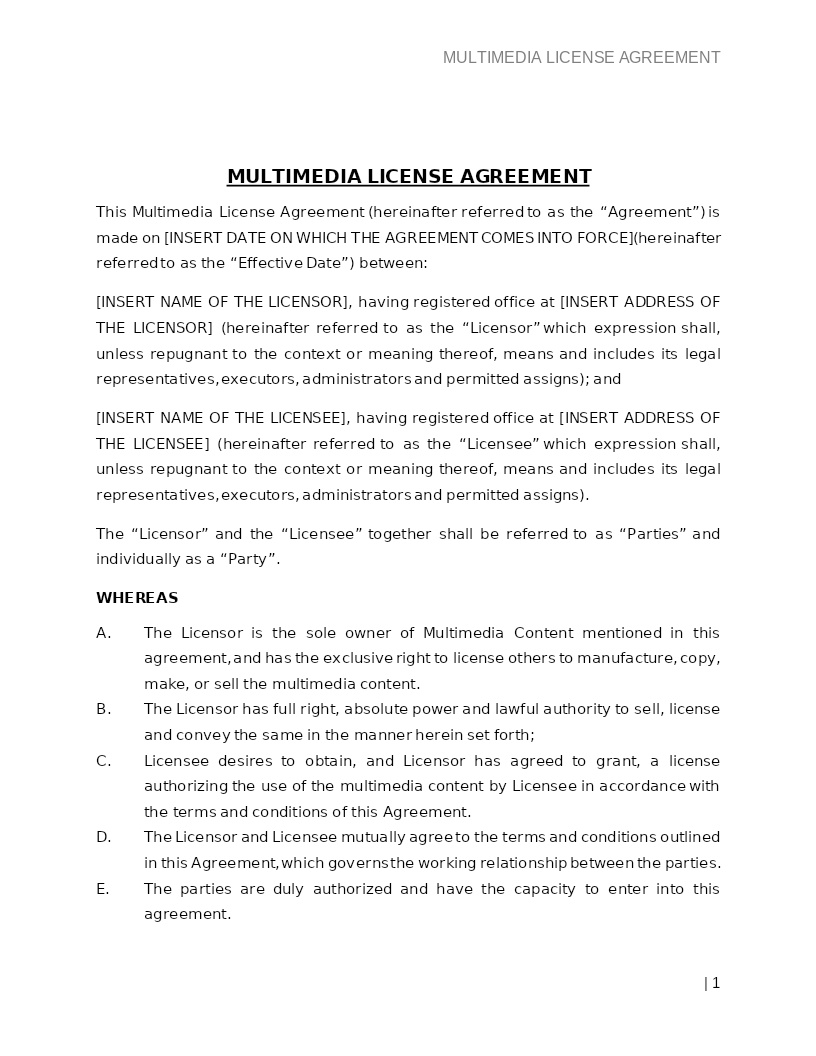
MULTIMEDIA LICENSE AGREEMENT
How does it work?
1. Choose this template
Start by clicking on "Fill out the template"
2. Complete the document
Answer a few questions and your document is created automatically.
3. Save - Print
Your document is ready! You will receive it in Word and PDF formats. You will be able to modify it.
Understanding Multimedia Licensing in Digital Content Use
A Multimedia License Agreement is a legally binding contract that governs how digital content such as images, videos, music, animations, graphics, and interactive media can be used, shared, displayed, or modified by the licensee. In the United States, these agreements define the rights a creator or rights-holder grants to users, ensuring both parties understand the permitted scope of use and the limitations imposed on the licensed material.
This agreement provides a professional and enforceable framework that protects the creator’s intellectual property while giving the user lawful access to content for personal, commercial, or organizational purposes. Whether you’re a business creating marketing materials, a designer using stock assets, or a company distributing multimedia products, a Multimedia License Agreement ensures you operate within clear legal boundaries.
Where Multimedia License Agreements Are Commonly Used
Multimedia licensing applies across countless industries, platforms, and creative environments, including:
- Marketing campaigns, social media content, and brand visuals
- Film production, advertising, and broadcast media
- Software products, mobile apps, and video games
- E-learning platforms, online courses, and corporate training
- Graphic design, digital art, and stock photo libraries
- Music compositions, jingles, and audio editing projects
- Web development, UI/UX design, and multimedia presentations
Any project that relies on creative content, especially when used commercially, requires proper licensing to avoid infringement issues.
Different Types of Multimedia License Agreements You May Encounter
- Royalty-Free License: Allows broad usage without continuous royalty payments, though restrictions still apply.
- Rights-Managed License: Limits usage by duration, geographic region, format, audience size, or distribution channel.
- Exclusive License: Grants the licensee exclusive rights to use the content, preventing the licensor from licensing it to others.
- Non-Exclusive License: Allows the content owner to license the same material to multiple users simultaneously.
- Editorial Use License: Permits use of the content for journalistic or educational purposes but not in commercial contexts.
- Commercial Use License: Allows the content to be used in advertising, marketing, product packaging, promotional campaigns, and revenue-generating projects.
When Legal Guidance Becomes Helpful
Because multimedia assets often involve layered copyrights and third-party rights, legal review is essential when:
- The content includes individuals, private property, logos, or brand elements
- The licensee needs global, perpetual, or exclusive rights
- The agreement involves reselling or redistributing multimedia content
- The project uses AI-generated content, open-source media, or stock libraries
- The content is integrated into commercial digital products or software
- Rights include sublicensing, public performance, or mass distribution
- There are concerns about copyright claims or indemnification
Lawyers help ensure the license terms align with U.S. copyright laws, DMCA provisions, fair use boundaries, and the specific needs of the project.
How to Work with This Template
- Identify the licensor and licensee with complete legal details
- Specify the multimedia content being licensed
- Define usage permissions, restrictions, and geographic limitations
- Clarify whether the license is exclusive, non-exclusive, royalty-free, or rights-managed
- Include terms on modification, adaptation, or derivative works
- Outline payment obligations, royalties, and renewal terms
- Add clauses covering copyright ownership, attribution, and third-party rights
- Establish termination, revocation, and dispute resolution procedures
- Choose the governing state law
- Sign electronically or in hard copy
This template reflects common U.S. licensing standards and supports a wide range of digital and creative industries.
Frequently Asked Questions
Q1. Why is a Multimedia License Agreement important for U.S. businesses and content creators?
A Multimedia License Agreement protects both the creator and the user by clearly defining how digital content can be used. Without a license, the user risks copyright infringement, takedown notices, or legal penalties. For creators, it ensures their work is not misused, altered without permission, or distributed beyond the authorized scope. This agreement acts as a safeguard that keeps creative rights intact while promoting responsible and legal content use.
Q2. What rights does a typical multimedia license grant to the user?
Most licenses grant limited rights to use, display, reproduce, or share multimedia content for specific purposes such as marketing, education, software integration, or publishing. The license outlines where, when, and how the content can be used and whether modifications are allowed. Rights may be narrowed by geography, project type, or platform, ensuring the content is used exactly as intended by the licensor.
Q3. Can multimedia content be modified, edited, or adapted by the user?
This depends on the license type. Some licenses allow users to edit, crop, remix, or integrate content into larger projects, while others strictly prohibit modifications to preserve artistic integrity or avoid misleading representations. The agreement should clearly state whether derivative works are allowed, and if so, whether credit or attribution is required.
Q4. What happens if multimedia content contains third-party elements?
If a multimedia asset includes music, images, models, trademarks, or other third-party materials, additional permissions may be required. The agreement may shift liability to the licensee by requiring them to confirm they have proper releases or may require the licensor to guarantee they have secured necessary rights. Understanding third-party rights helps prevent copyright claims and legal disputes.
Q5. How do royalties and payment terms typically work in multimedia licensing?
Payment structures vary. Some licenses require a one-time fee, while others charge recurring royalties based on views, downloads, audience size, or product sales. The agreement should clearly outline how payments are calculated, when they’re due, and whether they are refundable. This ensures both parties understand the financial expectations attached to using the content.
Q6. Can multimedia licenses be transferred or sublicensed to another party?
Only if the agreement explicitly allows it. Many licenses prohibit transferring rights or sublicensing because doing so expands the content’s distribution beyond what the creator intended. If a licensee needs to subcontract work or integrate the content into a product sold to others, the agreement should specify whether sublicensing or assignment is permitted.
Q7. What happens if a user exceeds the permitted scope of the license?
Exceeding the license scope, such as using the content commercially when only editorial use was allowed, may result in legal action, termination of the license, or financial penalties. The licensor may demand removal of the content, compensation for unauthorized use, or damages for copyright infringement. A clear enforcement clause protects both parties by defining consequences for misuse.
Q8. Are Multimedia License Agreements enforceable across U.S. states?
Yes. Multimedia License Agreements are widely enforceable under U.S. copyright law and contract principles. Choosing a governing state law ensures consistency, while compliance with federal regulations such as the DMCA strengthens enforceability. Properly drafted agreements prevent disputes and support clean, transparent licensing relationships across jurisdictions.