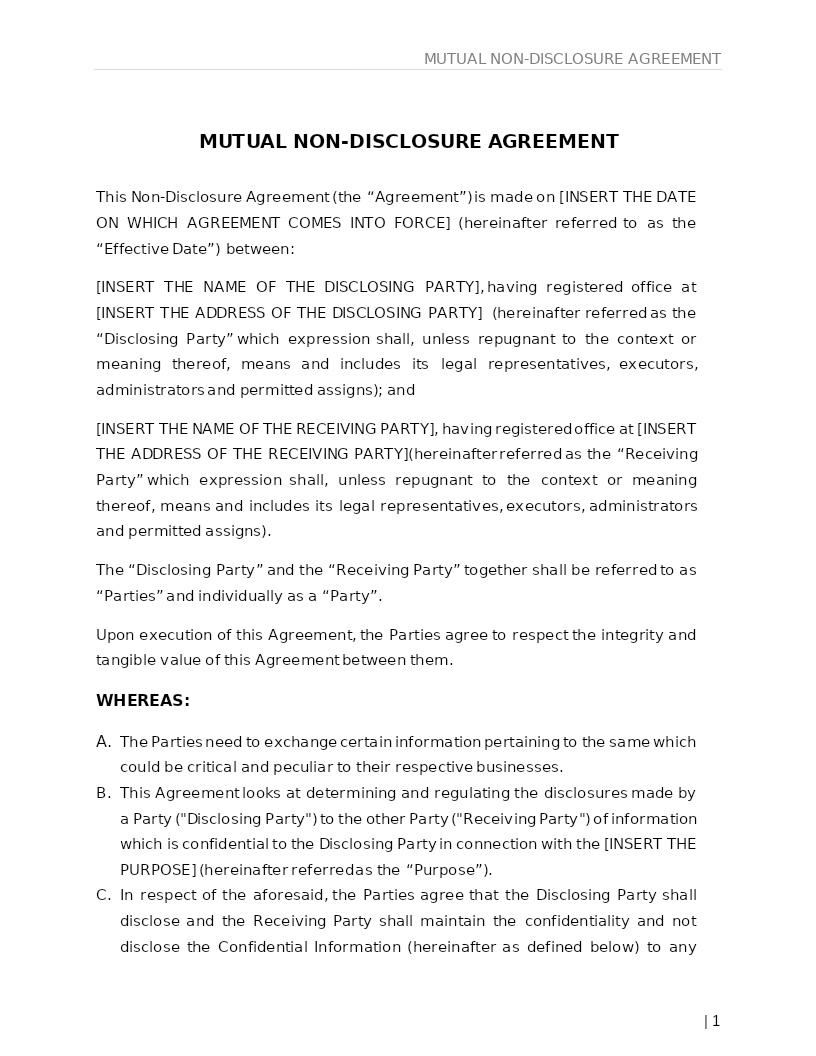
MUTUAL NDA
How does it work?
1. Choose this template
Start by clicking on "Fill out the template"
2. Complete the document
Answer a few questions and your document is created automatically.
3. Save - Print
Your document is ready! You will receive it in Word and PDF formats. You will be able to modify it.
Understanding Mutual Non-Disclosure Agreement (Mutual NDA)
When two parties plan to explore a potential partnership, evaluate opportunities, or exchange sensitive information, it’s important to establish a framework that protects both sides equally. A Mutual Non-Disclosure Agreement (Mutual NDA) provides that structure. It ensures that each party agrees to safeguard confidential information, use it only for the intended purpose, and refrain from disclosing it to unauthorized individuals.
A Mutual NDA builds trust between the parties, allowing them to communicate openly, share proprietary materials, and explore collaboration without concerns about misuse, copying, or premature disclosure.
Where Mutual NDAs Are Commonly Used
Mutual NDAs are standard wherever both sides expect to exchange sensitive information, including:
- Partnership evaluations and joint venture discussions
- Business collaborations, co-development, and innovation initiatives
- M&A negotiations, due diligence, and investment conversations
- Vendor–client onboarding where both parties share internal information
- Software integrations, tech demos, and API access
- External consulting, subcontracting, and research partnerships
- Creative collaborations involving designs, IP, or marketing assets
Any time confidential information flows both ways, a Mutual NDA protects the interests of all involved parties.
Different Types of Mutual NDAs You May Encounter
- Standard Mutual NDA: Used for routine business discussions where both sides expect to disclose confidential information.
- Project-Specific Mutual NDA: Tailored for a single project, event, or transaction with defined purposes.
- Technology & IP Mutual NDA: Used when the exchange includes prototypes, code, data, formulas, trade secrets, or innovative tools.
- Commercial Partnership NDA: Used when two businesses collaborate on operations, marketing, or service delivery.
When Legal Guidance Becomes Helpful
Professional review may be useful when:
- The parties will exchange trade secrets, code, algorithms, or proprietary data
- Discussions involve regulated industries such as healthcare, fintech, or defense
- International participants or multiple jurisdictions are involved
- The NDA supports a merger, licensing agreement, or intellectual-property-heavy transaction
- You require additional clauses like non-competition, non-solicitation, or data-security mandates
Legal review is not mandatory but helps reduce risk when the relationship involves sensitive intellectual property.
How to Work with This Template
- Identify both parties sharing confidential information
- Clearly state the purpose for which disclosures will be made
- Define what qualifies as confidential information
- Select the governing U.S. state law
- Specify the confidentiality duration
- Review mutual obligations on both sides
- Sign electronically or in hard copy
Frequently Asked Questions
Q1. What is a Mutual NDA?
A Mutual NDA is a confidentiality contract where both parties agree to protect each other's sensitive information during business discussions or collaborations.
Q2. Why should two businesses use a Mutual NDA?
It ensures fairness, prevents misuse of shared data, and creates a safe environment for open conversation and evaluation.
Q3. What information can a Mutual NDA protect?
It covers business plans, financials, prototypes, code, client lists, strategies, trade secrets, and any information marked or treated as confidential.
Q4. Is a Mutual NDA legally enforceable in the U.S.?
Yes. Mutual NDAs are enforceable under state contract laws as long as they are clear, mutual, and properly executed.
Q5. How long does confidentiality last under a Mutual NDA?
Most agreements specify a duration such as 2–5 years, but trade secrets may require longer protection.
Q6. Can a Mutual NDA be signed electronically?
Yes. Under the U.S. ESIGN Act, e-signatures are fully valid and enforceable.
Q7. Does a Mutual NDA cover verbal disclosures?
Yes, if the agreement includes oral information. Parties often follow up with a written confirmation to document what was shared.
Q8. Can a Mutual NDA be reused for multiple projects?
It can, but it’s best to update the purpose and scope for each new collaboration to keep the terms clear.
Q9. What happens if one side breaches the NDA?
The non-breaching party may demand immediate correction, return or deletion of materials, and seek legal remedies including damages or injunctive relief.
Q10. Do startups and freelancers use Mutual NDAs?
Absolutely. Mutual NDAs are common in early-stage partnerships, creative collaborations, consulting projects, and technology development.