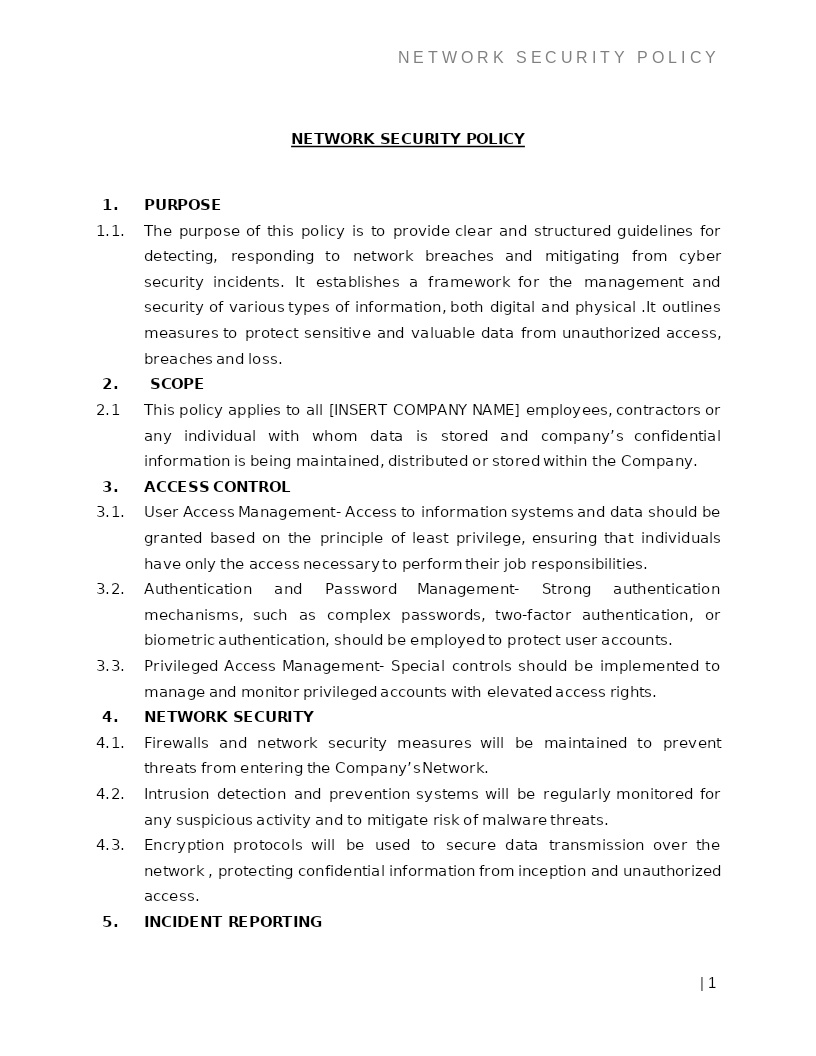
NETWORK SECURITY POLICY
How does it work?
1. Choose this template
Start by clicking on "Fill out the template"
2. Complete the document
Answer a few questions and your document is created automatically.
3. Save - Print
Your document is ready! You will receive it in Word and PDF formats. You will be able to modify it.
Safeguarding Digital Infrastructure Through a Network Security Policy
A Network Security Policy is a formally adopted organizational directive that outlines the standards, protocols, and responsibilities required to protect the confidentiality, integrity, and availability of an organization’s information systems. Developed in compliance with U.S. federal and state cybersecurity laws, including the Federal Trade Commission (FTC) Act, the Cybersecurity Information Sharing Act (CISA), state privacy statutes such as CCPA and NYDFS cybersecurity regulations, and industry frameworks such as NIST SP 800-53 and ISO/IEC 27001, this policy establishes the authoritative rules governing secure operation and monitoring of network assets.
A comprehensive Network Security Policy defines the technical and administrative measures required to protect organizational networks from unauthorized access, cyber intrusions, data exfiltration, malware, exploitation attempts, and emerging digital threats. It sets forth standards for authentication, encryption, access control, firewall configurations, intrusion detection, device management, and secure system architecture. By implementing this policy, an organization safeguards sensitive data, promotes regulatory compliance, strengthens operational resilience, and reduces the legal, financial, and reputational risks associated with cybersecurity failures.
Where Network Security Policies Are Commonly Used
Organizations across virtually all industries implement Network Security Policies to govern the secure handling and protection of digital infrastructure, including:
- Technology companies managing cloud-based platforms, SaaS solutions, and software systems
- Financial institutions required to comply with stringent cybersecurity and data-protection mandates
- Healthcare providers storing electronic health records (EHRs) under HIPAA security requirements
- Educational institutions maintaining large-scale student information networks
- Government contractors obligated to meet federal cybersecurity contracting standards (e.g., NIST 800-171)
- E-commerce businesses handling payment data, customer accounts, and sensitive transactions
- Manufacturing and industrial firms operating digital-controlled processes and OT (operational technology) networks
- Corporate enterprises with distributed workforces requiring secure remote-access protocols
Wherever sensitive data flows across digital systems, a Network Security Policy is essential for legal and operational protection.
Different Types of Network Security Policies
1. Access Control and Authorization Policies: Define permissions, authentication standards, privileged-account restrictions, and user-access protocols.
2. Acceptable Use and Device-Management Policies: Regulate employee use of company networks, personal devices, and digital resources.
3. Firewall, IDS/IPS, and Perimeter Defense Policies: Establish secure perimeter configurations and traffic-monitoring requirements.
4. Incident Response and Breach Notification Policies: Outline steps for detecting, responding to, and reporting cybersecurity incidents in accordance with legal mandates.
5. Data Encryption and Transmission Security Policies: Govern encryption standards for data at rest and in transit across networks.
6. Remote Access and VPN Security Policies: Address secure authentication for remote employees, contractors, and third-party vendors.
When Legal Guidance Becomes Helpful
Legal counsel may be necessary when:
- The organization handles regulated personal information (e.g., HIPAA, GLBA, COPPA, FERPA)
- State laws impose mandatory cybersecurity safeguards, breach-notification timelines, or data-security standards
- The company contracts with government entities requiring NIST-compliant systems
- Network security measures intersect with employee monitoring, privacy rights, or labor-law issues
- Vendor or third-party relationships require specific security assurances or indemnities
- The policy must address cross-border data transfers or international legal requirements
- The business experiences a cybersecurity incident or must develop an incident-response plan
- The organization stores financial information subject to PCI-DSS or similar compliance frameworks
Legal review ensures the Network Security Policy aligns with U.S. cybersecurity regulations, reduces liability, and supports defensible security practices.
How to Work with this Template
- Identify the systems, networks, devices, and data types covered by the policy
- Establish standards for authentication, access control, user privileges, and credential management
- Define acceptable use expectations for employees, contractors, and third parties
- Implement technical controls such as firewalls, encryption, VPNs, and secure-configuration procedures
- Describe security-monitoring mechanisms, log-retention practices, and threat-detection protocols
- Outline incident-response steps, breach-notification obligations, and communication procedures
- Assign responsibilities to network administrators, security officers, and authorized managers
- Detail training requirements and employee cybersecurity best practices
- Specify procedures for updates, periodic reviews, and compliance auditing
- Ensure acknowledgment of the policy through written or electronic signature as permitted under U.S. e-signature laws
This template is fully aligned with recognized cybersecurity governance practices and is suitable for organizations of every size and sector.
Frequently Asked Questions
Q1. What is a Network Security Policy, and why is it important?
A Network Security Policy is a formal document establishing the rules and controls used to secure an organization’s digital infrastructure. It is important because it ensures legal compliance, prevents cyberattacks, and protects sensitive data from unauthorized access.
Q2. What laws govern network-security requirements in the U.S.?
Key laws include the FTC Act, CISA, HIPAA, GLBA, CCPA, and various state cybersecurity statutes. In addition, federal contractors may need to comply with NIST 800-171.
Q3. Does the policy apply to employees using personal devices (BYOD)?
Yes. Most organizations include device-management or BYOD rules to ensure personal devices accessing company data maintain security standards.
Q4. Are businesses legally required to maintain a Network Security Policy?
While not all industries mandate a formal written policy, regulated sectors including finance, healthcare, and government contracting require documented cybersecurity procedures.
Q5. What happens if the organization fails to implement adequate network security?
Consequences may include data breaches, regulatory penalties, lawsuits, operational disruption, and reputational harm.
Q6. Does this policy cover remote-access requirements?
Yes. Remote access typically requires multifactor authentication, encrypted VPN connections, and secure-device protocols.
Q7. How often should the Network Security Policy be updated?
Regular updates at least annually are recommended due to evolving cybersecurity threats, new laws, and technological changes.
Q8. Can the policy help with compliance audits?
Absolutely. A detailed Network Security Policy is often required during regulatory, contractual, or vendor-due-diligence audits.
Q9. Should cybersecurity training be included?
Yes. Training employees on network-security measures is essential for preventing breaches and ensuring policy compliance.
Q10. Should legal counsel review the Network Security Policy?
Yes. Because cybersecurity laws evolve rapidly, a lawyer should review the policy to ensure it complies with federal and state regulations and mitigates liability.