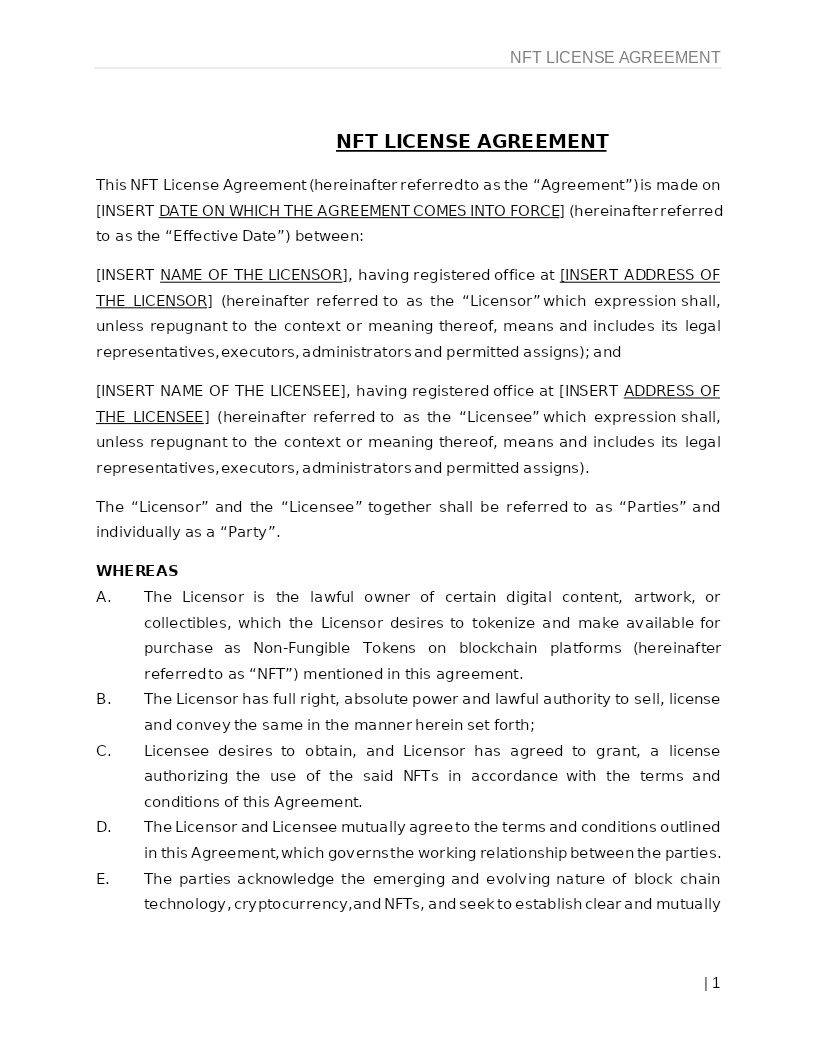
NFT LICENSE AGREEMENT
How does it work?
1. Choose this template
Start by clicking on "Fill out the template"
2. Complete the document
Answer a few questions and your document is created automatically.
3. Save - Print
Your document is ready! You will receive it in Word and PDF formats. You will be able to modify it.
Understanding NFT License Agreements
An NFT License Agreement is a legally binding contract that outlines the specific rights granted to a buyer or user of a Non-Fungible Token (NFT). While an NFT represents ownership of a unique digital asset, such as art, music, collectibles, or virtual items, ownership of the NFT does not automatically transfer intellectual property rights. This agreement clarifies the scope of rights, permitted uses, restrictions, commercial licensing terms, transferability, and protection of the underlying intellectual property.
In the United States, NFT License Agreements operate under federal IP laws (copyright, trademark, and licensing statutes), state contract laws, digital commerce regulations, and consumer protection standards. As NFTs continue to evolve in digital markets, well-drafted licensing terms help prevent legal disputes and ensure both creators and buyers understand their rights and limitations.
Where NFT License Agreements Are Commonly Used
NFT License Agreements are widely used across digital and creative industries, including:
- Digital artwork, illustrations, and design collectibles
- Music, videos, animations, and multimedia NFTs
- Gaming assets, skins, characters, and virtual land
- NFT-based utility passes, memberships, and access tokens
- Metaverse content and virtual real estate
- NFT collections created by artists, influencers, or brands
- Commercial licensing of digital content for merchandise, print, or media
- Web3 startups and blockchain-based platforms
Any time an NFT creator wants to control how the artwork or digital file is used, an NFT License Agreement is essential.
Different Types of NFT Licenses You May Encounter
- Personal Use License: Allows buyers to view, display, and share the NFT for personal, non-commercial use.
- Commercial License: Permits use of the NFT’s underlying artwork for revenue-generating activities, subject to defined limits.
- Exclusive License: Grants the NFT holder exclusive commercial rights, preventing others from using the IP.
- Non-Exclusive License: Allows multiple holders or buyers to use the artwork in permitted ways.
- Creative Commons License (CC0): Places the artwork into the public domain, allowing unrestricted use.
When Legal Guidance Becomes Helpful
Legal advice is beneficial when:
- The agreement involves copyrighted artwork, brand assets, or trademarks
- The NFT project includes commercial licensing terms or revenue sharing
- The creator wants to retain ownership while granting limited usage rights
- The license needs to comply with marketplace policies (OpenSea, Rarible, etc.)
- The project involves fractional NFTs, DAOs, or multiple stakeholders
- NFTs are used for merchandise, print products, or physical goods
- Buyer rights must be clearly separated from blockchain ownership rights
Legal review protects creators and buyers from infringements, misuse, or ambiguous licensing terms.
How to Work with This Template
- Identify the creator/licensor and the NFT holder/licensee
- Describe the digital asset and underlying intellectual property
- Define permitted uses—personal, commercial, or mixed
- Specify copyright ownership and whether rights are exclusive or limited
- Address resale, transferability, royalties, and smart contract terms
- Include disclaimers for blockchain functionality and marketplace risks
- Add confidentiality and restrictions on illegal or harmful uses
- Choose governing U.S. state law
- Sign electronically or via smart contract-based acceptance
This template follows recognized Web3 licensing practices and aligns with U.S. intellectual property and digital commerce standards.
Frequently Asked Questions
Q1. What is an NFT License Agreement and why is it important?
An NFT License Agreement clarifies the rights that come with owning an NFT—especially how the underlying artwork or digital asset may be used. It is important because NFT ownership alone does not transfer IP rights, making a written license essential for both creators and buyers.
Q2. Does buying an NFT give me copyright ownership?
No. Buying an NFT typically gives you ownership of the token itself—not the copyright. The creator retains IP rights unless the NFT License Agreement explicitly transfers them. This prevents unauthorized reproduction, resale, or modification of the original artwork.
Q3. What rights can an NFT License Agreement grant?
It can grant personal use rights, limited commercial rights, merchandising rights, or full commercial rights, depending on the project. The agreement outlines exactly what the buyer may and may not do with the digital content.
Q4. Are NFT licenses legally enforceable in the U.S.?
Yes. NFT licenses are enforceable under U.S. contract and intellectual property laws. A written or digitally accepted license agreement helps prevent disputes regarding commercial usage, reproduction, and distribution of the underlying content.
Q5. Can I resell an NFT I purchased?
Yes. Reselling NFTs is usually allowed through blockchain marketplaces. However, the license often travels with the NFT, meaning the new owner receives the same usage rights. Some licenses include royalty payments to creators via smart contracts.
Q6. What restrictions are typically included in an NFT license?
Common restrictions include prohibiting:
• Hate-related or illegal uses
• Unauthorized commercial activity
• Altering the artwork without permission
• Copying or minting derivative NFTs unless allowed
Restrictions protect the creator’s IP and ensure ethical use of the content.
Q7. Can NFTs be used for merchandise or physical products?
Only if the license allows it. Some projects grant limited merchandising rights, while others require additional agreements for commercial use. Always review the license terms before creating physical goods.
Q8. Are electronic signatures valid for NFT License Agreements?
Yes. NFT licenses can be accepted through electronic signatures or by using smart contract acceptance, which is legally recognized under U.S. digital contract laws.
Q9. Can the NFT creator revoke my license?
Not usually, unless the agreement includes specific termination rights, such as violating usage restrictions. Most NFT licenses remain valid as long as the NFT is held by the owner.
Q10. Is an NFT License Agreement necessary for small or personal NFT projects?
Absolutely. Even small artists and creators benefit from clear licensing terms—it protects their work, defines buyer rights, boosts professionalism, and prevents disputes in the rapidly growing NFT marketplace.